
- All News & Features
-
- Search News & Features
-
- The Hunt for Dark Matter Continues: PandaX Reaches World’s Best Sensitivity
- Stars Burning Strangely Make Life in the Multiverse More Likely
- Physics Professor Gordon Kane Awarded 2017 APS J. J. Sakurai Prize for Theoretical Particle Physics
- U-M Astrophysicist Katherine Freese Explains the Search for the Universe’s ‘Dark Stars’
- New Dwarf Planet Solar System’s 2nd Most Distant
- Physicist David Gerdes and Team Find New Dwarf Planet In Our Solar System
- Professor Keith Riles – Member of LIGO Team
- Researchers Invent New Material that can Switch Between Being Hard and Soft
- The 2017 Physics Commencement Live Event
- Physics Professors Receive MURI Grant
- Alec Josaitis Recently Awarded International Institute and Rackham Graduate School Individual Research Fellowship
- Dr. Priyashree Roy Earns 2016 Jefferson Science Associates (JSA) Thesis Prize
- LIGO Detects Gravitational Waves for Third Time
- U-M Physics Alum Alex Nitz Helps Detect Colliding Black Holes in Space
- Professor Henriette Elvang Selected for a College of Literature, Science, and Arts John Dewey Award
- Professor Gordon Kane Quoted in "Yearning for New Physics at CERN, in a Post-Higgs Way"
- Professor Rachel Goldman and Team Develop Technique which Could Boost Efficiency of LED Lighting by 50 Percent and May Pave the Way for Invisibility Cloaking Devices
- Dark Energy Survey reveals most accurate measurement of dark matter structure in the universe
- Professor David Gerdes Featured in USA Today Solar Eclipse Article
- U-M Physics Research Fellow Bachana Lomsadze and Professor Steven Cundiff Develop Novel Spectroscopy Technique that Could Revolutionize Chemical Detection
- Kip S. Thorne, Winner of 2017 Nobel Prize in Physics, Has U-M Physics Connections
- LIGO and Virgo Make First Detection of Gravitational Waves Produced By Colliding Neutron Stars
- Leinweber Foundation Gives $8M for Physics Center in U-M Department of Physics
- Four U-M Physics Faculty Named Fellows
- Michigan Fireball Meteor Registers As Quake: Astrophysicist David Gerdes Quoted
- Professor Fred Adams Quoted in Science News Article
- A Modern Rutherford Experiment: Scientists Use Known Energy Neutrinos to Study Nucleus
- It's Givin' Me Excitations: U-M Study Uncovers First Steps of Photosynthesis
- UM Astrophysicist David Gerdes and Team in the Hunt for Planet 9
- U-M Physics Professor Franco Nori Makes 2017 Highly Cited Researchers List
- U-M Society of Physics Students Talk STEM and More
- The 2018 Physics Commencement Live Event
- Professor Timothy McKay Reveals His Science Journey in Recent Podcast
- Physics Students Tali Khain and Noah McNeal Awarded Goldwater Scholarships
- Homer A. Neal 1942-2018
- The Higgs Boson Reveals Its Love for the Top Quark
- Physics Rev E Celebrates 'Milestone Articles' of Physics Faculty
- Physics Graduate Benjamin Isaacoff Awarded Optical Society of America's Guenther Congressional Fellowship
- Professor Katherine Freese and Team's Hunt for Dark Matter Turns to Ancient Minerals
- Professor Benjamin Safdi Awarded DOE’s Early Career Award
- Professor Christine Aidala Serves on National Academy Committee Endorsing Science Case for Electron-Ion Collider
- U-M Physicist Lu Li Cracks Code on Material that Works as Both Conductor, Insulator
- U-M Physicist Wins Nobel Prize
- New Physics Faculty Member Dominika Zgid
- Astrophysicist Katherine Freese Quoted in Astronomy Magazine
- Physicist Jennifer Ogilvie and Team Are Shedding New Light on Photosynthesis
- Professors Hui Deng and Mack Kira Named 2019 Fellows of the Optical Society
- Four Physics Faculty Named 2018 Fellows of the American Physical Society
- Four Physics Faculty Awarded American Physical Society Honors
- Gas-Detecting Laser Device Gets an Upgrade
- U-M Physicists Roberto Merlin, Meredith Henstridge and Team Develop Small Device that Bends Light to Generate New Radiation
- Physicist Steven Cundiff Elected as Fellow of AAAS
- Observing the Dance of Ten Million Quantum Dots
- Physicist Mark Newman's Scientific Cartogram Maps Featured in Washington Post
- U-M Physics Professor Tim McKay Developed Coaching Software to Help Students
- Physicist Lu Li and Team First to Uncover Rotational Symmetry Breaking in Magnetic Property of Unconventional Superconductor
- 11 Surprising Predictions for 2017 From Some of The Biggest Names In Science
- New Metamaterial Can Switch from Hard to Soft—And Back Again
- Physicist Michal Zochowski Collaborates with LSA Professor Sara Aton for ‘The Science of Sleep’
- Next-Gen Dark Matter Detector in a Race to Finish Line
- Physicist Roberto Merlin Selected as 2017 OSA Lippincott Award Recipient
- Michigan at the March for Science
- Physics Alum Larry Curtiss and Faculty Advisors Devised Contraption That Lead to Fiber Optics
- Michigan Physics Welcomes LSA Collegiate Postdoctoral Fellow Camille Avestruz
- Support Michigan Physics on Giving Blueday!
- Physicist Timothy Chupp Named Fellow of the American Association for the Advancement of Science
- U-M Physics Senior Noah McNeal Awarded Marshall Scholarship
- Astrophysicist Katherine Freese and Colleague’s Latest Theory About Dark Stars Made Astronomy Magazine's Cover Story
- First Postdoctoral and Graduate Student Fellows Named by Leinweber Center for Theoretical Physics
- Physics Graduate Student Awarded 2018-2019 Rackham International Student Fellowship
- Professor David Gerdes Named Next Physics Department Chair
- Three U-M Physicists Make Highly Cited Researchers 2018 List
- State of Michigan Governor Declares February 28, 2019: Chirped Pulse Amplification Day
- Physicist Dragan Huterer Receives Friedrich Wilhelm Bessel Research Award
- Physicist Sharon Glotzer Elected to National Academy of Engineering
- Professor Rachel Goldman Elected Vice Chair of Division of Materials Physics
- Physicist Liuyan Zhao Awarded NSF CAREER Award
- Physicist Henriette Elvang Awarded Thurnau Professorship
- Physics Senior Sophie Barterian Earns Prestigious Luce Scholarship
- Electric Dipole Moments and the Search for the Origin of Matter
- Three Physics Graduate Students Named Recipients of 2019-2020 Rackham Predoctoral Fellowship
- Professor Christine Aidala receives Fulbright U.S. Scholar Award to Italy
- Professor August Evrard's Problem Roulette Tool Recently Awarded Provost's Teaching Innovation Prize
- Five U-M Physics Faculty Recently Promoted
- Professor Steven Cundiff Discusses Quantum Information Science at the White House
- Professor Stephen Forrest named Henry Russel Lecturer for 2020
- Physicist Roy Clarke and International Team Devise Way to Show How Common Elements Can Make a More Energy-Secure Future
- Professor Jens-Christian Meiners Receives Grant to Tackle the Bends
- Graduate Student Summer Fellows Named by Leinweber Center for Theoretical Physics
- Professor Christine Aidala Wins Presidential Early Career Award for Scientists and Engineers
- U-M Physics Professor Wins Fundamental Physics Innovation Award
- 2019 U-M Physics Graduate Wins American Physical Society LeRoy Apker Award
- Pushing boundaries: Nobel prize winner on science literacy and lasers
- DESI opens its 5,000 eyes to capture the colors of the cosmos
- Team at U-M Sheds Light on New Electromagnetic Ordering
- LUX-ZEPLIN Dark Matter Detector Moved Nearly a Mile Underground
- Support Michigan Physics on Giving Blueday
- Six U-M Physics Students Awarded Competitive National Fellowships
- Professor Liuyan Zhao Wins Prestigious Air Force Young Investigator Research Program (YIP) Award
- Two Graduate Students Awarded Prestigious Department of Energy Fellowships
- Electron-Ion Collider, a New Nuclear Physics Facility, to Be Built at Brookhaven National Laboratory
- Physicist David Gerdes Quoted in Michigan News Article Regarding How COVID-19 Disrupts Research Projects
- Physicist Ben Safdi and Research Team Provide Another Twist in the Dark Matter Story
- U-M Physics Faculty Member Named Fellow of the American Association for the Advancement of Science
- Professor Xiaoming Mao Awarded $7.5M Grant to Bring Metamaterial to Life
- Now Complete, Telescope Instrument is Poised to Begin Its Search for Answers About Dark Energy
- Celebrating Our Undergraduate Awardees
- Celebrating Our Graduate Awardees
- U-M Senior’s COVID-19 Data Model Reaches CDC
- Physics Grad Student Rory Fitzpatrick and Professor Josh Spitz Shed Light on Electron Neutrino Interactions
- Professors Bjoern Penning and Marcelle Soares-Santos Highlighted in Physics Today Article
- U-M Physics Awarded $7.1 Million on Project to Upgrade the ATLAS Experiment
- When Dancers and Aliens Overlap
- Physicist David Lubensky and Team Determine Stress Fibers Help Cells Keep Their Shape—and May Also Regulate Size, During Development
- "Physics: A Resounding Legacy" - A Tribute to Patron Norman E. Barnett
- Physics Professor Joshua Spitz, Graduate Student Johnathon Jordan, and Research Team Propose Using Ancient Minerals from Deep within Earth’s Crust to Measure Cosmic Radiation
- U-M Physics Professors Byron Roe and Joshua Spitz Part of Collaboration to Search for New Physics
- Physics Grad Student Christopher Dessert Part of Team Researching X-Rays from Neutron Stars Which Could Lead to Discovery of New Particle
- Assistant Professor Liuyan Zhao Awarded a Prestigious Sloan Research Fellowship
- Assistant Professor Marcelle Soares-Santos Named 2021 Cottrell Scholar
- U-M Physicists Part of Study that Finds Unexpected Antimatter Asymmetry in the Proton
- Physics Graduate Student Kevin Napier is Lead Author on New Paper Casting Doubt on ‘Planet Nine’
- Physics Undergraduate Jiani Fei Proposes Solution to Quantum Field Theory Problem
- Physicists Hui Deng, Steve Forrest, and Research Team Discover “Egg Carton” Quantum Dot Array Could Lead to Ultralow Power Devices
- U-M Physics Group Led by Professor Tim Chupp Joins in Announcement of Stronger Evidence of New Physics Revealed by Fermilab's Muon g-2 Experiment
- U-M Physics Professors Roberto Merlin, Gregory Tarlé, and Graduate Student Noah Green Help Create Novel Optical Physics Method to Measure the Expansion of the Universe
- Physicist Christine Aidala Featured in LSA Magazine’s Spring 2021 Edition
- Dr. Melissa Hutcheson, Professor Myron Campbell and Research Team Find Possible Deviation from the Standard Model of Physics
- U-M Physics Professor Lu Li, Dr. Kuan-Wen Chen, Dr. Ziji Xiang and Research Teams Reveal a New State of Matter in Kondo Insulator
- Physicist Jennifer Ogilvie, Assistant Research Scientist Yin Song, and Researchers Trace Path of Light in Photosynthesis
-
Successful Start of Dark Energy Spectroscopic Instrument, Its ‘Eyes’ Designed by U-M Physicist Gregory Tarlé and Research Team
- Dark Energy Survey Releases Most Precise Look at Universe's Evolution
- Celebrating our 2021 Graduate Awardees!
- Physics Collegiate Fellow Eric Spanton Talks ‘Weird Science’
- An Inconstant Hubble Constant? U-M Research Suggests Fix to Cosmological Cornerstone
- ATLAS Provided the First Observation of the Triboson WWW Process
- 1985 Nobel laureate Klaus von Klitzing gives 29th annual Ta-You Wu lecture
- The Wow Moment, Remote
- MicroBooNE Experiment’s First Results Show No Hint of a Sterile Neutrino
- Magnets with a Twist: U-M Physics Researchers Liuyan Zhao and Her Team Engineer Magnetic Complexity into Atomically Thin Magnets
- Dr. Melissa Hutcheson Wins APS Mitsuyoshi Tanaka Dissertation Award in Experimental Particle Physics
- UM Physicists Michael Schubnell, Gregory Tarlé and Team Part of Dark Energy Spectroscopic Instrument Which Creates Largest 3D Map of the Cosmos
- Michigan Physics graduate Students Make Key Contributions to Experimental Results
- U-M Physics Researcher Co-Chairs Ballistic Missile Defense Report
- Congratulations to Physicist David Lubensky Awarded a 2022 Simons Fellowship
- Please Donate Today (March 17) to the Undergraduate Support Fund for Giving Blueday!
- What’s Inside a Black Hole? U-M Physicist Enrico Rinaldi Uses Quantum Computing, Machine Learning to Find Out
- Dr. Sangmin Choi Recipient of Honorable Mention in Rackham’s 2021 ProQuest Dissertation Awards
- U-M Physics Alum Lia Merminga Appointed Director of Fermi National Accelerator Laboratory
- Physics and Astronomy Senior Anna Simpson One of Five Students to Win Prestigious 2022 Goldwater Scholarship!
- Congratulations to Mark Newman on His Election to the Royal Society
- U-M Renames Randall Laboratory Addition After Pioneering Physicist Homer A. Neal
- Congratulations to Anna Simpson, U-M's 2022 Astronaut Scholar!
- Michigan Physics Welcomes Jalen Rose Leadership Academy Scholars to Ann Arbor Campus
- Successful Startup of Particle Detector Aims to Pin Down Dark Matter
- U-M Researchers Untangle the Physics of High-Temperature Superconductors
- Live From the International Space Station, It’s Saturday Morning Physics
- A team of researchers—Robert McGehee and Aaron Pierce of U-M Physics and Gilly Elor of Johannes Gutenberg University—proposed a new candidate for dark matter: HYPER, or “HighlY Interactive ParticlE Relics.”
- A Special Thank You to Navy Captain Josh Cassada and to NASA!
- Physicist Gregory Tarlé and Team, Find First Observational Evidence Linking Black Holes to Dark Energy
- Support Michigan Physics on Giving Blueday!
- $18M to advance materials research for quantum computing, sustainable plastics and more
- Michigan Physicists and Collaborators New Muon Result Explores Uncharted Territory in Search for New Physics
- U-M Physicist Joshua Spitz Receives 2023 Experimental Physics Investigator Award
- The Universe Caught Suppressing Cosmic Structure Growth
- U-M Collaboration to Receive DOE Grant to Diversify Physics
- Five Physics Researchers From U-M Named American Physical Society Fellows
- Thank You for Your Help Supporting Women in Physics!
- It Happened at Michigan — ‘You’ve got to be excellent’
- Physics Student Sanil Mittal awarded STEM Research Career Award!
- U-M Astronomer: Get to the path of April's total solar eclipse
- Thank You for Supporting Michigan Physics on Giving Blueday!
- U-M Physics Department Franco Nori Named 2024 Charles Hard Townes Medal Recipient
- U-M Anatol Rapoport Distinguished University Professor of Physics Mark Newman Named 2024 Leo P. Kadanoff Prize Recipient
- A New Measurement of the Expansion History of the Universe
- Physics Ph.D. Candidate and Professor Honored with Willie Hobbs Moore Awards
- U-M study: Using ‘tweezers’ to control active fluids
- Muscle machine: How water controls the speed of muscle contraction
- LZ experiment sets new record in search for dark matter
- Mining for Neutrinos, and for Cosmic Answers - Featuring U-M Alumni Bryan Ramson
- U-M Researcher Greg Tarlé and Colleagues Find Mounting Evidence for Dark Energy from Black Holes
- Physics Chair David Gerdes Named Dean of CWRU's College of Arts and Sciences
- New DESI results weigh in on gravity
- “Giving Tuesday” Fundraiser
- Applied Physics Graduate Student, Christopher Ayala, Named Winner of NSBP-NSHP 2024 Conference Oral Presentation Award
- Not So Simple Machines: Cracking the Code for Materials That Can Learn
- Physics Professor Liuyan Zhao Receives PECASE Award
- Physics Professor Dragan Huterer Receives Chambliss Astronomical Writing Award
- Getting the Most Out of Cosmic Maps - U-M research findings featuring researcher Minh Nguyen
- Physics Professor Gus Evrard named AAS Fellow for 2025
- Physics Assistant Professor Camille Avestruz selected as 2025 Cottrell Scholar
- Giving Blueday 2025
- Physics Professor Christine Aidala Honored with 2025 Rackham Distinguished Graduate Mentor Award
- Revealing a Natural Strategy for Making 'Superior' Materials - U-M Research Findings Featuring Physicist Xiaoming Mao and Team
- U-M Physics Alum and Nobel Laureate Samuel Ting Honored with 2025 Basic Science Lifetime Award
- U-M Physicists Among Winners of Prestigious Breakthrough Prize in Fundamental Physics
- How Origami Could Unlock a New Class of Materials
- How Origami Could Unlock a New Class of Materials
- Scientists achieve record precision probing a particle where the universe may be hiding its secrets
- ‘A more versatile and powerful foundation for future photonic technologies’
- Researchers Capture Nanoparticle Organizations to Forge New Materials
- Dark energy-filled black holes plus DESI data give neutrino masses that make sense
- How an in-between quantum state could boost future technologies
- LSA Physicists Xiaoming Mao and Liuyan Zhao Named American Physical Society Fellows
- Physicist Xiaoming Mao and Researchers Find Metamaterial Stifle Vibrations with Intentional Complexity
- The year a-flied physics lit up the MLB
- ‘Really Bizarre and Exciting’: U-M Physicist Lu Li and Team Find Quantum Oscillations Coming from Inside
- MicroBooNE experiment finds no evidence for the long-sought ‘sterile neutrino’
- To get lifelike movement from synthetic materials, physics researchers can embrace chaos
- A ‘new era’ in cosmology: Dark Energy Survey releases new analysis of how the universe expands
- Norman M. Leff Assistant Professor Na Hyun Jo Selected as 2026 Cottrell Scholar
- Empowering the Next Generation: Thomas Schwarz Receives University’s Highest Teaching Honor
- Physicist Mark Newman awarded the 2026 John von Neumann Prize!
- DESI completes planned 3D map of the universe, is still exploring
- Physics Professor Tim Chupp and Students Share the 2026 Breakthrough Prize for Fundamental Physics
- U-M Physicist Lu Li Receives Prestigious 2026 National Brown Investigator Award
- U-M’s Stephen Forrest elected Royal Society Fellow
- Physicist Camille Avestruz Receives Henry Russel Award
- Physicist Roy Clarke Saving Lives with Creative Solar Power Solutions
- ‘Electron lighthouse’ Illuminates New Physics
- U-M researchers use AI to help set record-setting sensitivity in search for new physics
- Assistant Professor of Physics Open Position
- LZ experiment sees surprising result in search for dark matter
- U-M physics researcher Stephen Forrest named Clarivate Citation Laureate
- All Events
- Special Lectures
- K-12 Programs
- Saturday Morning Physics
- Seminars & Colloquia
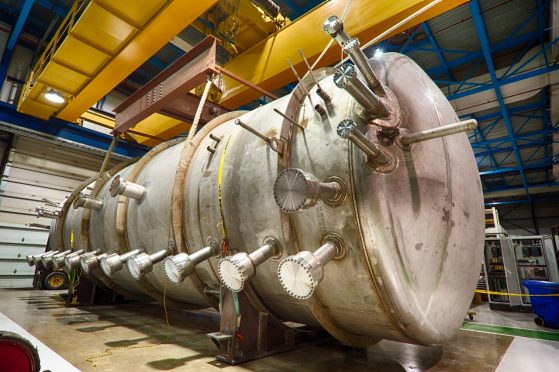
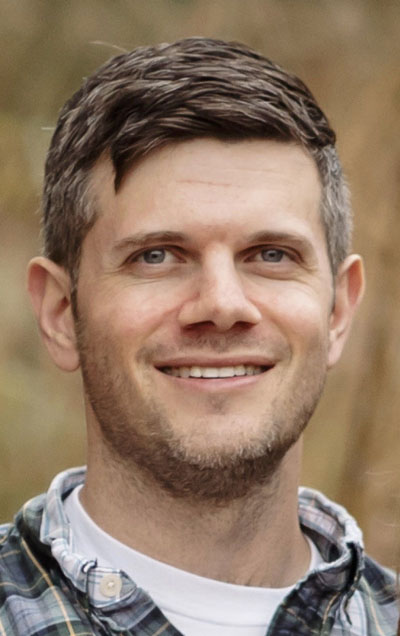
Scientists are closing the door on one explanation for a mystery that has plagued particle physics for decades. An international collaboration of scientists, which includes researchers from the University of Michigan, announced that it found no evidence for a so-called “sterile neutrino.”
This new particle was proposed to explain results from experiments happening since roughly the turn of the 21st century that couldn’t be reconciled with just the three known neutrinos. Now, however, the cutting-edge MicroBooNE experiment at the U.S. Department of Energy’s Fermi National Accelerator Laboratory, or Fermilab, has ruled out the sterile neutrino as a solution to that problem with 95% certainty. The research team published its results in the journal Nature.
“MicroBooNE is exposed to two different neutrino beams while using the same detector. This provides an extra, enhanced sensitivity because you don’t have the systematic uncertainties that would come with using different detectors,” said Joshua Spitz, a professor of physics at U-M and a collaborator who’s been working on MicroBooNE since its inception.
“And the punchline is, basically, we don’t see anything we didn’t expect. We’re able to rule out the sterile neutrino as the explanation for the anomalies in earlier experiments.”
Anomalies
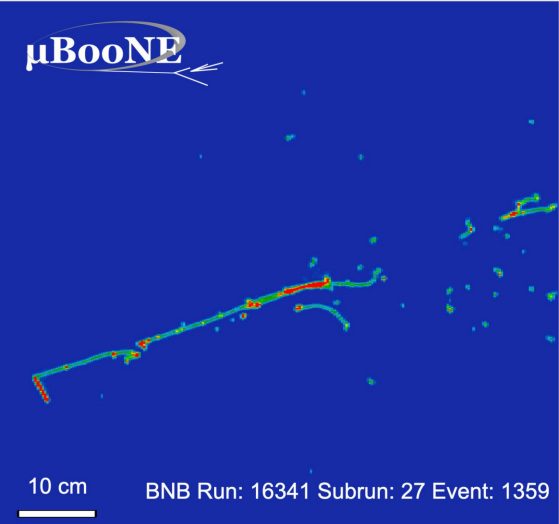
The spots and tracks here are particles that emanate from a collision between a neutrino and a liquid argon atom in MicroBoone’s detector. MicroBooNE can pinpoint these particles with millimeter precision. Image credit: MicroBooNE Collaboration
MicroBooNE’s predecessors had revealed neutrinos behaving in a way inconsistent with the Standard Model of particle physics, which successfully accounts for many of the fundamental particles and interactions at work in the universe. And, while the Standard Model is a triumph of modern physics, scientists know it still has some holes.
“The Standard Model does a great job describing a host of phenomena in the natural world,” said Matthew Toups, Fermilab senior scientist and co-spokesperson for MicroBooNE. “And at the same time, we know it’s incomplete. It doesn’t account for dark matter, dark energy or gravity.”
When neutrino experiments began showing inconsistencies with the Standard Model, they opened exciting pathways to potentially discover new physics and address deficits of the Standard Model.
According to the Standard Model there are three types, or flavors, of neutrino: muon, electron and tau. Neutrinos can switch or oscillate between these flavors, changing, for instance, from a muon neutrino to an electron neutrino. Scientists have been studying how neutrinos oscillate for decades, providing a strong foundation for understanding how often neutrinos naturally change flavor.
The Liquid Scintillator Neutrino Detector, or LSND, at Los Alamos National Laboratory raised the first hints that our understanding wasn’t quite aligning with reality in 1995. Fermilab then launched an experiment called MiniBooNE to verify the LSND results. Both experiments made observations suggesting that muon neutrinos were oscillating into electron neutrinos over shorter distances than are possible with only three neutrino flavors.
“They saw flavor change on a length scale that is just not consistent with there only being three neutrinos,” said Justin Evans, a professor at the University of Manchester and co-spokesperson for MicroBooNE. “And the most popular explanation over the past 30 years to explain the anomaly is that there’s a sterile neutrino.”
Now MicroBooNE has ruled out that explanation.
Looking ahead
Researchers have offered other hypotheses to explain the anomalies, said Spitz of U-M. One line of thinking is that there are “unknown unknowns” in the design, operation or interpretation of the previous experiments that give rise to the appearance of too-short oscillations.
“The other path is that you can start thinking about the existence of more than one sterile neutrino participating in oscillations,” Spitz said.
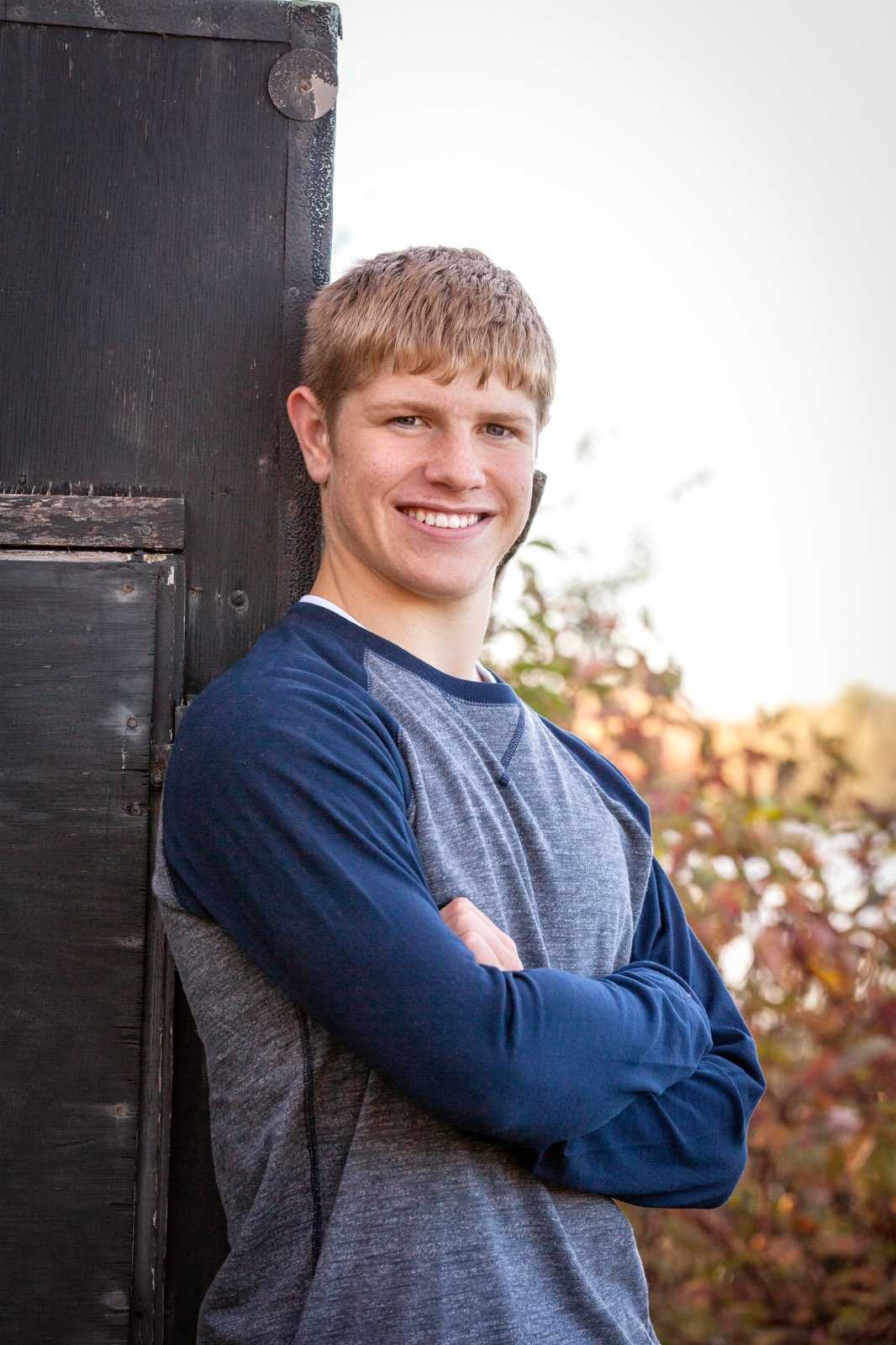
There could also be explanations aside from sterile neutrinos, said Benjamin Bogart, a doctoral student at U-M and co-author of the new study. MicroBooNE and the newer Short-Baseline Neutrino Program, or SBN, could help explore those possibilities.
“Though we closed the door on a single light sterile neutrino, MicroBooNE and SBN continue to open doors on a whole host of other scenarios—sometimes more complex and more interesting—beyond the Standard Model,” Bogart said.
The SBN Program adds a powerful multidetector approach with a near detector and a far detector to determine whether a more complicated model could explain the LSND and MiniBooNE anomalies. ICARUS, the far detector in the program, began taking beam data at Fermilab in 2021 and the Short-Baseline Near Detector, or SBND, started taking data in 2024. Both Bogart and Spitz are also collaborators on the SBND experiment.
While these experiments provide unparalleled insights into the workings of the universe, they’re also preparing the next generation of experts. For example, half of the researchers at MicroBooNE—which involves nearly 200 from 40 institutions in six countries—are students or postdocs.
That includes Bogart.
“I’m very grateful for how things have fallen in the timeline of my Ph.D., where I have lots and lots of data from MicroBooNE for analysis,” said Bogart, who noted MicroBooNE started collecting data when he was in 10th grade. “But I’ve also been able to help with some of the assembly of SBND. So I’m basically at opposite ends of the lifetimes of both these experiments, which is a unique and special opportunity that I’m really quite thankful for.”
More Information:
Doctoral Student Benjamin Boagart
Study: Search for light sterile neutrinos with two neutrino beams at MicroBooNE (DOI: 10.1038/s41586-025-09757-7)
