
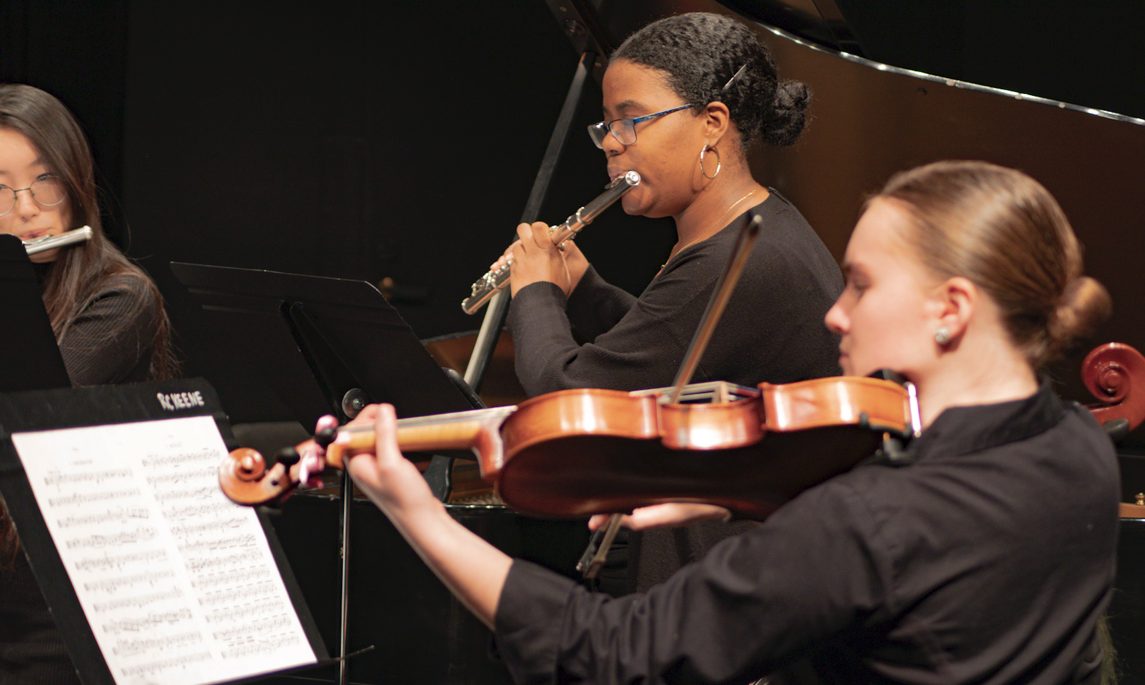
The RC Music program educates and empowers students of all levels through process-oriented teaching and music making.
RC Music is led by a team of multi-disciplinary musicians. We offer experiential music education to all students and foster creativity through innovative teaching strategies. Students who join us are equipped with insights and tools for a lifetime of learning and making music.


WE VALUE / WE CREATE
- A community of music makers
- A refuge for creativity
- Individual progress without judgment
- An atmosphere of support
- Room for individual interests and contributions
- Connection to the community
- Small class sizes
- Process as opposed to product
- Play, Experimentation, Hard work
- Transferable skills - Communication, Leadership, Teamwork
- Inclusion of all people, art forms, genres and cultures
- Critical listening

Students from all schools and colleges are welcome to enroll!
The program supports students seeking to fulfill the RC Arts Practicum, students majoring in the RC Arts and Ideas, as well as the those music majors and minors, who may have difficulty in finding fitting classes at the School of Music or do not have the capacity to go between Central and North Campus. Most RC music classes have no prerequisites.
RC Music Course Credits Explained
- 1-2 credit Performance and Theory labs:
- Chamber Music
- Chinese Ensemble
- Voice Class
- Creative Musicianship Theory Lab
- Afro-Cuban Drumming and Styles
- Found Instruments
- All 200 or 300-level RCMUSIC courses
- 4 credit Recitations:
- Foundations of Music
- Songwriting Craft and Practice
- Creative Musicianship
- Electronic Music
- Improvisation
- Some 200- and 300-level RCMUSIC courses

Need another reason to take an RC Creative Arts Class, like music?
Check out this video:
Playing and listening to music uses the whole brain at once. [Alluri et al., University of Jyväskylä, Finland].
Learning to play an instrument raises your IQ. [Schellenberg, University of Toronto Missisauga].
Playing music makes people better readers, and better students. [Kraus, Harmony Project, Northwestern University Auditory Neuroscience Lab].
When people play music together, their brainwaves get synchronized. [Lindenberger, Li, Gruber and Müller, Max Planck Institute for Human Development in Berlin].
Residential College: Music Program
Professor Emerita Arts and Ideas in the Humanities Program, Department of Afroamerican and African Studies, and Women's Studies
Interim Program Head of Drama; Advisor, Drama Major and Drama Minor; Lecturer, First Year Seminar
PCAP Exhibition and Curatorial Manager; Intermittent Lecturer, Residential College. Limited License Counselor (LLPC) and Provisional Art Therapist (ATR-P)
Lecturer II, German Intensive I & II, Humanities in Arts and Ideas, Cultural Anthropology and CBL in Social Theory and Practice
Professor, Social Theory and Practice, Richard A. Meisler Collegiate Professor of Afroamerican and African Studies, and History
Clinical Associate Professor Emeritus, Physical Medicine and Rehabilitation; Instructor, RC Social Theory and Practice Program
Teaching Professor and Program Head, German; Arts and Ideas in the Humanities Program; First Year Writing Seminar
U-M Detroit Center
Lecturer Emeritus, Social Theory and Practice; Faculty Scholar Integrative Medicine; Faculty Fellow, Mellon Faculty Institute on Arts Academic Integration; Academic Advisor
Theodore Roethke Distinguished University Professor of English Language and Literature, RC Creative Writing and Literature Program
Professor of Theatre & Drama, Residential College, Prison Creative Arts Project, Latina/o Studies Program, English, and Penny Stamps School of Art & Design
Walgreen Drama Center, room 2435
RC Community Programs Business Manager; Associate Director, Prison Creative Arts Project
Lecturer Emerita, Spanish, Comparative Literature, Arts and Ideas, American Culture, Latino/a Studies, Women's Studies
701 E. University
Ann Arbor, MI 48109-1245
701 E. University
Ann Arbor, MI
Associate Director of Living-and-Learning; Lecturer IV; Social Theory and Practice Major Program Head and Advisor; General Academic Advisor
Lecturer, Spanish Program, Social Theory and Practice; Coordinator Intensive Spanish II
Lecturer Emerita, Creative Writing and Literature, First Year Seminar Program Head, Academic Advisor
Lecturer, Social Theory and Practice, and Spanish Language Internship Program Coordinator
Director of Residential College Admissions, Recruitment; MLC Administration; Adjunct Lecturer
Collegiate Professor of History and African American Studies in the History, Afroamerican and African Studies Departments and in the Residential College Social Theory and Practice Program
Director of the Residential College; Arthur F. Thurnau Professor; Social Theory and Practice Program; Associate Professor, Department of Afroamerican and African Studies
Professor, Arts and Ideas in the Humanities Program; Professor, Afroamerican and African Studies; Professor, History
