
Meat, Veggies, or Termites? New Insights into Hominin Diet from Nitrogen Isotopes in Fossil Tooth Enamel
Tina Lüdecke from Max Planck Institute for Chemistry
- About our Building
- Camp Davis Group Photographs
- Camp Davis History
- Community Engagement
- Deliveries to the North University Building
- Department History
- Department Newsletters
- Faculty History
- A History of Camp Davis in T-Shirts
- Job Postings
- News
-
- All News
- All Events
- Past Guest Lectures
- 2021 Strategic Plan
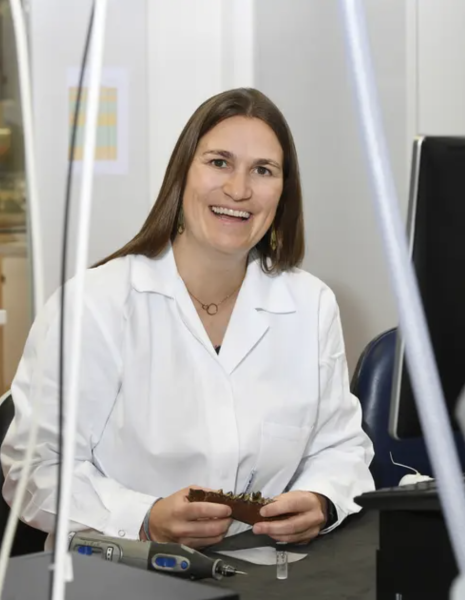
Dr. Lüdecke investigates early hominin diets and their ecological context, with a focus on the onset and evolution of meat consumption and the position of Plio-Pleistocene hominins in African paleo–food webs, using stable isotopes in tooth enamel. She also reconstruct Neogene paleolandscapes inhabited by early hominins, examining C4 grassland expansion in relation to changes in seasonality, precipitation, temperature, atmospheric pCO₂, and tree cover.
Her work combines extensive field research with geochemical approaches — stable isotopes of carbon, oxygen, nitrogen, and zinc, clumped isotopes, and multi-element analyses — applied to fossil tooth enamel, pedogenic carbonates, and other proxy materials. Her research areas span the Miocene to Pleistocene in eastern and southern Africa, including early hominin sites of the Afar Depression (Ethiopia), Manyara Basin (Tanzania), Karonga Basin (Malawi), Urema Basin (Mozambique), and the Cradle of Humankind (South Africa). Dr. Lüdecke also works on younger, out-of-Africa localities including Oman, Indonesia, Mexico, and Turkey.
Her goal is to link early hominin dietary adaptations to ecosystem change, assess the significance of animal resource consumption, and evaluate the role of dietary flexibility in extinction and adaptive radiation.
Her work combines extensive field research with geochemical approaches — stable isotopes of carbon, oxygen, nitrogen, and zinc, clumped isotopes, and multi-element analyses — applied to fossil tooth enamel, pedogenic carbonates, and other proxy materials. Her research areas span the Miocene to Pleistocene in eastern and southern Africa, including early hominin sites of the Afar Depression (Ethiopia), Manyara Basin (Tanzania), Karonga Basin (Malawi), Urema Basin (Mozambique), and the Cradle of Humankind (South Africa). Dr. Lüdecke also works on younger, out-of-Africa localities including Oman, Indonesia, Mexico, and Turkey.
Her goal is to link early hominin dietary adaptations to ecosystem change, assess the significance of animal resource consumption, and evaluate the role of dietary flexibility in extinction and adaptive radiation.
| Building: | 1100 North University Building |
|---|---|
| Event Type: | Lecture / Discussion |
| Tags: | Earth And Environmental Sciences |
| Source: | Happening @ Michigan from Earth and Environmental Sciences |
