
Hydrology Land Use and Climate Change (HYLUCC) Lab End-of-the-Year Presentation!
Betty Jahateh, Yinjiao Zhong, Md Ehsan Alam
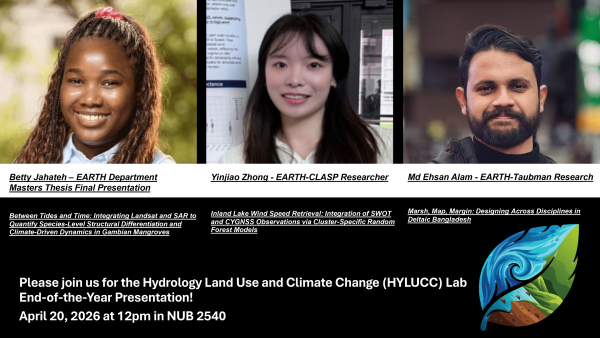
Betty Jahateh - Masters Thesis Final Presentation
Between Tides and Time: Integrating Landsat and SAR to Quantify Species-Level Structural Differentiation and Climate-Driven Dynamics in Gambian Mangroves
Mangrove ecosystems provide critical coastal protection, carbon sequestration, and fisheries support, yet they are increasingly vulnerable to climate variability and anthropogenic pressures. However, most existing mangrove monitoring in West Africa focuses on overall extent rather than species composition, which leaves a critical gap in species-level mapping that can be addressed using remote sensing techniques capable of distinguishing spectral differences among mangrove species. This study integrates Landsat optical time series, Sentinel-1 SAR, elevation metrics, canopy height, and field observations to quantify internal mangrove heterogeneity and incorporates SWOT water levels and GLDAS and GPM precipitation data to assess seasonal and annual climate dynamics in The Gambia. Field validation across 26 sites in the North Bank and Lower River Region linked these classes to ecologically meaningful assemblages. We found that classes differed consistently in spectral indices, SAR backscatter,
canopy height, and distance to water, which shows hydrological and tidal zonation. Time-series analysis showed an overall greening trend with some class-level separation through time. Long-term modeled rainfall records (1950-2025) revealed pronounced interannual variability, with dry conditions beginning in the late
1960s and continuing through the mid 1990s, leading to mangrove mortality as documented in other studies.
--
Yinjiao Zhong - EARTH-CLASP Researcher
Inland Lake Wind Speed Retrieval: Integration of SWOT and CYGNSS Observations via Cluster-Specific Random Forest Models
Measuring wind speeds over small inland lakes is difficult due to complex shorelines and low wave heights. This study combines CYGNSS (L-band) and SWOT (Ka-band) satellite data to improve the accuracy of wind speed retrievals over inland lakes. We grouped large and moderate-sized lakes in North America and Asia into 14 categories using K-means clustering based on the features such as area and depth to develop specific geophysical function models (GMFs) for each cluster and validating them with ERA5 data (2023-2025). This study provides essential data for understanding lake energy balances and regional climate.
--
Md Ehsan Alam - EARTH-Taubman Research
Marsh, Map, Margin: Designing Across Disciplines in Deltaic Bangladesh
Secondary cities are among the world's fastest-growing urban areas, often at the cost of hydrological precarity. This talk examines what happens when urban design enters into conversation with hydrology. Developed jointly between Taubman College and the Hydrology, Landuse and Climate Change (HYLUCC) Lab at the University of Michigan, this brief thesis presentation traces how aspirational urbanity encroaches upon perennial floodplains; displacing aquatic systems, marginalizing communities, and erasing vernacular practices. The thesis spans remote sensing, vernacular knowledge systems, filmmaking, and design speculation. What emerges is a provocation about whose city, whose water, and whose future.
Between Tides and Time: Integrating Landsat and SAR to Quantify Species-Level Structural Differentiation and Climate-Driven Dynamics in Gambian Mangroves
Mangrove ecosystems provide critical coastal protection, carbon sequestration, and fisheries support, yet they are increasingly vulnerable to climate variability and anthropogenic pressures. However, most existing mangrove monitoring in West Africa focuses on overall extent rather than species composition, which leaves a critical gap in species-level mapping that can be addressed using remote sensing techniques capable of distinguishing spectral differences among mangrove species. This study integrates Landsat optical time series, Sentinel-1 SAR, elevation metrics, canopy height, and field observations to quantify internal mangrove heterogeneity and incorporates SWOT water levels and GLDAS and GPM precipitation data to assess seasonal and annual climate dynamics in The Gambia. Field validation across 26 sites in the North Bank and Lower River Region linked these classes to ecologically meaningful assemblages. We found that classes differed consistently in spectral indices, SAR backscatter,
canopy height, and distance to water, which shows hydrological and tidal zonation. Time-series analysis showed an overall greening trend with some class-level separation through time. Long-term modeled rainfall records (1950-2025) revealed pronounced interannual variability, with dry conditions beginning in the late
1960s and continuing through the mid 1990s, leading to mangrove mortality as documented in other studies.
--
Yinjiao Zhong - EARTH-CLASP Researcher
Inland Lake Wind Speed Retrieval: Integration of SWOT and CYGNSS Observations via Cluster-Specific Random Forest Models
Measuring wind speeds over small inland lakes is difficult due to complex shorelines and low wave heights. This study combines CYGNSS (L-band) and SWOT (Ka-band) satellite data to improve the accuracy of wind speed retrievals over inland lakes. We grouped large and moderate-sized lakes in North America and Asia into 14 categories using K-means clustering based on the features such as area and depth to develop specific geophysical function models (GMFs) for each cluster and validating them with ERA5 data (2023-2025). This study provides essential data for understanding lake energy balances and regional climate.
--
Md Ehsan Alam - EARTH-Taubman Research
Marsh, Map, Margin: Designing Across Disciplines in Deltaic Bangladesh
Secondary cities are among the world's fastest-growing urban areas, often at the cost of hydrological precarity. This talk examines what happens when urban design enters into conversation with hydrology. Developed jointly between Taubman College and the Hydrology, Landuse and Climate Change (HYLUCC) Lab at the University of Michigan, this brief thesis presentation traces how aspirational urbanity encroaches upon perennial floodplains; displacing aquatic systems, marginalizing communities, and erasing vernacular practices. The thesis spans remote sensing, vernacular knowledge systems, filmmaking, and design speculation. What emerges is a provocation about whose city, whose water, and whose future.
| Building: | 1100 North University Building |
|---|---|
| Event Type: | Lecture / Discussion |
| Tags: | Earth And Environmental Sciences |
| Source: | Happening @ Michigan from Earth and Environmental Sciences |
