

“My Horizons experience in undergrad laid the groundwork for my entire life.”
—Ever O’Donnell
For undergraduate students, a single summer of research can be transformative—helping students discover whether they have an interest in research while providing essential experience for graduate programs, medical schools, and other life sciences careers. Yet many undergrads are unaware that opportunities exist to do research with University of Michigan faculty or can’t afford to spend the summer volunteering in a lab. The Department of Molecular, Cellular, and Developmental Biology (MCDB)’s Horizons Summer Research Internship Program is dedicated to expanding opportunities for students by equipping them with lab skills fundamental to biological science through direct participation in a research project, providing programmatic activities designed to introduce them to career opportunities in science, and paying a stipend to support their summer work.
Horizons relies on a combination of departmental resources and generous donor gifts to make each summer possible. Existing donor funding supports approximately half of its five participants each season, along with the cohort programming that helps Horizons stand out. Every additional contribution moves Horizons closer to a future where donor funding sustains it entirely, ensuring that the program can thrive independent of shifting budget priorities—and no promising student is left out for lack of resources. Gifts to the MCDB Horizons Internship Program will ensure that students’ summers are defined by scientific discovery, not financial concerns.
Mentorship and Community

New MCDB graduate Sydney Richardson (B.S. ’26) discovered academic research through the Horizons Summer Research Internship Program in 2023. She’s coming back to Horizons this summer to work as program coordinator and mentor for the next cohort of Horizons fellows.
“This position goes a long way toward helping make the new interns feel comfortable. Having someone who recently went through the program is an important asset for them,” says MCDB Chair Ken Cadigan.
Sydney is thrilled to have the chance to pay her Horizons experience forward—to be as impactful a mentor for the next cohort as her mentors were for her. “I had such a supportive Horizons mentor,” says Sydney. “Having the chance to be that for someone else, and helping someone else find their love for science, is so much fun. Horizons gave me the confidence and the curiosity to turn science into my life.”
Sydney will begin a Ph.D. program in cancer biology at Wayne State University in the fall. She traces her path to graduate school directly back to that first summer in an MCDB lab. “I couldn't have predicted this was what I’d be doing when I started at the University of Michigan. Before the Horizons internship, I had a totally different idea of what research looks like,” she says. “I thought I was going to stare into a microscope all day and not talk to anyone.” What she found instead was a supportive community and many opportunities to interact with peers. “It’s so much more collaborative than I thought it was going to be.”
Through Horizons, Sydney joined Professor Jayakrishnan Nandakumar’s lab after her freshman year. By the end of that summer, she wanted to keep going: “I wanted to investigate more because we answered one question during my time there, but then a million more questions sprouted because of that.”
So she returned to the Nandakumar Lab in a more independent role during her sophomore year, juggling labwork and coursework. “My experience continuing in the lab sophomore year was very different,” she reflects. “Having a full course load made it difficult to go in as much as I would have liked or to work in depth on those questions that sprouted from the summer, but it was still so fun, and I helped generate incredibly interesting data surrounding the POT1 protein in the protein complex shelterin.”
“One thing that you can definitely get out of extending your time in research after the summer is that you’re going to learn if this is something that you really want to do,” she continues. “It’s a chance to see what grad school will be like. I realized that even despite the stress, this was important to me.”
Sydney further leveraged her Horizons foundation the summer following her sophomore year to pursue a research internship at Henry Ford Hospital in Detroit, where she worked on pancreatic cancer research. “I was able to take the skills the Horizons program gave me, conducting independent research and presenting it, and build on them at the Henry Ford Health Pancreatic Cancer Center, where I investigated cancer-associated fibroblasts,” she says. “I was even fortunate enough to present at the PancMidwest Symposium (a pancreatic cancer research seminar) when it was held at the University of Michigan in October 2025. I don’t think I would have been so confident about pursuing the Henry Ford experience if I hadn’t done Horizons.
“Horizons opened my eyes to a path I never knew existed for me,” she reflects. “I thought I had to go to medical school and become a medical doctor to have a career that allows me to form connections, collaborate with others, immerse myself in science, and be curious. In reality, I found those values [in the lab] through the Horizons internship.”
“I thought I had to ... become a medical doctor to ... collaborate with others, immerse myself in science, and be curious. In reality, I found those values [in the lab] through the Horizons internship.”
—Sydney Richardson
The Hidden Curriculum

Knowing that getting started on research experience as early as possible would be valuable, Ever O’Donnell (B.S. ’24) cold-emailed roughly 100 professors shortly after arriving on campus for their first semester, landed a position, and dove in.
“I thought I wanted to go to medical school because I really liked science,” says Ever. Once in the lab, though, something shifted, and Ever’s pre-med plan gave way to something that felt more like a calling. “I fell in love with research. I discovered such a drive inside me to answer some of these super complex questions about the fundamental mechanisms of life. It really brings me joy.”
Ever had already been in the lab for months and developed an interest in transporter biology—studying proteins on the surface of the cell membrane that act like a door that lets certain molecules or drugs come in and out of the cell—before applying to be one of the inaugural interns in MCDB’s Horizons Summer Research Internship Program in summer 2021.
As a first-generation student with a newly discovered love for research, being part of the Horizons cohort provided something Ever’s previous lab work hadn’t: a roadmap to a career in academic research, and a community that made that career feel possible.
The hidden curriculum that’s built into Horizons matters. Consider that more than half of tenure-track higher-ed faculty have at least one parent with a master’s degree or a Ph.D., according to a 2022 study published in Nature: Human Behaviour. For many graduate school applicants, insider knowledge of how the system works is an inherited privilege.
“I didn’t come from a family of academics; my mother was getting her college degree at the same time I was,” says Ever. “I had no idea how undergraduate college works, let alone graduate school.”
The Horizons program’s weekly professional development seminars helped fill the knowledge gap. “They explained what a thesis committee looks like, what rotations look like. I didn’t know what the NSF GRFP was, or what an NIH K99 or F32 is. It all sounded like jargon. Horizons helped demystify all that,” Ever says. “I would not have been able to apply to grad school without getting not just the scientific and technical knowledge from the lab, but the administrative information that Horizons provided.”
The final Horizons poster presentation, explaining their research to a non-specialist audience, turned out to be a skill that Ever has won awards for and continues to draw on years later. “The practice we did in presenting our research really helped me with my Ph.D. interviews,” they say. “Gaining the ability to translate my research into whatever context would be most digestible for the current audience is a skill I’m going to take with me throughout my career.”
The program also connected them with peers who were navigating the same unfamiliar terrain. “A lot of my fellow Horizons students and peer mentors were first-gen students or students of color—backgrounds that are underrepresented in science,” says Ever. “It was cool getting connected with others who also didn’t come into college already knowing how to navigate academia, and learning how they figured it out.”
Ever continued to do research throughout their undergraduate career, eventually switching labs to pursue a more specialized interest in transporter biophysics—and earning a spot in one of the most competitive Ph.D. programs in their field at the University of California, San Francisco. “My Horizons experience in undergrad laid the groundwork for my entire life.”
MCDB chair Cadigan recalls, “Ever really challenged me in a Horizons workshop—challenging the establishment, and I was the establishment. I loved that. They were in our very first cohort, when we hoped that Horizons would help talented students who have curiosity and the drive, but not the inherited access, to succeed in academic research. And now they’re in a Ph.D. program at UCSF.”
“Gaining the ability to translate my research ... for the current audience is a skill I’m going to take with me throughout my career.”
—Ever O’Donnell
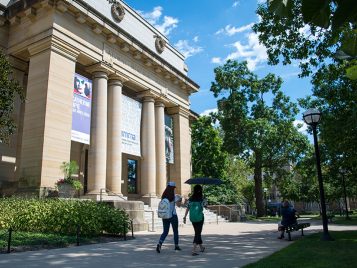
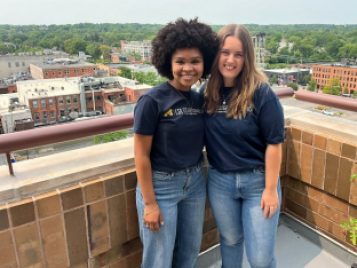
From the top: The U-M Biological Sciences Building, photo by Marc-Gregor Campredon, Office of University Development; photo by Suzanne Tainter, courtesy of MCDB; photo courtesy of Ever O’Donnell
Free to Follow the Science

A new donor-supported fund in MCDB will help students who participate in Horizons keep working in the lab throughout the academic year to expand their research proficiency and explore whether a career in academic research is right for them.
Life-Changing Education in LSA
In the University of Michigan’s College of Literature, Science, and the Arts, life-changing education in the liberal arts and sciences extends beyond the classroom. Hands-on scientific research internships help undergraduates gain the skills, confidence, and time in the lab to discover new interests, think like scientists, and prepare for careers they may never have imagined possible.


Look to Michigan for the foundational knowledge and experience to ignite purposeful change.
LSA is the place where creative thinkers engage with a complex, diverse, and changing world. See how your support can make an impact on what’s next, for a better tomorrow. Learn more.
