Korea Foundation Endowed Associate Professor of Sociology, Professor of Law (by courtesy)
she/her/hers
About
I am a political sociologist and law and society scholar studying race/ethnicity/nationalism and international migration and citizenship. What are the distinctive bureaucratic, organizational, and knowledge infrastructures that have enabled the modern state to see, know, and produce the population as an object of rationalized governance? How have these developments shaped the ways in which people conceive, represent, and perform their identities? What kinds of state and non-state actors mediate these categorization and identification practices, impacting shifting boundaries of inclusion and exclusion and reproducing or challenging the hegemony of law and state? I am interested in exploring these questions in the context where borders move over people and people move across borders. I draw on comparative historical and ethnographic methods and engage in transnational, multisited research.
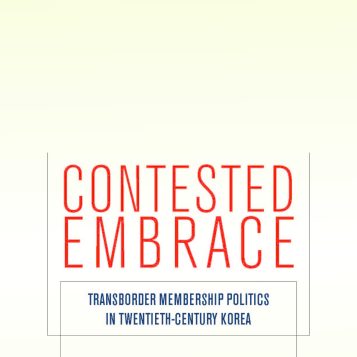
My first book project, which began as my dissertation research, asks how people who enduringly reside outside the territory of the state are constituted as an indispensable part of the national community. I explore this question through a comparative historical analysis of “transborder membership politics” in and around the Korean peninsula during the colonial, Cold War, and post-Cold War periods. Despite a widespread and deeply entrenched belief in Korean ethnic nationhood, the embrace of transborder coethnic populations by the colonial state and its two postcolonial successors, North and South Korea, has been selective, shifting, and recurrently contested. Transborder membership politics in Korea thus provides a rich and distinctive case to explore when, how, and why a state seeks to claim (or fails to claim) a certain transborder population as “its own,” and how transborder coethnics participate in the making, unmaking, and remaking of transborder ties as they seek long-distance membership on their own terms. This work eventually resulted in several articles and a book, Contested Embrace: Transborder Membership Politics in Twentieth-Century Korea (Stanford University, 2016; paperback 2020). The book won multiple awards from the American Sociological Association (ASA), the Social Science History Association (SSHA), and the Association for Asian Studies (AAS).
My second book project examines the hitherto underexplored nexus of migration governance, humanitarian regime, and transnational religion, focusing on asylum-seeking of unauthorized migrants on religious grounds. Students of international migration have long treated religion largely as an engine of assimilation or a sanctuary from exclusion for migrants. But what if membership in a faith community opens for migrants a path to formal, de jure inclusion into their states of residence, leading to the acquisition of coveted membership in affluent liberal democracies? What kinds of practical challenges, legal intricacies, and moral dilemmas do the actors involved face, and how do they make sense of and respond to these? How do their complex interactions reshape migration governance, humanitarian regime, and transnational religion? I seek to answer these questions through a long-term, in-depth ethnographic investigation of the migration trajectories, legalization strategies, and conversion careers of Korean Chinese migrants to the U.S., focusing especially on those who applied for asylum as Christians in the first two decades of the 21st century. My recent articles derived from this project examine the complex politics of religious asylum through the lens of migration brokerage, temporality, identity craft, and state-church relations and were published in Theory and Society, Migration Studies, International Migration Review, and Canopy Forum: On the Interactions of Law and Religion.
I am also interested in sociological theorizing. I published articles proposing a Bourdieusian theory of international migration and “ethnic capital” in Sociological Theory and Ethnic and Racial Studies. The former received the 2019 Theory Prize from the ASA Theory Section. I am also one of the contributors of The Oxford Handbook of Sociological Theorizing (forthcoming) and currently serving as an editor of Theory and Social Inquiry (previously, Theory and Society).
Before joining the University of Michigan, I received my PhD degree from UCLA, was a postdoctoral fellow at Princeton and Stanford, and taught at George Mason University for a year. I was a member of the Institute for Advanced Study (School of Social Science) in Princeton during 2016–2017 and a fellow at Wissenschaftskolleg zu Berllin (Institute for Advanced Study in Berlin) during 2020–2021, where I currently hold a non-resident permanent fellow position.
Below is the list of my recent articles. For a comprehensive list, please check my CV.
Kim, Jaeeun. 2026. “Unauthorized Identity Craft: Rethinking ‘Fraud’ in the Study of Migration.” International Migration Review. Advanced Online Publication
Kim, Jaeeun. 2025. “Getting Saved from Illegality and Unbelief? Religious Asylum, Migration Dreams, and Christian Conversion.” Migration Studies 13 (3). (Special Issue: Mobile Temporalities and Political Possibilities)
Kim, Jaeeun. 2024. “Seeing like a Church, Seeing like a State: The Church-State Relation in Religious Asylum Adjudications.” Canopy Forum: On the Interactions of Law and Religion, May 23, 2024.
Kim, Jaeeun. 2022. “Between Sacred Gift and Profane Exchange: Identity Craft and Relational Work in Asylum Claims-Making on Religious Grounds.” Theory and Society 51 (2): 303–33.