Skip to Content

Search: {{$root.lsaSearchQuery.q}}, Page {{$root.page}}

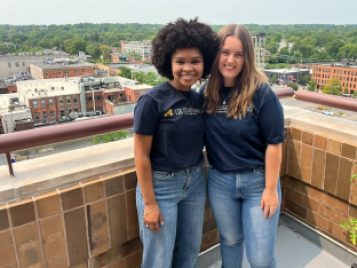
From left to right: Archaeologist Kat Slocum, anthropology Prof. Tiffany Fryer, and student Naida McCoy participate in the day of service at Woodlawn Cemetery. Fryer is one of the co-leads of the Woodlawn Cemetery Restoration Project. Photography by Doug Coombe

This Juneteenth, on a warm, nearly cloudless morning, Tiffany Fryer and a group of community leaders, elected officials, and volunteers met at Woodlawn Cemetery in Ypsilanti. They carried chainsaws, hoes, and shovels.

They started in a vast open area—one that had been covered by trees and brush for decades—and fanned out to the surrounding woods to uncover the gravesites of Washtenaw County’s African American community.

Woodlawn Cemetery was founded in 1946,  a year after the end of World War II. Southern Jim Crow laws remained in full swing; and, not coincidentally, so did the Great Migration to the North. The Rev. Garther Roberson Sr., pastor of the Second Baptist Church in Ypsilanti, co-founded the cemetery alongside the Rev. Booker Rhonenee of Brown Chapel African Methodist Episcopal, as a “community response to a lack,” explains Tiffany Fryer, anthropology professor, U-M Museum of Anthropological Archaeology curator, and one of the co-leads of the restoration project.


“It wasn’t a church-specific cemetery—it was a community cemetery, and one that was responding to economic hardships and racism.” Woodlawn was one of the only dignified options for Black community members to bury their dead, as they were often rejected by other cemeteries or relegated to a corner in the back.

The Woodlawn Cemetery Restoration Project aims to preserve the grounds by removing overgrowth, locating gravesites through non-invasive geophysical surveys, recovering lost headstones, and establishing a publicly accessible historical archive for community members.

The effort to restore Woodlawn Cemetery—co-led by U-M alum and former Michigan Engineering staff member Debby Covington, archaeologist Kat Slocum, and Fryer—began in the early months of 2025. Covington had just started her role as a historic district commissioner for Washtenaw County, in addition to starting as the board chair of the African American Cultural and Historical Museum of the county. Slocum, a cultural resource specialist, leveraged her experience as historic preservation officer of the county to ensure that Woodlawn would receive the government recognition it deserved. Together, the two recruited Fryer to help lead research efforts and involve U-M students and the local academic community.

LSA student Naida McCoy is doing research on her own ancestry and recently discovered that she comes from a long line of civil servants. The work of tracing genealogy is personal to her.


One of those students is Naida McCoy, an international studies and history double major. Her role as a researcher on the genealogy team is to summarize existing records of the deceased, giving the public a basis for Woodlawn-specific research. Through her work on the team, she has met descendants of the individuals buried at Woodlawn, including the family of Bertha M. Campbell (1890–1947). Campbell, a local matriarch who had 13 children, was married to a Red Cap porter and janitor at the Ypsi Depot. Her extraordinary legacy is preserved in the lives of her 137 great-great-grandchildren. 

“Being here in person is really grounding my work in the actual history,” McCoy reflects. The team has been able to trace the lineage of a person buried at Woodlawn to their enslaved ancestors. For McCoy, whose own grandfather was a sharecropper, the legacy of enslavement feels shockingly close—both in emotional resonance and temporal proximity. 

That history, whose long wake reaches us through places like Woodlawn, is not always evident or even recognized. In the years after its founding, the cemetery could not manage to sustain itself. Up until the 1960s, Woodlawn took anyone, including those who were unable to pay long-term maintenance fees. “Woodlawn gave people a resting place when they didn’t have options,” Fryer says. “You can see that the community stood up and solved a problem for itself, even if in the long term it didn’t wind up the way they had imagined.


When clearing gravesites, the volunteers find all sorts of artifacts: a fragment of an old Squirt bottle and a BB gun from the 1950s among them.


“It’s a real testament to the ongoing struggles people were facing in the mid-20th century,” Fryer notes. “Even as Black folks were migrating north, they thought they were going to encounter this extraordinarily free space. Then they found out that they still couldn’t even bury their dead with dignity.” 

Many early members of Washtenaw County’s Black community are buried at Woodlawn, but the cemetery did not receive government recognition or care for its first eight decades. “It’s not because descendants weren’t pushing for it,” Fryer says. 

One of these descendants is Anita Rosser of Romulus, Michigan. She is a great granddaughter of Bertha Campbell and recalls how her mother would tell her and her siblings to care for their ancestor’s gravesite by cutting the grass and remembering her life. Now, Rosser is among those local volunteers leading efforts with the genealogy team. “I’m excited to help other people find their lost family,” she says. 

The work at Woodlawn has begun in just the past two years, but the effort will be ongoing. The project received a generous donation of services from  archaeologists at Terracon who conducted the first phase of a non-invasive geophysical survey in order to identify gravesites without disturbing them. They also received volunteer help during the summer from a human remains detection dog, who confirmed that there may be as many as double the burials as the team initially suspected interred at the site. Local government officials and representatives, including Congresswoman Debbie Dingell, have lauded the work of the restoration project since its inception.

Anita Rosser of Romulus, Michigan, is a descendant of Bertha M. Campbell, who is buried at Woodlawn. She now contributes to the work of the genealogy team.


The restoration of Woodlawn is part of a larger trend. In the past decade, Black cemeteries have begun to receive more attention from researchers and restorers—but the majority of them, Fryer explains, are located in the South. 

“They are special in their own right,” Fryer says, “but Woodlawn is unique because it’s showing how these problems that we try to isolate as regional problems were deeply American problems.” 

On community volunteer days, multiple generations of helpers show up for the cemetery. Grandparents bring their children and grandchildren with the goal of learning and sharing together. The crowd is multiracial, and a range of socioeconomic classes is represented. “Everybody can relate to wanting their family members to be buried with some semblance of peace and dignity,” Fryer says. 

Often, Fryer and Slocum bring their young children to Woodlawn. While their moms are working, the kids run free onsite, searching for frogs and playing tag. Descendants and community members endorse it wholeheartedly. “They want it to be a lively community space,” Fryer says. “They want it to be a place where people go for contemplation and reflection, or have their lunch, or have a small family gathering. They want it to be a place that’s alive.”


—Katie Vloet contributed to this story



Look to Michigan for the foundational knowledge and experience to ignite purposeful change. 

LSA is the place where creative thinkers engage with a complex, diverse, and changing world. See how your support can make an impact on what’s next, for a better tomorrow. Learn more.


More Stories from the Magazine

Gentle Giants: The Mountain Gorillas of Rwanda

Three LSA graduate researchers scale volcanoes to encounter some of our closest evolutionary relatives.


The Classical Jurisprudent

The legal profession has its origins in ancient Greece and Rome, and LSA’s Department of Classical Studies is where one alum decided to become a human rights attorney.


Starting a Collection

LSA is home to six museums. Each was built on a foundation of curiosity, academic rigor, an eye for things rare and meaningful, and the hope of educating future students and researchers.


Be part of their foundation

Look to Michigan.

Donor support makes LSA scholarships possible—creating access to a foundational education that gives students the skills to think clearly, communicate confidently, and solve today’s problems creatively.

Email
Tags: LSA