
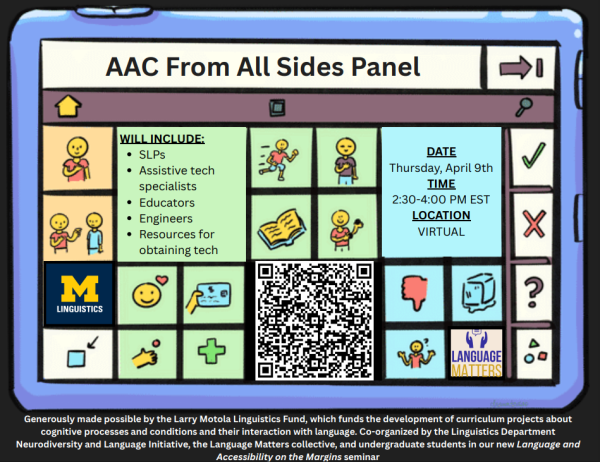
Thursday, April 9, 2026
2:30-4:00 PM
Virtual
Join us for a panel discussion featuring those involved with creating, obtaining, and using AAC devices. The panel will contain Speech Language Pathologists, assistive technology specialists, educators, engineers, and resources for obtaining technology. Ask questions, explore possible career paths, and expand your knowledge of communication. Welcome to all!
According to the American Speech-Language-Hearing Association:
Assistive and Alternative Communication devices are used by individuals who cannot rely on their speech. Typically, these individuals with expressive language impairment have disabilities like autism spectrum disorder, cerebral palsy, and others. AAC devices can also be used by those who need temporary assistance, like those recovering from surgery. As the name suggests, these devices are used to add to the individual's existing communication and give them the opportunity to fully realize their communication capabilities.
AAC devices come in many different forms. Some lower tech options include pointing to letters, pointing to pictures, gestures/facial expressions, and picture exchange communication systems. High tech options include using an app on a digital device and using a speech-generating device. One person's AAC may include one or multiple of these options, they are all part of the communication system.
Interested? Come learn more!
Generously made possible by the Larry Motola Linguistics Fund, established to support the development of curriculum projects and research related to cognitive process and conditions, and their interaction with language and neurodiversity.
Please RSVP here: https://forms.gle/6HUGV6Ar8ywvTAok6
WHEN: April 9th, 2026
WHERE: Online
TIME: 2:30-4:00 PM EST
According to the American Speech-Language-Hearing Association:
Assistive and Alternative Communication devices are used by individuals who cannot rely on their speech. Typically, these individuals with expressive language impairment have disabilities like autism spectrum disorder, cerebral palsy, and others. AAC devices can also be used by those who need temporary assistance, like those recovering from surgery. As the name suggests, these devices are used to add to the individual's existing communication and give them the opportunity to fully realize their communication capabilities.
AAC devices come in many different forms. Some lower tech options include pointing to letters, pointing to pictures, gestures/facial expressions, and picture exchange communication systems. High tech options include using an app on a digital device and using a speech-generating device. One person's AAC may include one or multiple of these options, they are all part of the communication system.
Interested? Come learn more!
Generously made possible by the Larry Motola Linguistics Fund, established to support the development of curriculum projects and research related to cognitive process and conditions, and their interaction with language and neurodiversity.
Please RSVP here: https://forms.gle/6HUGV6Ar8ywvTAok6
WHEN: April 9th, 2026
WHERE: Online
TIME: 2:30-4:00 PM EST
| Building: | Off Campus Location |
|---|---|
| Location: | Virtual |
| Website: | |
| Event Type: | Livestream / Virtual |
| Tags: | Accessibility, All Majors Welcome, Disability, Education, Information and Technology, Linguistics, Neurodiversity, Panel, Speech Language Pathology |
| Source: | Happening @ Michigan from Department of Linguistics |
