



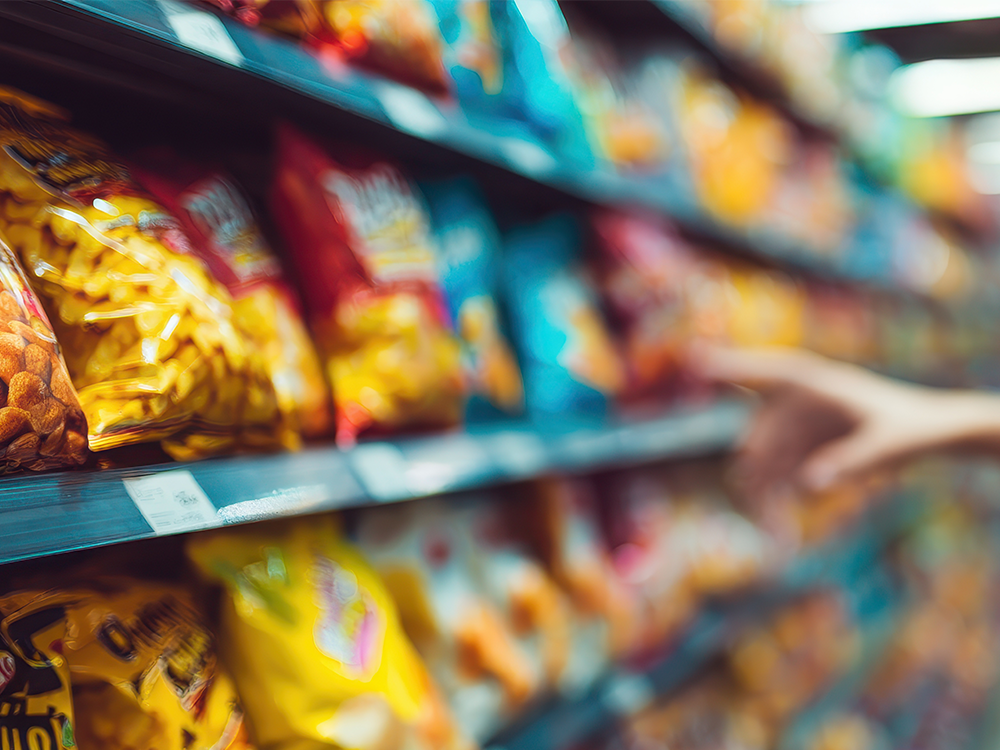
You go to the gas station for a snack and you are immediately inundated with options—each crunchier than the next. Walking down the cereal aisle at the grocery store with your kid, you notice that the brightly illustrated mascots’ eyes are pointing down, trying to connect with your child. You stream your favorite reality TV show and see weight-loss ads that are pushed to you by the same companies that seduce you with unnatural flavors. What’s the deal?
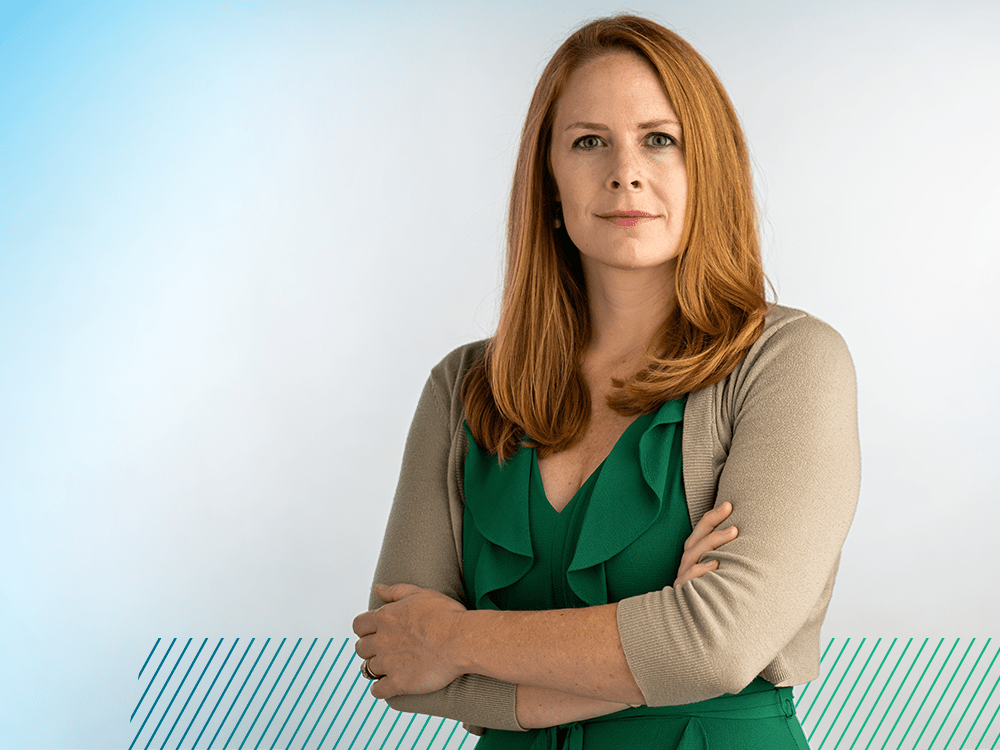
We spoke with Ashley Gearhardt, professor of psychology at LSA, about Big Food’s siren song that aims to keep us hooked on the crunch—and how we can resist it.
A 20th-Century History
“It’s something that started in one generation,” Gearhardt explains. Beginning in the 1970s, Big Tobacco corporations like Philip Morris and R.J. Reynolds acquired food companies and applied their knowledge of cigarette marketing to ultraprocessed foods, which are extracted from naturally occurring ingredients and synthesized in labs. They began thinking about what ingredients and formulas would trigger the reward systems of the human brain—engineering a super-high sugar hit or a salty fat bomb. Or an appetizing crunch.
Those triggers, which “helped us survive times of famine” as a species, have “turned into something that’s killing us,” Gearhardt says. By engineering ultraprocessed foods that crunch in exactly the right way, Big Food taps into our base instincts: Our ancestors knew that crunching meant freshness, and that sugar, salt, and fat rarely occurred in the same food.
They would have loved cheese puffs.
The Psychology of Addiction
Gearhardt is familiar with how predatory the ultraprocessed food industry can be, and how it has removed everyday people from their food sources. She grew up on an industrial farm, but her family never grew anything they could actually eat. “It was all staple crops that go into processed foods, and that’s because of agricultural policy,” she says. Farming families like hers were simply responding to economic and government incentives. “It feels like tobacco all over again.”
She went on to study addiction, both as an undergraduate psychology major at LSA and in graduate school. As a clinical psychologist, she saw clients who began to parallel their experiences of smoking tobacco with consuming sugary, fatty junk foods, many of which had a specific crunchy mouthfeel.
“It’s really nothing magical or different from other kinds of addiction,” Gearhardt says. “An Oreo or Flamin’ Hot Cheetos will hit your bliss points and maximize craveability.”
Big Food: Providing Solutions to the Problems They Created
As the food environment changed in the latter half of the 20th century, body ideals began to shift, too. The industry kept up: Companies like Nestle began dabbling in weight-loss brands.
Taking a leaf from Big Tobacco’s book, Big Food began marketing to children. “If you go to a grocery store and you look at the cartoons on sugary cereal boxes,” Gearhard points out, “notice that their eyes look slightly down. They’re trying to catch kids, not adults.” By hooking children on crunchy, ultraprocessed foods, Big Food has ensured that they will have consumers for generations.
New fads in dieting continue to influence Big Food. “The industry is trying to create functional foods, which are just junk foods with something fancy,” Gearhardt says. “Having a fatty, crappy, addictive food base and adding a little protein isn’t going to save you.” The industry, she says, is motivated to prey on the natural urges of human beings.
Joining the Resistance
Gearhardt always returns to her roots in clinical psychology. “Addiction is a real human experience,” she says, and, historically, the tendency is to blame the victim. Since junk foods have become ubiquitous, she has seen people trying desperately to control their desire for them.
“Everyone I’ve ever seen in the clinic has tried hundreds of different approaches,” she explains. “Cabbage diets, weight loss pills, GLP-1s [popular diabetes and weight-loss medications]. Anything they can try to find a way to have a more moderate intake of these foods. And they can’t.”
Gearhardt tries to lead with compassion and to help lead her patients on a path toward self-awareness. She herself has attempted to shift her mindset when it comes to consuming ultraprocessed foods. “I look at those foods, and I feel grossed out,” she says. “They’re pre-chewed and pre-digested. And I’m mad because they’re trying to manipulate me.”
She tries to give people the tools they can use not only to fight cravings but to feel healthier and more whole. “Make at least 80 percent of what you’re eating on any given day food that looks like it came from Mother Nature,” she says. “I often see people try to cut down their calories but don’t pay attention to the quality of what they’re eating.” This practice, she says, sets them up to fail.
When people with ultraprocessed food addictions incorporate more unprocessed foods in their diets, Gearhardt’s Food and Addiction Science and Treatment (FAST) Lab at LSA has seen “fewer cravings, more energy, and more emotional stability.”
Gearhardt also recommends tracking cravings in order to identify triggers. “It could be certain times of day, or a certain meeting, or walking past a certain vending machine,” she says. Having that knowledge means that clients can prepare themselves; they can, for instance, start carrying peanuts or baby oranges in their bag, as she does.
“What are things you can realistically fit into your lifestyle?” she asks. “These tools help tune down those cravings so I don’t feel deprived.”
Above all, Gearhardt empathizes with the allure of ultraprocessed foods. The industry’s processes are intended to be addictive, and snacks are “being delivered into the body more like a cigarette than a fruit or vegetable,” she says.
The stakes? Gearhardt makes them known in no uncertain terms: “It’s a slow-motion overdose.”


Look to Michigan for the foundational knowledge and experience to ignite purposeful change.
LSA is the place where creative thinkers engage with a complex, diverse, and changing world. See how your support can make an impact on what’s next, for a better tomorrow. Learn more.
