
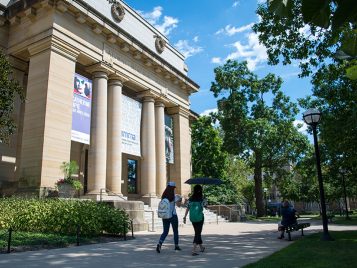



Reading the Michigan Daily in early 1949, Margaret Brewer (A.B. 1952) paused before turning the page.
“Gal Marines To Try for Commissions”
The sophomore had a soft spot for the Marines. As a high school student, she had the opportunity to meet several Marines who raised the American flag at Iwo Jima in 1945.
Now the Marine Corps, for the first time in its peacetime history, was offering college women either a regular or reserve commission after completing an officer training program over two summers. Brewer signed up. She would train at Quantico, Virginia, between her sophomore and junior years and again before her senior year. She planned to complete her bachelor’s degree in geography, receive her commission as a second lieutenant, serve three years as a reservist, and then move on to a master’s degree in conservation.
Instead, the young woman whose career choice was influenced by a headline would begin making headlines herself.
In her pioneering 28-year career, Brewer became the Marines’ first woman general when she was appointed brigadier general in 1978. (She always remembered the details of President Jimmy Carter nominating her: “Thursday, the sixth of April about 10:00 in the morning,” she later wrote.)
While women had served as Marine reservists during World War II, they did not receive regular military status until 1948. Brewer served in an era when females in the Corps were always known as Women Marines. Her duties primarily involved supervising all-women companies, including being commander of the Woman Officer School and director of Women Marines.

In 1973, she shepherded a major report calling for the Marines to end policies that kept women out of certain roles, such as military police and aircraft maintenance, because of their gender. The report also called for assigning women to the Marines’ combat force, the Fleet Marine Force (but not to the point of being in combat).
It was a bold step that Brewer, in an oral history interview for the Marine Corps Historical Center, recalled discussing with the commandant of the Corps, General Robert E. Cushman Jr.
“I said, ‘Well, general, this is just a pilot program and if it doesn’t work we can always discontinue it and not assign any more women to these units.’
“He looked at me and smiled and he said, ‘Margaret, you know as well as I do that once we establish this pilot program there will be no turning back.’ And, of course, he was right, and I knew that he was.”
Cushman signed off on all the recommendations, scribbling, “O.K.—let’s move out!” Women in the Corps became MPs, welders, mechanics, combat engineers, and truck drivers.
The deeper integration of women saw Brewer as the last director of Women Marines. Women became simply “Marines.”
After retiring in 1980, Brewer said she never felt discriminated against as a woman. “But, at the same time,” she added, “I felt that there were more opportunities that were out there that should be open to women.”
Illustration by Carly Parker


Look to Michigan for the foundational knowledge and experience to ignite purposeful change.
LSA is the place where creative thinkers engage with a complex, diverse, and changing world. See how your support can make an impact on what’s next, for a better tomorrow. Learn more.
