


Bee Hotels, Lab Swap Shop, Pollinator Gardens, and More: LSA’s Focus on Sustainability Brings Positive Results to Campus and Beyond
What do bee hotels, a lab swap shop, pollinator gardens, and water refill stations have in common? They are examples of the nearly 20 creative and impactful ideas submitted by LSA students, faculty, and staff as part of the Year of Sustainability in 2024. These projects shared in $100,000 in grant funds from the LSA Sustainability Office. In just a year, the ideas have turned into action and are multiplying the college’s return on investment and creating positive results on campus and beyond.
As the largest and most academically diverse college at the University of Michigan, LSA is in a unique position to drive sustainability on campus, resulting in significant savings of water, energy, and dollars. For example, LSA’s moving and sustainability teams partner with the Office of Campus Sustainability and EHS to operate the Lab Swap Shop. This facility allows researchers to browse, shop for free supplies, and donate pre-owned laboratory supplies and equipment, while also supporting waste reduction. This redistribution effort has helped the college save nearly $1 million and diverted more than 18,000 pounds from landfills.
“This initiative has been helping our community further advance our efforts to make a more sustainable LSA,” said Professor Anne McNeil, inaugural LSA faculty sustainability advisor. “We are proud of and excited by all the ideas brought forward in 2024, and we continue to support new ideas through these funds in 2025 and beyond.”
The inaugural LSA sustainability projects stretch across the humanities, natural sciences, and social sciences, highlighting the powerful cross-team collaboration that makes LSA a national leader in liberal arts and sciences.
“It’s gratifying to see how engaged LSA students are in our sustainability efforts. In many cases, they are driving this important work,” said Rosario Ceballo, dean of the College of Literature, Science, and the Arts at the University of Michigan. “Their ideas, and those of our faculty and staff, are making a profound impact on energy and water conservation, reducing plastic waste, and protecting our natural environment. This kind of collaboration across the college is exactly what makes LSA so special, and highlights the value and significance of the liberal arts and sciences.”
The 2024 LSA Year of Sustainability projects included:
Unit: Biodiversity Lab
Project: Reuse to Reduce Single-Use Plastics
- Housed in the Department of Ecology and Evolutionary Biology, the Biodiversity Lab implemented a pipette tip washing station for EEB and teaching labs in the Program in Biology. This uniquely shared space also serves as a public exhibit in the U-M Museum of Natural History. Each single-use tip can now be reused up to 20 times. The Program in Biology lab courses use about 100 boxes per week (which is around 350,000 individual pipette tips for the full year). This machine has the potential to decrease the use of pipettes going to the landfill from 100 boxes per week to 100 boxes per year.
Unit: Earth and Environmental Sciences
Project: Service Donated Lab Equipment
- The LSA Lab Swap Shop has a robotic workstation for DNA and RNA extraction that is available for student researchers in the Department of Earth and Environmental Sciences lab course, and also more efficiently used consumables, reducing waste. The course is being designed as a low-barrier entry into research to prepare students for undergraduate research and senior thesis projects. The use of this workstation helps to increase student accessibility and promote collaboration among campus partners.
Unit: Chemistry
Project: Eliminating Water Waste for Condenser Cooling
- The Department of Chemistry is aiming to reduce its water waste and save energy costs by replacing single-pass water-cooled condensers with waterless condensers for drying solvents or running reactions. The initiative, which was led by graduate student Dylan Vitt, led the department to purchase 121 HeidolphTM Radelys Findenser Super Air Condensers for wet research and teaching labs. This installation is the largest of its kind in the nation and second largest in the world. The goal is to help reduce the chemistry department’s water waste by 6 percent and introduce new technology for students.
Unit: Earth and Environmental Sciences
Project: Lab Glass Washer
- The Geomicrobiology Lab is home to the Western Lake Erie Culture Collection. Launched in 2017, the lab focuses on the study and research of cyanobacterial harmful algal blooms (cHABs), through strains of microcytosis. This project has developed a lab glassware washer that will enable replacing disposable plastic consumables with glass alternatives, reducing greenhouse gas emissions and biohazardous waste, and in turn, promote hands-on learning for undergraduate researchers.
Unit: Earth and Environmental Sciences
Project: Wash and Reuse Pipette Tips
- Pipette tips are essential lab tools used to transfer small, accurate volumes of liquids. The challenge is they are for single-use and lack reusable alternatives. The idea is to create a TipNovus Mini, or a pipette tip washer machine, to reduce laboratory waste. This machine was adopted by the Centers for Disease Control and Prevention (CDC) and the National Institutes of Health (NIH) and has already proven to be an effective way to reduce laboratory waste. This project will save more than 23,000 pipette tips weekly from landfills, lower greenhouse gas emissions, and educate the community on laboratory sustainability by allowing researchers to test its effectiveness.
Unit: U-M Museum of Natural History—Biodiversity Lab
Project: Reducing Plastic Waste
- As a shared facility, the Biodiversity Lab serves more than 60 researchers in the Department of Ecology and Evolutionary Biology. The lab’s project has replaced plastic homogenization tubes with reusable stainless steel ones for DNA extraction, with the goal of reducing environmental impacts and breaking DNA better and faster. The lab also aims to raise awareness about sustainability in LSA laboratories, as it serves as a public exhibit at the U-M Museum of Natural History.
Unit: U-M Museum of Natural History—Investigative Labs
Project: Ultrasonic Bath
- Housed in the U-M Museum of Natural History, the Investigative Labs is one of two hands-on learning labs in the museum. Their initiative aims to educate staff and the public about the use of the lab’s ultrasonic cleaner, which uses high-frequency soundwaves to agitate liquids to clean products. The goal is to improve the museum’s ability to clean and reuse lab materials that are typically disposable to reduce waste.
Unit: LSA Lab Safety
Project: Sustainable Lab Summit
- In the spirit of spreading awareness and encouraging collaboration, the Office of Campus Sustainability in partnership with LSA Lab Safety and numerous on-campus units, hosted the inaugural Sustainable Lab Summit in February 2025. The summit featured various workshops, breakout sessions, table vendors, and a keynote speaker focused on sustainability opportunities in research. Topics included water and energy conservation, lab safety, space optimization, environmental justice, and more. The summit included an award presentation for researchers and research groups who have gone above and beyond to incorporate sustainability in their work or lab practices.
Unit: Clean Up Campus
Project: Student Org Pilot Funds
- The LSA Sustainability Office granted funds to support Clean Up Campus, a student-led organization dedicated to raising awareness about preserving natural areas. The group accomplishes this through clean-ups, regular volunteering, and educational outreach with local schools. The funding went toward advancing their various projects and initiatives, including weekly workdays, where they restore and maintain public areas throughout Ann Arbor through trash pick-ups, waste prevention establishments, and collaborations.
Unit: LSA Student Government (Trees)
Project: Pollinator Patch
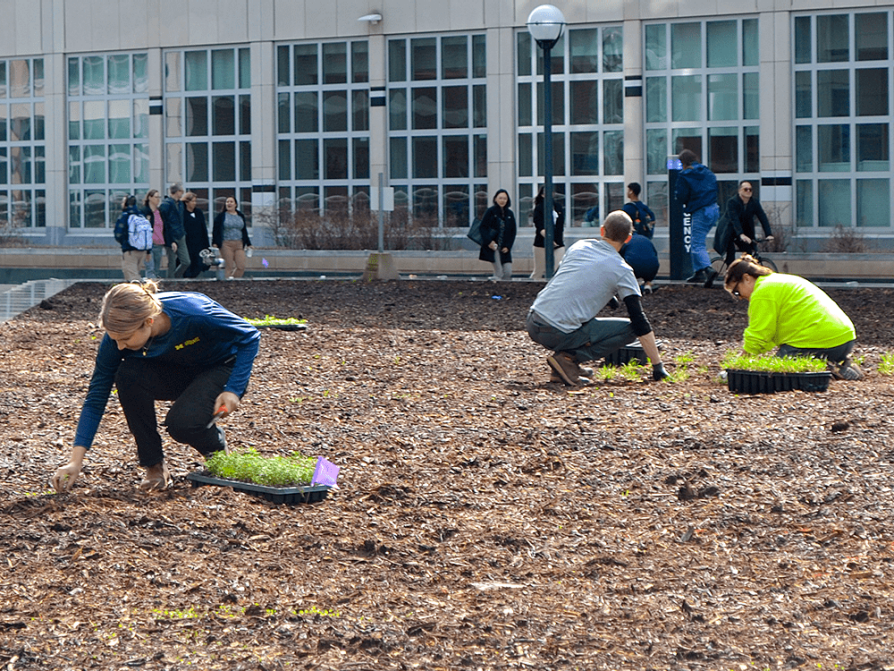
- The Taking Responsibility for the Earth and Environment Subcommittee (TREES) in LSA Student Government installed a native plant pollinator garden between the Power Center and the Undergraduate Science Building on Central Campus. This patch provides food and shelter for birds and insects to advance local biodiversity, education, and hands-on opportunities for student learning.
Unit: LSA@Play
Project: Portable Water Refill Station
- In an effort to reduce plastic bottle waste and increase awareness of resource use, LSA@Play purchased two Water Bars, portable water stations that don’t require electricity and eliminate the need for plastic water bottles. As the college’s hub for event planning, LSA@Play attracts anywhere from 200-1,000 attendees for various events. Through this initiative, the stations divert up to two dozen pounds of plastic waste at each event.
Unit: U-M Sustainable Food Program
Project: Rooting for Change
- Food sustainability is one of the biggest issues across the nation and globally. In partnership with Student Life Sustainability, Rooting for Change brought together U-M students who are committed to sustainability in food systems on a local, regional, and global level. Intersecting art, health, and science, the summit included workshops, a panel discussion, and a collaborative environment for students to learn, share their knowledge, and connect with other like-minded individuals.
Unit: Sustainable Living Experience
Project: Flower Farm and Pollinator Garden
- The Michigan Sustainability Community is a student living-learning community at U-M whose latest initiative included the creation of a flower farm and pollinator habitat at Oxford Housing Grounds. Combining experiential learning and educational outreach on campus, the flower farm aims to involve students in sustainable agriculture while supplying flowers for campus beautification, targeting 70 percent native species by 2028 at Oxford Houses. Students supplied flowers for all of the Climate Week 2025 keynote events.
Unit: U-M Aquaponics
Project: Student Org Pilot Funds
- The LSA Sustainability Office granted funding to support the Michigan Aquaponics Club, a student-led organization, and its new initiative to pilot an innovative aquaponics system in research space at the Matthaei Botanical Gardens. The goal is to explore sustainable integration of fish, plants, and insects within an ecosystem. By integrating hands-on learning and education beyond the classroom, their goal is to enhance practical skills and establish potential partnerships with aquaculture businesses.
Unit: Anthropology
Project: Sustainable Life: Practice, Values, and Culture
- The Department of Anthropology’s annual symposium had a theme of “Sustainable Life: Practice, Values, and Culture” in 2024. The event featured anthropologists as guest speakers, representing the four subfields of anthropology: archaeology, linguistic, sociocultural, and biological or evolutionary anthropology. The goal of the symposium was to share the latest anthropological research on sustainability, foster conversation around sustainability, and encourage new sustainability-centric research projects for U-M students.
Unit: Lloyd Scholars for Writing and the Arts
Project: Sustainable Speakers Series
- Last fall, the Lloyd Scholars for Writing and the Arts (LSWA) hosted a sustainability creativity speaker series. The series featured three artists from academia and the corporate world, and discussions and workshops that focused on how the arts can make a positive contribution to sustainability. U-M students were able to connect with alumni and create art and writing projects, engaging their minds and expertise.
Unit: Nature Rx
Project: Nature for Wellness Symposium
- The University of Michigan’s Nature Rx initiative hosted the Nature for Wellness Symposium in 2024, a forum centered on the healing capabilities of nature through research, teaching, technical assistance, and cross-collaboration across campus. The event featured students, faculty, and staff, with the goal of promoting mental health and well-being.
Unit: U-M Museum of Natural History
Project: Marquee Display
- Combining creativity and science, the U-M Museum of Natural History set up a large-scale display to pay homage to a Cretaceous Period diorama by George Marchand that was previously featured in the Ruthven Building. Using repurposed materials such as carpet tiles, ceiling tiles, and hand sanitizer stands, the display signifies the ways sustainability can be incorporated into art and history.
Unit: U-M Museum of Natural History
Project: A Better Bee Hotel
- The U-M Museum of Natural History’s “insect hotel” provides a safe place for solitary bees to nest and overwinter, contributing to the university’s “Bee Campus” certification from the Xerces Society. Grant funding allowed for major renovations to better support bee guests. The project replaced existing materials with new, bee-friendly materials such as reusable trays and updated “rooms” that are sized appropriately for Michigan’s native bees. With the remodel of the bee hotel, the goal is to encourage more pollinators to live on campus and support the nearby flower gardens.
Learn more about supporting LSA Sustainability.


Look to Michigan for the foundational knowledge and experience to ignite purposeful change.
LSA is the place where creative thinkers engage with a complex, diverse, and changing world. See how your support can make an impact on what’s next, for a better tomorrow. Learn more.
