



Beth Lane (A.B. 1985) recalls the precise moment when she knew she had to make a documentary about her mother, aunts, and uncle, and how the seven siblings survived the Holocaust, journeyed to the United States, and started their lives anew.
It was 2017, and Lane was standing in the village of Worin, Germany, at the site of a fruit orchard where the seven Weber siblings were hidden when they were children. She spoke with the grandson of the couple who hid them, Arthur and Paula Schmidt, near the tiny laundry house where the siblings slept between 1943 and 1945.
“He told me, ‘I never met my grandfather. I never knew the story until I got the letter from Yad Vashem [The World Holocaust Remembrance Center in Jerusalem] asking me, as next of kin, to receive the honor on his behalf posthumously.’ The grandson, also named Arthur, said he’s quite sure that even his own father never knew the story, either. The Schmidts truly took this story to their graves,” Lane recalls. “So, when Arthur told me that, I said: ‘I will make a film. I will not stop until it’s done.’”
Lane, who earned her degree from LSA in English language and literature, was an accomplished actress, singer, and dancer, so the world of filmmaking was not entirely foreign to her. She had not written and directed a movie, however. At the time, she was enrolled at UCLA in pursuit of her Master of Fine Arts in theater, a journey she took on while her three sons attended the University of Michigan (Joshua Moody, B.S.E. in aerospace engineering with a physics minor, ’17; Oliver Moody, A.B. ’18 in communications and media; and Sebastian Moody, A.B. ’18 in political science).
“It was in between my second and third year of graduate studies, and the timing was perfect. I had a lot more free time for electives, and I selected a documentary film and production class,” recalls Lane, the founder of the Weber Family Arts Foundation. “You know the universe wants you to do something when it just lines up like that.”

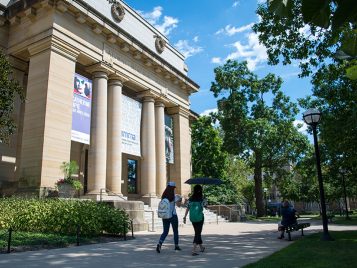
She describes what happened next as a “very Michigan story. We were always taught to be victors valiant, yes?” she says. “My memories at Michigan were filled with fears to conquer—I was a transfer, and I came to Ann Arbor in the middle of my sophomore year, never having seen the campus. I studied literature, in addition to music, dance and theatre, performed on stages like the Power Center and the Mendelssohn Theatre.”
She also took an ethnographic film class at U-M at a time when she “had no idea what a documentary film was. That class gave me the chutzpah to walk into my professor’s office at UCLA and ask to be enrolled in her 30-week class,” she recalls. “I said, ‘I know I’m a theater kid, but I have to make a movie, and I have to direct it, and I’ve never directed a film before. Can you help me get ready? I have my first principal photography shoot in March at Yad Vashem! And she said, ‘Come on in,’ and it really got me ready.”
Indeed, it did. Over the next several years, she filmed on location at various sites in Germany, Israel, and with the surviving Weber siblings in the United States. What resulted was a feature-length documentary called UnBroken, which chronicles Lane’s mother’s life in Nazi Germany along with her six siblings, how they were hidden by a neighbor for two years, and what their lives were like when they moved to the U.S.
The film has earned widespread recognition, including the recent inaugural recipient of the Lichtbrücke Prize for Human Rights in Film in Tutzing, Germany, and several prizes at film festivals, including Best Documentary Feature Premiere at The Heartland International Film Festival. When it premiered on Netflix in 2025, it ranked number five in the U.S. within 24 hours. “The morning we learned of our ranking, I was in an airport lounge on my way to another festival, and I screamed," Lane recalls. "The guy next to me was like, ‘Are you OK?’ I told him, ‘Yeah, I’m really, really good.’”
Two Years in Hiding
The Weber family was at risk from the moment Hitler came to power. Their siblings’ father, Alexander, was in and out of concentration camps and prisons and subjected to police surveillance as early as 1933. Their mother, Lina Banda Weber, was part of the resistance movement and was captured by the Gestapo for her efforts to help other Jewish people escape from Berlin. She was sent to Auschwitz.
In 1943, all of the Weber children were arrested as well and Alexander learned they would soon be sent to Auschwitz. The family lived in a Berlin apartment atop a cellar that stored the fruit and vegetable crates owned by a farmer named Arthur Schmidt. He and his wife, Paula, heard that the children were going to be taken to the infamous camp, where more than a million people were murdered during World War II. Somehow, Arthur Schmidt secured the children’s release, put them on the back of his truck and hid them under a tarp. In the dark of night, he drove them to his orchard 60 kilometers away in Worin.
“If it wasn’t for Schmidt, I don’t know where we would’ve wound up,” Lane’s Aunt Ruth says in UnBroken.
While they were in hiding, the children’s father stayed in Berlin. He worked and was able to sneak food to them at times. In 1944, he learned that Lina, his wife and the mother of the seven siblings, died at Auschwitz. The youngest of the children, then known as Bela, was just three years old at the time.
Bela and her siblings—Alfons, Senta, Ruth, Gertrude, Judith, and Renee—lived on the Schmidts’ farm. They picked fruits and vegetables to stay alive and tried to remain inconspicuous.
The movie documents how the children fought through hunger, loneliness, rape, bombings, and ever-present fear. Lane’s mother recalls digging for potatoes in the fields. The children stayed hidden in the remote farm, with only the Schmidts and Rudolf Fehrmann, the mayor of Worin, aware of their identity. In UnBroken, when Lane went to film in Worin and install some plaques of gratitude for the town, the historians surprised her again with another descendant of a silent hero—this time Lane meets Fehrmann’s grandson—and hugs him.
“Had they been discovered, they would’ve surely been killed,” Lane’s mother, Ginger (who was named Bela at birth) says of Fehrmann and the Schmidts in the movie.
After the war, the seven Weber children went to the Joint Distribution Committee, which was providing support to Jewish survivors in Germany. Lane says they were told that they must pretend their father was dead and pretend to be orphans in order to get to the United States. They did, under the assumption that he would follow in a couple of weeks.
“When we left my father, he said, ‘Ruth, keep all of you together no matter what happens. You do not separate.’ And that stuck with me,” Lane’s Aunt Ruth says in UnBroken.
Nothing would go according to plan. Instead of a couple of weeks, Alexander Weber could not get to the United States to reunite with his children for 10 years. Bela was adopted by a Jewish family, and the seven Webers would not all be together again for 40 years.

When Faced with Adversity
This article is just a snapshot of the lives of Lane, her mother, and her uncle and aunts. UnBroken is a more complete photo album, with its narration from Lane and excerpts of Alfons’s writings. It includes more information about why Lane’s mother didn’t see her siblings again until 1986, the surprise Lane found about her mother during her research, and further details about how they all survived to get to the United States in the first place.
Early in the film, a voiceover pulled from Alfons’s writings says, “There are no rational explanations for miracles. But here we are.”
Here we are. Alfons and Senta had passed away when Lane began making the movie, but she was able to interview other aunts and her mother. Today, only Ginger Lane and her sister Judith survive.
Yet that is not the end of the story. The film is the gift that keeps on giving, Lane says.
Even though UnBroken is widely accessible to stream, museums, schools and houses of worship continue to book the film for live audiences. Lane partnered with Journeys in Film to create a learning guide, descendants of Lina’s siblings came to a private screening at the Museum of Jewish Heritage in New York to celebrate the 80th anniversary of the Weber siblings coming to America, and much more.
Lane is especially touched by the comment that her son Oliver makes in the movie: “When you’re faced with adversity, who do you become?”
For Lane, that sentiment has become a guidepost for her life.
“Hopefully, most people leave with a sense of hope, with a sense of empathy and compassion, and with a sense of ‘I gotta be a good neighbor, ’” she says. “For me, I know I can be a better neighbor. Maybe I can’t hide seven people, but we can all be a little more like the Schmidts.”
Top image: Beth Lane and her mother, Ginger, during filming. All images courtesy of Beth Lane.


Look to Michigan for the foundational knowledge and experience to ignite purposeful change.
LSA is the place where creative thinkers engage with a complex, diverse, and changing world. See how your support can make an impact on what’s next, for a better tomorrow. Learn more.
