
The Department of Astronomy 2025-2026 Colloquium Series Presents:
Dr. Erik Peterson & Dr. Nicholas Kern Post Doc Colloquium
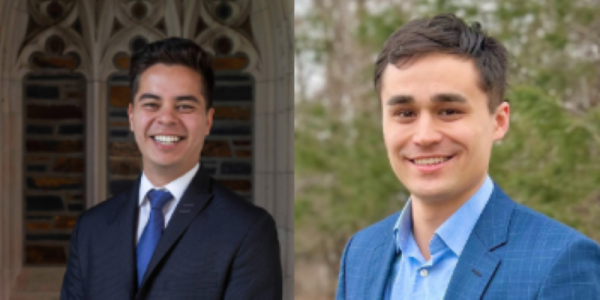
Erik’s Title: Addressing Type Ia Supernova Systematics in the Era of Precision Cosmology
Abstract: Various cosmological parameters such as H0 and S8 measured using Type Ia Supernovae (SNe Ia) have been shown to be in tension with measurements from the early universe. I look to improve cosmological parameter measurements and test the limits of SNe Ia by focusing on some of the top systematics for SN Ia cosmology: (i) intrinsic scatter, by leveraging the near-infrared (NIR) and (ii) peculiar velocities, by leveraging galaxy groups. With the DEHVILS sample, one of the largest uniform NIR samples of SN Ia light curves, I take advantage of the fact that NIR light is less affected by dust to better characterize intrinsic scatter. Using the low-redshift sample from Pantheon+ combined with a pilot program using the AAT spectrograph, I demonstrate the benefits for averaging the redshifts of galaxy groups to correct for peculiar velocities and motivate a future full scale analysis using redshifts from DESI as well as 4MOST. With the impending arrival of both the Rubin Observatory’s Legacy Survey of Space and Time, which we show will greatly benefit from accounting for peculiar velocities, and the Roman Space Telescope, which will observe in the NIR and need a well understood low-redshift anchor SN sample, we encourage an increased effort to define more galaxy groups and further analysis on SNe Ia in the NIR.
Nicholas’s Title: Mapping the high redshift universe with HI: towards a more complete picture of Cosmic Dawn
Abstract: Next-generation radio telescopes promise to revolutionize our understanding of early structure formation by using the 21cm line from neutral hydrogen as a tomographic tracer. In particular, they have the potential to probe deep into the Epoch of Reionization and Cosmic Dawn, constraining the radiative processes of the first stars and galaxies. In this talk, I'll present an overview of 21cm cosmology and discuss recent results from 21cm radio telescopes in constraining the astrophysics of Cosmic Dawn, and will discuss near-term opportunities ahead of us as next-gen, multi-wavelength telescopes aim to paint a more complete picture of Cosmic Dawn.
Abstract: Various cosmological parameters such as H0 and S8 measured using Type Ia Supernovae (SNe Ia) have been shown to be in tension with measurements from the early universe. I look to improve cosmological parameter measurements and test the limits of SNe Ia by focusing on some of the top systematics for SN Ia cosmology: (i) intrinsic scatter, by leveraging the near-infrared (NIR) and (ii) peculiar velocities, by leveraging galaxy groups. With the DEHVILS sample, one of the largest uniform NIR samples of SN Ia light curves, I take advantage of the fact that NIR light is less affected by dust to better characterize intrinsic scatter. Using the low-redshift sample from Pantheon+ combined with a pilot program using the AAT spectrograph, I demonstrate the benefits for averaging the redshifts of galaxy groups to correct for peculiar velocities and motivate a future full scale analysis using redshifts from DESI as well as 4MOST. With the impending arrival of both the Rubin Observatory’s Legacy Survey of Space and Time, which we show will greatly benefit from accounting for peculiar velocities, and the Roman Space Telescope, which will observe in the NIR and need a well understood low-redshift anchor SN sample, we encourage an increased effort to define more galaxy groups and further analysis on SNe Ia in the NIR.
Nicholas’s Title: Mapping the high redshift universe with HI: towards a more complete picture of Cosmic Dawn
Abstract: Next-generation radio telescopes promise to revolutionize our understanding of early structure formation by using the 21cm line from neutral hydrogen as a tomographic tracer. In particular, they have the potential to probe deep into the Epoch of Reionization and Cosmic Dawn, constraining the radiative processes of the first stars and galaxies. In this talk, I'll present an overview of 21cm cosmology and discuss recent results from 21cm radio telescopes in constraining the astrophysics of Cosmic Dawn, and will discuss near-term opportunities ahead of us as next-gen, multi-wavelength telescopes aim to paint a more complete picture of Cosmic Dawn.
| Building: | West Hall |
|---|---|
| Website: | |
| Event Type: | Lecture / Discussion |
| Tags: | astronomy, astrophysics |
| Source: | Happening @ Michigan from Department of Astronomy, Department of Physics |
Events
Featured
Mar
11
2026 Ford Motor Company Distinguished Lecture in Physics | Organic Semiconductors – From OLED displays to new applications
Richard Friend, Professor of Physics (Cavendish Laboratory, University of Cambridge)
4:00 PM
Amphitheater, 4th Floor, Rackham Building
Rackham Graduate School (Horace H.)
Upcoming
Jan
29
Quantum Research Institute | Quantum computers and their potential to enable scientific discovery
Bert de Jong (Lawrence Berkeley National Laboratory)
11:00 AM
PML2000
Virtual
Jan
29
The Foundations of Modern Physics (FOMP) | Can a scientific field survive on pursuit-worthiness alone?
Richard Dawid (Stockholm University)
1:00 PM
2271
Angell Hall
Jan
29
The Department of Astronomy 2025-2026 Colloquium Series Presents:
Dr. Erik Peterson & Dr. Nicholas Kern Post Doc Colloquium
3:30 PM
411
West Hall
