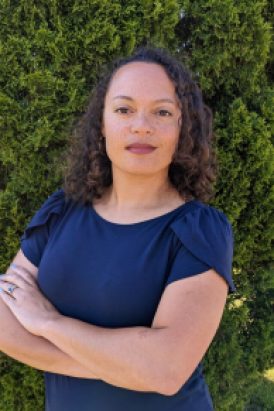
Assistant Professor of Comparative Literature; Assistant Professor in the Residential College, Co-Director of Graduate Studies: Graduate Student Advisor
she/her/hers
About
Personal website: reneeraginrandall.com
Languages: English, Spanish, French, Arabic
Affiliations: Center for Middle East and North Africa Studies, Program in International and Comparative Studies
______
Research interests: I am finishing a monograph entitled The Accident of Atrocity: Narratives of Surviving Dispossession from Modern Lebanon and have begun a second project on spirituality in speculative fiction in the Global South.
Publications:
- "Words Stuck in the Throat, Truths That Will Not Be Told,” Routledge Literary Studies in Social Justice: Reading Violence and Trauma in Asia in the World (2024)
- “Art, Archive and Fictive Historiography in Lebanon's 'Protracted Now'” (Cultural Critique, 2023)
- "Lebanon in Devil's Waters: Possession and Madness in Ghada al-Samman's Civil War Trilogy" (Middle Eastern Literatures, 2023)
- “No Guilt, No Shame: Discerning Signs of Post-Conflict Moral Injury in Atmospheres of Political Impunity,” Journal for Veterans Studies, 6.1 (April 2020)
- “Contemporary Epistemologies of Militarization in the Global South: Palimpsests and accumulative processes in Lampedusa and Lebanon,” Special Issue of Cultural Dynamics, 31.4 (September 2019)
______
Teaching interests: My primary teaching interests fall into two categories. The first is world literature: how has it been, and how is it being (re)defined? What role does the literary prize economy play in shaping ideas of world literature today? How does the translation and circulation of literature happen differently in--and within--the Global South? I am particularly interested in genres of speculative fiction across the Global South, especially those which draw upon mythology, mysticism, religion and other forms of spirituality. A new interest of mine (because we are always learning, aren't we?): global performance studies!
The second category is trauma and memory studies; in addition to foundational and evolving theories of trauma (and healing), my courses ask students to think about how knowledge of trauma is produced in the first place. Can we derive a theory of trauma from its textual representation? How can classical trauma theory avoid the pitfall of refracting other cultural contexts through its own lens? And how do individual, collective, cultural and generational memories shape identity and belonging within national, transnational and diasporic contexts?
Recent courses:
- “Adapting World Literatures” (CL323) Why, and how, are literary works adapted to produce new meanings, across different periods and cultures? How does the genre and medium of adaptation (e.g. theatre/film/TV, visual arts, graphic novel, video games) influence these meanings? Is there ever truly an "original" text? Upper Level Writing Requirement, with option to produce an adaptation as a final project.
- “Global Narratives of Trauma” (CL300) How is the experience of psychological trauma expressed in narrative forms? How (and why) have Western European and US theories of trauma become “global”? This course helps student develop a comparative approach to thinking through trauma, the forces that cause it, its representations, and the structures that mediate them.
- "Writing Madness" (CL720) How do notions and representations of madness appear on the page? In what way do genres of writing influence the shape and voice of madness? For graduate students only.