
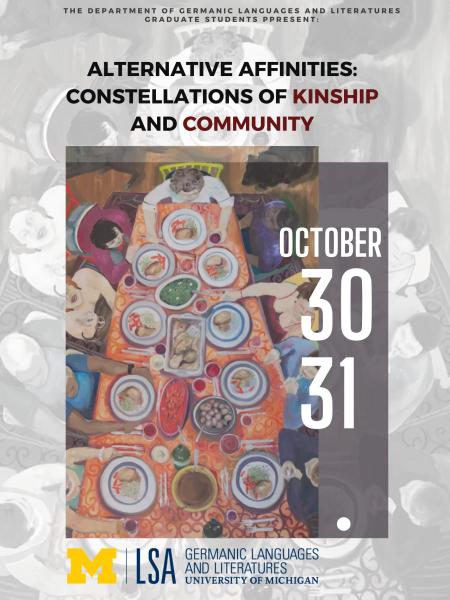
The Kleinfamilie, or “nuclear family,” endures as a core structure that helps to define human relations. With roots in the eighteenth century, the Kleinfamilie provided a social and economic foundation for the rise of the modern nation state. However, the heterogeneous and multidimensional ways individuals and communities connect with one another today require a broader focus. A more fluid and encompassing term, “kinship,” offers a way of seeing and describing those ties that extend beyond the nuclear family and are by nature shifting and
temporary.
Using kinship as a framework, Heidi Schlipphacke’s book The Aesthetics of Kinship: Form and Family in the Long Eighteenth Century (Bucknell University Press, 2023) reexamines 18th-century German novels and dramas to uncover alternative affinities that are hidden when exclusively considered through the walled-off Kleinfamilie. Sclipphacke’s investigation belongs to a larger body of recent scholarly work seeking to reconceive of repurpose the term “kinship.” For example, Jennifer Evans’s The Queer Art of History: Queer Kinship after Fascism (Duke University Press, 2023) deploys kinship as an analytic category to demonstrate how queer and trans people in postwar and contemporary Germany navigated citizenship, love, and public and family life. A broader investigation into kinship, Adele E. Clarke’s and Donna Harraway’s edited volume
Making Kin Not Population: Reconceiving Generations (The University of Chicago Press, 2018) contemplates questions of reproductive and environmental justice to
consider how we establish personal and public connections today. Building on recent interventions like these, this conference will approach kinship as an interdisciplinary tool for exploring relational networks and the formation of personal and collective identity within–and in opposition to–“Western,” modern, white, heterosexual, and even anthropocentric norms.
PROGRAM:
Friday, October 30th
Palmer Commons, Great Lakes North
3:00 pm
Keynote: Heidi Schlipphacke
Title: Kinship in Space and Time
4:30 pm
Coffee and Tea Break
4:45 pm: Panel 1: Loss, Fracture, and Memory
● Henrique Carvalho Pereira, Der andere Fehl
● Emma Stratman, Wer über die Märchen lacht, war nie in Not: On Obstinacy and the
Fairytale in the Work of Alexander Kluge
● Nathan Bailey, Seismic Epiphanies: Utopian Modes of Caring and Nursing in Heinrich
von Kleist‘s Das Erdbeben in Chili
Respondent: Ella Wilhelm
Saturday, October 31st
Palmer Commons, Great Lakes North
8:00 am
Breakfast
8:45 am: Panel 2: Nation and Empire
● Hannah Edwards, Kinship and Kingship: Heraklean Affinities and Diplomacy in Ancient
Macedonia
● Sam Farmer, Partisan Places and Anti-Fascism in the (Post-)Yugoslav Family on Film
● Deborah Pomeranz, The Klein-Familie on Wheels: Race, Genre, and Kinship in Turn of
the Century Popular Performance (Deborah Pomeranz)
● Ibrahim Adissa Owoo, Orphans of the Empire: Colonial Kinship and Diasporic Belonging
in La Saison de l’ombre of Léonora Miano
Respondent: Kristin Dickinson
10:15 am: Coffee and Tea Break
10:30 am: Panel 3: Female Kinship
● Tamar Gutfeld, Daughters of 1930: Authority, Crisis and Kinship in Gilgi eine von uns
(Keun, 1931) and Kuhle Wampe (Dudow and Brecht, 1932)
● Mathilda Trausch, Flying Witches: Gossip and Alternative Female Kinship in Helma
Sanders Brahms’ Deutschland, bleiche Mutter (1980)
● Maria Zahner, Mothers and Daughters in the Holocaust: reading Ruth Klüger and
Cordelia Edvardson
Respondent: Kerstin Barndt
12:00 pm: Lunch
1:00 pm: Panel 4: Kinship in 20th Century Literature
● Kehinde Sowunmi, Witnessing the Wall: Narrative Kinship and the Implicated Reader in
Marlen Haushofer’s Die Wand
● Ruth Ireti Falaiye, Kinship and Transatlantic Friendship in Kafka’s Das Urteil
● Olivia Gilbert, Lateral Affinities: Sibling Sociality in Robert Musil’s Man Without Qualities
(1930-1934)
Respondent: Johannes von Moltke
2:30: Closing Remarks
temporary.
Using kinship as a framework, Heidi Schlipphacke’s book The Aesthetics of Kinship: Form and Family in the Long Eighteenth Century (Bucknell University Press, 2023) reexamines 18th-century German novels and dramas to uncover alternative affinities that are hidden when exclusively considered through the walled-off Kleinfamilie. Sclipphacke’s investigation belongs to a larger body of recent scholarly work seeking to reconceive of repurpose the term “kinship.” For example, Jennifer Evans’s The Queer Art of History: Queer Kinship after Fascism (Duke University Press, 2023) deploys kinship as an analytic category to demonstrate how queer and trans people in postwar and contemporary Germany navigated citizenship, love, and public and family life. A broader investigation into kinship, Adele E. Clarke’s and Donna Harraway’s edited volume
Making Kin Not Population: Reconceiving Generations (The University of Chicago Press, 2018) contemplates questions of reproductive and environmental justice to
consider how we establish personal and public connections today. Building on recent interventions like these, this conference will approach kinship as an interdisciplinary tool for exploring relational networks and the formation of personal and collective identity within–and in opposition to–“Western,” modern, white, heterosexual, and even anthropocentric norms.
PROGRAM:
Friday, October 30th
Palmer Commons, Great Lakes North
3:00 pm
Keynote: Heidi Schlipphacke
Title: Kinship in Space and Time
4:30 pm
Coffee and Tea Break
4:45 pm: Panel 1: Loss, Fracture, and Memory
● Henrique Carvalho Pereira, Der andere Fehl
● Emma Stratman, Wer über die Märchen lacht, war nie in Not: On Obstinacy and the
Fairytale in the Work of Alexander Kluge
● Nathan Bailey, Seismic Epiphanies: Utopian Modes of Caring and Nursing in Heinrich
von Kleist‘s Das Erdbeben in Chili
Respondent: Ella Wilhelm
Saturday, October 31st
Palmer Commons, Great Lakes North
8:00 am
Breakfast
8:45 am: Panel 2: Nation and Empire
● Hannah Edwards, Kinship and Kingship: Heraklean Affinities and Diplomacy in Ancient
Macedonia
● Sam Farmer, Partisan Places and Anti-Fascism in the (Post-)Yugoslav Family on Film
● Deborah Pomeranz, The Klein-Familie on Wheels: Race, Genre, and Kinship in Turn of
the Century Popular Performance (Deborah Pomeranz)
● Ibrahim Adissa Owoo, Orphans of the Empire: Colonial Kinship and Diasporic Belonging
in La Saison de l’ombre of Léonora Miano
Respondent: Kristin Dickinson
10:15 am: Coffee and Tea Break
10:30 am: Panel 3: Female Kinship
● Tamar Gutfeld, Daughters of 1930: Authority, Crisis and Kinship in Gilgi eine von uns
(Keun, 1931) and Kuhle Wampe (Dudow and Brecht, 1932)
● Mathilda Trausch, Flying Witches: Gossip and Alternative Female Kinship in Helma
Sanders Brahms’ Deutschland, bleiche Mutter (1980)
● Maria Zahner, Mothers and Daughters in the Holocaust: reading Ruth Klüger and
Cordelia Edvardson
Respondent: Kerstin Barndt
12:00 pm: Lunch
1:00 pm: Panel 4: Kinship in 20th Century Literature
● Kehinde Sowunmi, Witnessing the Wall: Narrative Kinship and the Implicated Reader in
Marlen Haushofer’s Die Wand
● Ruth Ireti Falaiye, Kinship and Transatlantic Friendship in Kafka’s Das Urteil
● Olivia Gilbert, Lateral Affinities: Sibling Sociality in Robert Musil’s Man Without Qualities
(1930-1934)
Respondent: Johannes von Moltke
2:30: Closing Remarks
| Building: | Palmer Commons |
|---|---|
| Website: | |
| Event Type: | Conference / Symposium |
| Tags: | Books, Conference, Ecology, European, European Studies, Free, German, German Studies, Germanic Languages And Literatures, Germany, global, Graduate, Graduate School, Graduate Students, Humanities, In Person, Interdisciplinary, International, Language, LGBT |
| Source: | Happening @ Michigan from Germanic Languages & Literatures, Classical Studies, Eisenberg Institute for Historical Studies, Department of History, Department of English Language and Literature, LSA Graduate Education, Alamanya: Transnational German Studies |
| Upcoming Dates: |
Saturday, October 31, 2026 8:15 AM-4:00 PM
(Last)
|
