The telling of United States history is an interminable task. Whose voices speak the loudest? Conversely, whose stories are buried in the archives? For history students Madeline Wise and Jewell Mason, and history alum Christopher Wilson (A.B. 1989), these questions form the backbone of their professional work.
Wilson is now the supervisory curator and chair of the Division of Home and Community Life at the Smithsonian’s National Museum of American History, but he began his college years believing that he would pursue a career in medicine. His mother was a scientist, and he went to U-M thinking about specializing in veterinary medicine. But when the time constraints of pre-med courses and the demands of the varsity track team began to conflict, he knew that he had to make a change. His advisors suggested exploring the humanities and social sciences—he performed well in his English and philosophy courses, so why not lean into those interests?


The summer after his first year, Wilson was looking for a temporary job. His father had always admired the work of the Henry Ford Museum in Dearborn, Michigan. At the time, the museum was working on expanding its outdoor history park known as Greenfield Village by creating Firestone Farm: a “living museum” that would show visitors what life was like on a Midwestern farm in the 1880s. Instead of bussing tables at a restaurant, Wilson landed a job operating the sawmill at the Henry Ford Museum.
“I had never really liked talking in public,” Wilson says. “But somehow I found this informal teaching platform, and when I was talking about the history of the sawmill, you couldn’t shut me up.”

Wilson continued working at the farm throughout his undergraduate career and then joined as a full-time employee after graduating from U-M in 1989. He spent 18 years at the Henry Ford Museum, rising to the position of experience developer. When the opportunity came to apply for a position at the Smithsonian in 2004, he jumped at the chance, hoping that his passions and qualifications would align. “I followed what I found joy in,” he reflects, “and that led me to have a varied set of experiences that then was pretty attractive for the Smithsonian.”
One of those experiences, which he took to Washington, D.C., was using the performing arts to interpret historical events. Educational theater, he found, was effective in teaching empathy. “We want to use theater for things it’s good at, like creating opportunities for emotional and experiential learning,” he says. Wilson cares deeply about public access to history—a mission he has passed on to history majors Madeline Wise and Jewell Mason.


Both Wise and Mason found their way to the Smithsonian thanks to their passion for American history. Mason, who was homeschooled before coming to LSA, had always loved history as a field of study. Wise, as a double major in history and psychology, was drawn to the heavy focus on research at a large national institution.
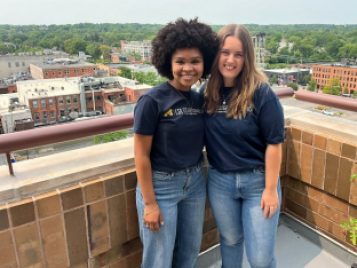
The two undergraduate students interned at the Smithsonian in the summer of 2025 and worked with Wilson on a variety of projects at the museum. Their magnum opus was a presentation about the Greensboro lunch counter, a site significant to the Civil Rights Movement in North Carolina. They set up a cart in the museum where they spoke with visitors about the experiences of the nonviolent protesters.
Part of the brief was to share just how collective activists became during the 1950s and ’60s. “It wasn’t an individual movement,” Wise explains. Community members in Greensboro took part in the six-month nonviolent protest at the Woolworth lunch counter—an object now on display at the Smithsonian. Mason and Wise had the opportunity to connect directly with tourists coming from different states as well as visitors from Europe and Australia.


“It was great to be able to share a part of our history with people of different cultures,” Mason reflects. “It was an impactful thing for them because they didn’t learn about it. And if you grew up in America, it’s something you take for granted.”
Mason’s experience at the Smithsonian has confirmed her passion for archival work; she intends to apply for a master’s in library and information studies after she graduates in 2026. Wise believes that the behind-the-scenes work that she and Mason accomplished has prepared her well for the rigors of law school.
And she knows that the work they produced will make a difference: “It was special,” she says, “to be able to create something that I’m proud of and directly responsible for.”


LSA is the place where creative thinkers engage with a complex, diverse, and changing world. See how your support can make an impact on what’s next, for a better tomorrow. Learn more.


Students learn to slow down in order to see clearly in an LSA history of art course.

LSA professors, students, and staff are finding innovative ways to impact science education’s environmental footprint. Where to begin? By looking at their own two feet.

Dean Ceballo writes that our world is changing rapidly, and new careers are emerging in the blink of an eye. LSA graduates will always be ready.

A bright future shouldn’t be limited by financial barriers. Donor support makes LSA scholarships possible—creating access while supporting tomorrow’s leaders, thinkers, and doers in their hopes to make a difference in the world.

| Release Date: | 05/19/2026 |
|---|---|
| Category: | Alumni; Research; Students |
| Tags: | LSA; History; LSA Magazine; Social Sciences; Internships; Stephanie Wong; Aimee Andrion |