Skip to Content

Search: {{$root.lsaSearchQuery.q}}, Page {{$root.page}}

Defining Gravity: 30 Years of Saturday Morning Physics


“University of Michigan Saturday Morning Physics, this is the International Space Station, how do you hear?”

Applause erupts from the lecture hall on Central Campus where roughly 650 people are packed in seats to watch astronaut and physicist Josh Cassada, broadcasting live from space. Hundreds more are tuning in remotely.

LSA Physics Professor Timothy Chupp greets Cassada on behalf of Saturday Morning Physics (SMP), the LSA program that coordinated every aspect of Cassada’s visit. Since its founding in 1995, SMP has grown into a popular public-facing program with the mission of engaging, entertaining, and educating the public about science and technology. Twelve times a year (six lectures per semester), hundreds of people show up in person and online to learn about wavelengths, vaccines, the science of dance, the physics of hockey, space exploration, and much more.

“I am so excited to be a part of this, as is everybody else up here on the International Space Station,” Cassada says, holding a microphone and floating in microgravity. “This is a really special opportunity for us, and I can’t thank you enough for making me a part of it.”


“University of Michigan Saturday Morning Physics, this is the International Space Station, how do you hear?” That was the greeting when astronaut and physicist Josh Cassada first made contact with SMP audiences in 2023.


Like most SMP talks, Cassada’s space visit was recorded and put on YouTube. The video has been watched more than 3,600 times since it aired in 2023. Not bad for a science-focused talk with “physics” in the name.

But that’s the magic of SMP: It’s not a lofty, dense lecture that only a handful of people can understand. The idea of the program, which celebrated its 30th anniversary last year, is to make science, and its impact in everyday life, applicable and interesting to a broad audience. “Physics impacts everything,” Chupp says, “and SMP is all about how science impacts everyday life.”


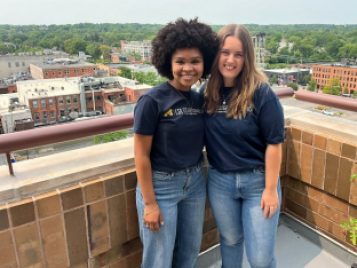
(Left) SMP appeals to the next generation of scientists with activities such as this stationary bicycle connected to a generator that powers a set of light bulbs. The orange ball is a large pendulum that was used to demonstrate the conservation of energy and the transformation of energy from potential to kinetic. (Right) Students Cyprus Gabriel-Menegay and Xinzhi Zhou explore an “accretion disk” demonstration: a rubber sheet model of spacetime.

The concept of SMP began at Fermilab, the particle accelerator and physics lab just west of Chicago. Physicist Leon Letterman started the program to give postdoctoral researchers the opportunity to present their research and engage the public.

Physicist Dante Amidei was at Fermilab and brought the concept to U-M when he became a professor in 1990. The U-M lectures began in October 1995 with postdoctoral researcher Robert Welsh speaking about brain MRIs and xenon, the noble gas.

“Five minutes before it started, people were packed out into the hallway,” recalls Chupp, who worked in the lab with Welsh at the time. “They had to delay the start because they didn’t want to turn anyone away.” They’d booked a lecture hall that held 40 people, “but more than 100 people showed up.”

The lecture was moved to a larger venue in the Dennison Building (now Weiser Hall), where it has remained. Over the decades the lectures have expanded beyond postdoctoral researchers to include faculty and scientists in a variety of fields and positions from all over the world. Chupp was there on the ground floor. “I was hooked from the start,” he says.

“It’s different from teaching physics. It’s great to teach scientists, but I prefer to teach classes that are out of the norm because of the public engagement. You’re making people feel like they’re learning something, making them laugh, entertaining them.”


Many of the staff and faculty who make SMP a success, from left to right: Monika Wood, Timothy McKay, Nicholas Arnold, Dante Amidei, Christine Aidala, Sean Reilly, Carol Rabuck, and Timothy Chupp.

Chupp is quick to note that he doesn’t do any of this alone. Key to the program’s success are Carol Rabuck and Monika Wood. The lab supports the SMP lectures by helping create and execute demonstrations that help audiences grasp what’s being taught.

“Some people don’t have a topic that lends itself naturally to a demonstration, but I try my hardest to find something that fits,” says Wood, who manages the Physics Lecture Demonstration Laboratory. “Like imagining that the fabric of space-time is a sheet of fabric. It’s not exact, but it’s an analogy that lets you say, ‘Oh, I can kind of see how that works.’”

Rabuck is the administrator for Saturday Morning Physics and a marketing communications specialist for the Department of Physics, and the behind-the-scenes maverick, coordinating countless SMP details.

Wood, Rabuck, Chupp, and many others go above and beyond to make SMP a success. For example, Wood’s lab is geared primarily toward supporting U-M classes and, last year, Wood and her two colleagues did 2,567 demos for 30 classes, not including SMP.

Wood also helped launch the virtual SMP physics programs during the COVID-19 pandemic. “When COVID hit, we didn’t want SMP to be a casualty,” she says. “The transition to live webcasts made sense because the world is moving in that direction. We want to evolve with our audience.”

Several videos have been viral successes: “The Many Worlds of Quantum Mechanics” with physicist Sean Carroll, professor at Johns Hopkins University and host of the Mindscape podcast, has more than 131,000 views; “The Physics of Complex Systems,” with Mark Newman, the Anatol Rapoport Distinguished University Professor of Physics in LSA, has 18,000 views; “The Truth about Entropy” with Sharon Glotzer from U-M’s Department of Chemical Engineering has 4,100 views.

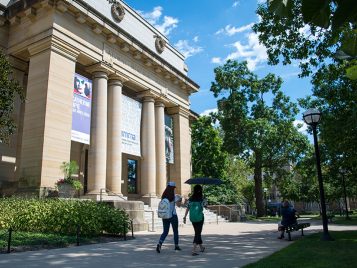
Saturday Morning Physics has evolved to a hybrid format in which they can reach a much larger audience online while still catering to attendees who can visit in person. At right, Monika Wood, who manages the Physics Lecture Demonstration Laboratory, demonstrates eddy-current braking.

There have been more than 400 lectures in SMP’s 30-year history. With an average attendance of 200 people per lecture, that’s a reach of around 80,000 people. Add in the YouTube views, and it’s an exceptional feat of science outreach.

But Chupp still has concerns about impact and wants to be doing more. “There is a huge effort to discredit science,” Chupp says, citing data from the National Science Board and the Pew Research Center that shows a decreasing number of people think that scientists act in the best interests of the public. When asked “Do you trust science?”, 20 percent of people said no.

“We shouldn’t go out and say, ‘trust us,’” Chupp says. “Instead, we should show what and how we do science and explain that it’s a human endeavor. Science is not perfect, but it’s also very rigorous and reproducible.”

That’s the heart of SMP’s work, but it’s work that requires investment. Each SMP lecture costs about $6,500. The Van Loo Family Endowment pays for the postdoctoral lectures each year. But the other talks—astronauts explaining space, award-winning physicists explaining dark matter, doctors explaining vaccines—are funded separately.

“From the start, there has been a dedicated effort among faculty, staff, and donors to make SMP happen and to make it more,” says Chupp. “There have been ideas to take it on the road or expand venues, but it’s not inexpensive, and we have to pay people to work on a Saturday.”

As the SMP team members strive to amplify its reach, they will continue the work of presenting lectures and fulfilling their mission to educate and entertain.


Astronaut Josh Cassada first visited SMP through a livestream from the International Space Station, then later followed it with an in-person appearance and talk. Photography by Erin Kirkland/Michigan Photography


In 2023, astronaut Josh Cassada came back to SMP for a lecture that was multigenerational, packed with school kids, and filled with fun. “We had a question from a three-year-old,” Chupp laughs. 

Coordinating with Cassada from the space station and for a second time was the most work Chupp had ever put into SMP, and the lecture remains one of his favorites because of its impact—particularly how the science excited kids and sparked curiosity. “It made me realize that any amount of energy and effort I put into SMP is worth it,” he says.


Photography by Amanda Mae Photography and courtesy of the Department of Physics unless otherwise noted.


Look to Michigan for the foundational knowledge and experience to ignite purposeful change. 

LSA is the place where creative thinkers engage with a complex, diverse, and changing world. See how your support can make an impact on what’s next, for a better tomorrow. Learn more.


More Stories from the Magazine

“It Was the Right Thing To Do”

Speaking truth to power is not always easy, but a visitor to an LSA class on the Civil Rights Movement tells students why standing up for what is right matters.


LSA to Med

LSA is a major feeder to top medical schools around the country, thanks to a liberal arts and sciences education that offers rigor, flexibility, and human connection.


Bananapocalypse?

One fruit rules the world—and its demise is destabilizing for growers and consumers around the globe.


Unlock life-changing opportunities

Look to Michigan.

A bright future shouldn’t be limited by financial barriers. Donor support makes LSA scholarships possible—creating access while supporting tomorrow’s leaders, thinkers, and doers in their hopes to make a difference in the world.

Email
Release Date: 05/19/2026
Tags: LSA