
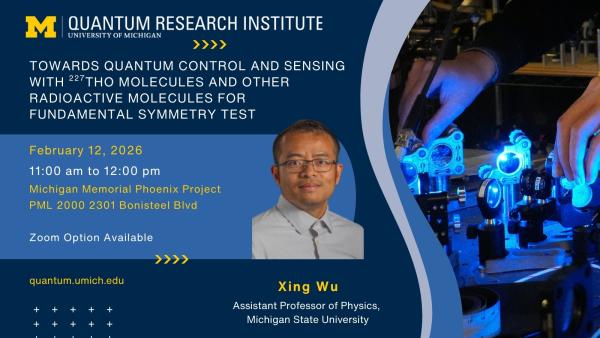
Quantum Research Institute | Towards Quantum Control and Sensing with 227ThO Molecules and Other Radioactive Molecules for Fundamental Symmetry Test
Xing Wu (Michigan State University)
Thursday, February 12, 2026
11:00 AM-12:00 PM
Virtual
In-Person: West Hall 411
Zoom: https://umich.zoom.us/j/99497477868?jst=2
Abstract:
The Standard Model of particle physics accurately describes all fundamental particles discovered so far. However, it is unable to address two great mysteries in physics, the nature of dark matter and why matter dominates over antimatter throughout the Universe. Novel theories beyond the Standard Model may explain these phenomena. These models predict very massive particles whose interactions violate time-reversal (T) symmetry and would give rise to an electric dipole moment (EDM) along the spin of electron and nucleon. Thus, searching for EDM provides a powerful probe to these new physics and sheds light on the mystery of the matter-antimatter asymmetry of the Universe.
This talk outlines the roadmap to establish a new generation EDM measurement at Michigan State that can outperform the current generation of precision measurements testing hadronic T-violations. We report our ongoing effort at Facility for Rare Isotope Beams (FRIB) to perform quantum control and sensing of 227ThO molecules and other radioactive molecules. These pave the way for quantum-enhanced test of fundamental symmetry, projecting to constrain T-violating new physics in 10~100 TeV energy range, exceeding what the Large Hadron Collider and its future upgrade could probe.
Bio:
Born in Hefei, China, I embarked on an international academic journey that took me from Singapore where I spent my undergraduate to Munich, Germany, where I earned both my MS and PhD. While my academic focus stays in physics, my true passion lies in the exploration of diverse fields, driven by curiosity. During my doctoral studies at the Technical University of Munich and the Max Planck Institute of Quantum Optics, I pioneered a nonconventional technique leveraging centrifugal force to decelerate molecular beams to a complete standstill.
My academic journey led me to Harvard University, where I delved into precision molecular spectroscopy, contributing to the investigation of fundamental symmetries in nature. Notably, I achieved a groundbreaking milestone by measuring the most precise bound on the electron electric dipole moment, utilizing cold Thorium Monoxide molecules as a quantum sensor.
Currently based at FRIB and MSU, I am at the forefront of building a groundbreaking precision spectroscopy experiment. This initiative aims to synergize the rare isotope resources at FRIB with cutting-edge quantum technology in atomic and laser physics. The goal is to push the boundaries of fundamental symmetry testing, marking a significant contribution to the field and further advancing our understanding of the physical universe.
Zoom: https://umich.zoom.us/j/99497477868?jst=2
Abstract:
The Standard Model of particle physics accurately describes all fundamental particles discovered so far. However, it is unable to address two great mysteries in physics, the nature of dark matter and why matter dominates over antimatter throughout the Universe. Novel theories beyond the Standard Model may explain these phenomena. These models predict very massive particles whose interactions violate time-reversal (T) symmetry and would give rise to an electric dipole moment (EDM) along the spin of electron and nucleon. Thus, searching for EDM provides a powerful probe to these new physics and sheds light on the mystery of the matter-antimatter asymmetry of the Universe.
This talk outlines the roadmap to establish a new generation EDM measurement at Michigan State that can outperform the current generation of precision measurements testing hadronic T-violations. We report our ongoing effort at Facility for Rare Isotope Beams (FRIB) to perform quantum control and sensing of 227ThO molecules and other radioactive molecules. These pave the way for quantum-enhanced test of fundamental symmetry, projecting to constrain T-violating new physics in 10~100 TeV energy range, exceeding what the Large Hadron Collider and its future upgrade could probe.
Bio:
Born in Hefei, China, I embarked on an international academic journey that took me from Singapore where I spent my undergraduate to Munich, Germany, where I earned both my MS and PhD. While my academic focus stays in physics, my true passion lies in the exploration of diverse fields, driven by curiosity. During my doctoral studies at the Technical University of Munich and the Max Planck Institute of Quantum Optics, I pioneered a nonconventional technique leveraging centrifugal force to decelerate molecular beams to a complete standstill.
My academic journey led me to Harvard University, where I delved into precision molecular spectroscopy, contributing to the investigation of fundamental symmetries in nature. Notably, I achieved a groundbreaking milestone by measuring the most precise bound on the electron electric dipole moment, utilizing cold Thorium Monoxide molecules as a quantum sensor.
Currently based at FRIB and MSU, I am at the forefront of building a groundbreaking precision spectroscopy experiment. This initiative aims to synergize the rare isotope resources at FRIB with cutting-edge quantum technology in atomic and laser physics. The goal is to push the boundaries of fundamental symmetry testing, marking a significant contribution to the field and further advancing our understanding of the physical universe.
| Building: | West Hall |
|---|---|
| Event Link: | |
| Event Type: | Workshop / Seminar |
| Tags: | Astronomy, Chemistry, Electrical And Computer Engineering, Electrical Engineering And Computer Science, Materials Science, Physics, Quantum, Quantum Computing, Quantum Science |
| Source: | Happening @ Michigan from Quantum Research Institute, Department of Astronomy, Department of Physics, Electrical and Computer Engineering, Computer Science and Engineering Division, Applied Physics, Department of Chemistry, Materials Science and Engineering, Quantum Research Institute |
