
LSA is the place for foundational knowledge where creative thinkers engage with a complex, diverse, and changing world. We need your support to fuel our innovative environment, invest in the brightest people, and advance tomorrow’s breakthroughs.
Astronomy
Recent News
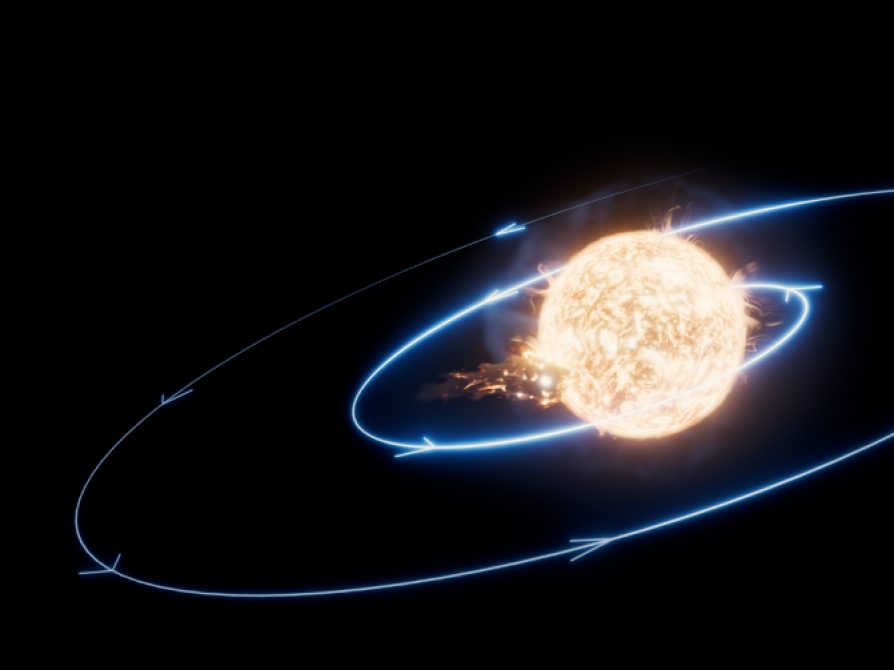
Suns set on hunt for giant planets in nearby binary system
But smaller worlds may yet hide in the two-star system's habitable zones

Launching a new phase of NASA astrophysics
A University of Michigan astronomer is helping lead NASA’s far-infrared telescope mission to explore the history and evolution of the universe

The University of Michigan Department of Astronomy is united by our quest to unlock the secrets of the Universe, from the formation and evolution of stars and their planets, to the effects that black holes and neutron stars exert on their surroundings, to the drivers of galaxies’ and clusters’ assembly and growth. We strive to lead the astronomical community toward impactful answers to these questions using our unique resources, as well as recruiting a diverse cohort of "leaders and best" at all levels supported by effective mentorship enhancing excellence for everyone in our community. We strive to maintain a supportive and welcoming climate, identifying structural changes we can make to improve opportunity for all. We embrace the joint goals of training the next generations of astronomers and teaching the wonders of the Universe to all students. Fundamentally, the success of our department depends on: making new discoveries, training new astronomers, and sharing the wonders of the Universe with all who would like to learn. Welcome. Astronomy is for everyone.

Events
Oct
14
2026 Ta-You Wu Lecture in Physics | From Prehistoric Qubits to Building a Useful Quantum Computer
John Martinis, Qolab and Professor of Physics (UC Santa Barbara)
4:00 PM
4th Floor Amphitheatre
Rackham Graduate School (Horace H.)
Oct
22
Quantum Research Institute | Thinking Inside the Box: Quantum Many-Body Frontiers with Ultracold Fermions
Nir Navon (Yale University)
11:00 AM
411
West Hall
Nov
05
Quantum Research Institute | TBD
Pankaj Jha (Syracuse University)
11:00 AM
411
Virtual

The University of Michigan Department of Astronomy is proud to be a member of four international consortia building instruments for the European Southern Observatory's 39-meter Extremely Large Telescope, currently planning for science operations in 2029. Learn more.
