
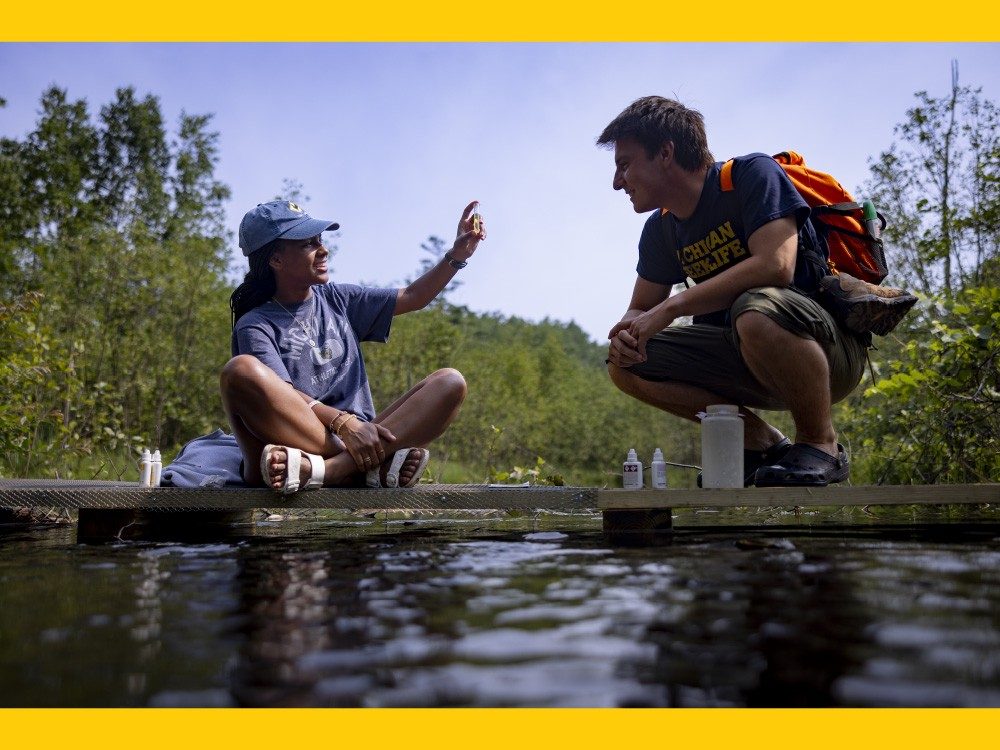
PELLSTON, Mich. — The application for 2026 field-based courses at the University of Michigan Biological Station is now open.
The lineup includes the return of historic favorites such as Field Mammalogy, Field Studies of Freshwater Fishes, and Ethnobotany. It also includes the debut of three new courses: Introduction to Data Science, Great Lakes Policy and Management, and Michigan: People and Place in a Changing Climate.
The spring term runs May 19 through June 18, 2026, and summer term runs June 30 through July 30, 2026, on the campus nestled along Douglas Lake — about 20 miles south of the Mackinac Bridge.
From microbiology to English and general ecology options, view the full menu of 2026 classes and apply now on the UMBS Courses website. That is where prospective students also can examine how available courses satisfy academic requirements and review the schedule structure.
The priority deadline is March 15, 2026.
UMBS welcomes undergraduate and graduate students from universities all over the world to the remote, vast campus in northern Michigan. Most courses have a research component. No prior field experience is required.
Plus, all students can be considered for UMBS scholarship funding, including guest and international students.
The U-M Biological Station also is recruiting applicants for Undergraduate Research Fellowships that include a $5,500 stipend and a research mentor for eight weeks. Fellows pursue their own original research in field ecology. The program provides hands-on training and knowledge-building in analytical, applied field methods, data collection and management, and science communication skills.
Last year UMBS welcomed 10 Undergraduate Research Fellows from across the U.S. to the sprawling, forested campus in northern Michigan to kick off the new, eight-week program. Learn about the 2025 Undergraduate Research Fellow projects.
“Whether joining Michigan’s field research station to take adventurous academic courses or conduct research, our sprawling campus surrounded by lakes, rivers and bogs is your living laboratory,” said Dr. Aimée Classen, director of the U-M Biological Station.
Prospective students are invited to a Virtual Information Session 5 p.m. Thursday, Jan. 29. Registration is required for the Zoom meeting.
UMBS staff and alumni will answer questions about living and learning at the historic field research station located on more than 10,000 forested acres, including academic course credits, hands-on research opportunities and the transformative experience of being immersed in nature.
Dominick Noeker, a sophomore at U-M, took courses in 2025 during both the spring and summer terms at UMBS and also served as a resident advisor (RA) for both terms.
“It is an opportunity unlike anything else,” said Noeker, who now serves as a UMBS Ambassador, sharing insider knowledge and his passion for UMBS at events in Ann Arbor. “The Biostation is the reason I went to Michigan, and it has had a huge influence over my career aspirations. It connected me with researchers and professors who I've kept in touch with even after leaving the Biostation.”
After their UMBS experience, alumni go on to change the world in a wild variety of fields — everything from medicine and law to teaching and documentary filmmaking.
“My first summer at UMBS defined my entire adult life in just about every way,” said Molly West, a cancer researcher at Michigan Medicine.
Since 1909, generations of students from around the world have developed life-long relationships after joining the UMBS community where cabins, classrooms and laboratories are nestled along Douglas Lake.
“The Biological Station was one of the most important experiences that I’ve had, as it fundamentally changed the way I think about and understand the world around me,” said Dr. Kiran Goyal, a third-year medical resident in vascular surgery at Ohio State University.
The vast UMBS campus in northern Michigan (the largest of U-M’s campuses!) engages all of the senses. Its remote, natural setting nurtures deep thought and scientific discovery.
“The spirit of UMBS was and is a huge inspiration for me,” said Sharon Shattuck, an award-winning documentary filmmaker. “The playfulness and humor of my colleagues and friends; the boundless curiosity and intelligence of the researchers; and the delight of teaching students cool things about nature — I've taken all of that with me in my work as a filmmaker.”
Go to the UMBS Alumni Success website to explore the role UMBS played in their career paths.
The University of Michigan Biological Station serves as a gathering place to learn from the natural world, advance research and education, and inspire action. We leverage over a century of research and transformative experiences to drive discoveries and solutions to benefit Michigan and beyond.
Our vast campus engages all of the senses. Its remote, natural setting nurtures deep thought and scientific discovery.
Founded in 1909, UMBS supports long-term research and education through immersive, field-based courses and features state-of-the-art equipment and facilities for data collection and analysis to help any field researcher be productive. It is where students and scientists from across the globe live and work as a community to learn from the place.
Subscribe to the UMBS monthly e-newsletter and follow the field station on LinkedIn, Instagram, Facebook, YouTube and X (formerly Twitter).
