

After nearly a decade of production, a landmark cultural and civic development a decade in the making opened its doors to the public on June 19, with a significant contribution from two LSA alumni. The grand opening ceremony of the Obama Presidential Center Museum (OPCM) in Chicago featured impassioned speeches from President Barack Obama and former First Lady Michelle Obama and musical performances by Stevie Wonder, Common, Bruce Springsteen, and The Roots. Both Obamas even read Where the Wild Things Are to a group of school kids. Tours commenced of the 19.3 acre OPCM campus, its interactive museum, edible garden, basketball court, playground, and public library.
Last week, LSA alumni Linda Batwin O’Donovan (A.B. 1980) and Adam Casini (A.B. ‘04) were also celebrating the culmination of their large-scale, years-long collaboration with the Obama Foundation. Their company, batwin + robin productions, designed and produced the exhibit media throughout the museum. And with community involvement and guidance from industry experts, Batwin O’Donovan and Casini thoughtfully integrated American Sign Language, audio descriptions, and captioning into all of the media in the exhibits, in order to enhance the experience of every visitor to the space.
In the midst of their well-earned celebrations, Batwin O’Donovan and Casini made time to talk with LSA about the power of words, accessibility, and working with President Obama.
LSA: How did the collaboration with the Obama Presidential Center Museum in Chicago come about?
Linda Batwin O’Donovan: We were invited to participate in the proposal process to bid on the project … and for the OPCM, we put together an extensive proposal detailing our approach to the project, our history of success on other major museum projects, and our diverse team of production collaborators who would work with us to create the many different exhibit media pieces.
When we were asked by the Obama Presidential Center team to come to an in-person interview (several companies were), we all felt there was great chemistry between the Obama Foundation and our team at B+R. And it proved to be so true! The collaboration, mutual respect, and direct, clear communication between our teams throughout the four-year project was truly special.
We did not meet President Obama until later in the process, after we had started production, both in occasional reviews and during filming and audio recordings of the president. Those meetings were truly a memorable experience. His intelligence, integrity, and respect for people around him was so real and true that you were frankly in awe of this incredible man.
LSA: Could you explain for our readers what exhibit media is in the context of a museum, and specifically in the context of the OPCM?
Adam Casini: While most traditional media is produced for television, cinema, or phone screens, the media that we design and produce is ultimately for display and integration into different types of environments, theaters, and immersive spaces. Our environmental media work can be seen in such diverse places as cultural centers to various stage productions on Broadway, and the company has been a leading innovator in these spaces since it was founded 35 years ago.
In the case of museums such as the OPCM, our role is to work with exhibit designers and the museum stakeholders to design and produce media that fits seamlessly into the physical and graphic design of the exhibit space. Whether that be large-scale projection theater pieces or intimate single monitor pieces, it is our job to enhance and support the storytelling of the various exhibits through the multimedia pieces we create. This can range from traditional documentary pieces that include interviews, archival and originally shot footage, or less traditional animation pieces that primarily use 2D/3D motion graphics.
LSA: Could you please share more about the accessibility component of this project? Why is accessibility particularly important in spaces like the OPCM?
AC: Creating a world-class museum that is accessible to all visitors is an incredibly important part of designing contemporary experiences. This is particularly true for the exhibits at the Obama Presidential Center, which are meant to inspire visitors to take action in their communities and also celebrate the diversity of the American people. The OPCM was committed to being the standard bearer for an accessible visitor experience.
For our media production this meant integrating offerings for deaf and hard of hearing, and blind or visually impaired visitors. Recorded audio descriptions were created for each film, along with ASL windows onscreen, and we participated in workshops with accessibility advisors to understand best practices and to brainstorm more inclusive design approaches to integrate into our filmmaking, imagery selection, and graphic design.
Because ASL is a living language without fixed signs for every idea, the team engaged in thoughtful discussions about how best to express phrases such as “We the People,” “undocumented immigrants,” and “Affordable Care Act.” Given the visibility of the OPCM, the DASL [director of artistic sign language] team took seriously their opportunity to shape and standardize interpretations for such concepts, balancing accuracy, cultural context, and emotional tone. Providing comprehensive audio descriptions was a contractual and ethical requirement, ensuring visitors who are blind, have low vision, or other disabilities could experience the museum’s linear media independently.
LSA: When you imagine visitors to the OPCM moving through the space and interacting with the pieces in the museum, what do you hope that they will experience? How might the exhibit media that you created enhance that experience?
LBO: As a visitor explores the exhibits and the special artifacts in the OPCM, the exhibit media has the unique ability to both add layers of perspective to the themes of the exhibits and to deliver individual, personal stories to the visitor. The exhibit media is most successful when each visitor comes away having been touched deeply with strong emotions of hope, strength, and community through the stories told.
During the soft opening period as visitors began experiencing the museum, the OPCM put out boxes of tissues near some of the media pieces because people were so moved by the stories—so I think we felt we had done a good job in connecting to people at a deep core level … and that truly is the power of media in an experience like this.
LSA: Tell us about the challenges and joys of this project. Can you share some of the creative and technological problem-solving you had to undertake to make this project work? What part of the project are you the most proud of?
AC: Power of Words is an immersive, 85-feet tall, four-story media piece that welcomes visitors and anchors the storytelling of all four levels of the museum. It surrounds visitors with striking imagery, cinematic video, and expressive graphic text that unfold through poetic storytelling moments.
Because of the building’s distinctive architecture that tapers outward on Levels 2 and 3 and then back inward on Levels 4 and 5, the projection surfaces for the museum’s signature media experience varied dramatically and created a technological problem to solve with projection-mapping. Each wall on each level required unique “pixel-maps” that had to be meticulously calibrated and tested to create perfectly aligned continuous images spread across multiple levels of the museum. [We also] created a VR experience where project stakeholders could move throughout the space and review different media experiences…We found this to be the only way for people to truly understand the scale of the media, understand the different viewpoints, and see what worked and what didn’t.
LBO: We have done many large projection experiences in our past, both for museums and theatrical pieces, but Power of Words was the most unique. You enter up the escalator to Level 2 and you look up to see 85 feet of seamless projection media soaring above you, from the floor to the ceiling of the building. As you go through the museum and enter each level, you can get a different perspective of the 85-foot media canvas. Both the visuals and the soundscapes were designed to work individually for each level when we wanted to and then we were able to take over the entire four stories as a unique “take-over” showcase moment.
LSA: Could you please describe a favorite item, object, or exhibit on view at the OPCM? What was it like to create exhibit media for this museum piece?
LBO: [One of my favorites is] Panorama of a Presidency, which is an immersive three-walled media installation that reveals both the joy and the rigor behind the work of President Obama’s administration. It offers visitors an experiential pause from the robust—and at times weighty—content of the third floor, inviting them into a more delightful sensory encounter.
And President Obama recently noted that his favorite exhibit in the museum is Ten Letters a Day, a large projection piece that was created in collaboration with Chicago-based performance studio Manual Cinema. The animated short film explores how during his presidency, Barack Obama had a daily ritual of reading and responding to 10 hand-picked letters every day. Reading the words of everyday Americans helped the president keep perspective on the issues people were facing in their lives and helped influence his policies. The film uses shadow puppets to re-create different scenes and also recorded voice-overs of people reading the letters, including the president himself.

LSA: You’re both graduates of LSA. What did you study and how did your liberal arts and sciences education inform your career paths and the work that you do now as batwin + robin productions?
AC: I graduated in 2004 from LSA, where I double-majored in what was then called the Film and Video Studies Program and the history department. My biggest takeaway from the Film and Video Studies Program was a broad and diverse exposure to different world cinemas, filmmakers, and eras. Learning film theory, understanding visual techniques and cinematography, and getting hands-on production experience (both shooting on film and then transitioning to HD video as that technology began to emerge) all helped inform my professional production work when I started my career in environmental media design and production. Even now, these are all things I continue to learn and grow from as I explore how large-scale multimedia can be integrated into all different types of exhibit environments, theatrical productions, and immersive spaces—both from a creative and constantly-evolving technological standpoint.
LBO: I graduated a long time ago … in 1980! I graduated in the Film and Video Studies Program from LSA, where I studied film theory, film genres, and made many films—in 16mm and, believe it or not, also worked in video which was at its very beginning. I have always been passionate about media and its power to communicate and, throughout my career, I have felt so fortunate to have loved the work I do. Whether it’s a documentary, a museum, a live event, or theater project. The wonderful part about batwin + robin productions is we don’t do “one thing,” so our work is always interesting, evolving, and imagining endless ways media and technology can touch people in meaningful ways.
This interview has been edited for clarity and length.
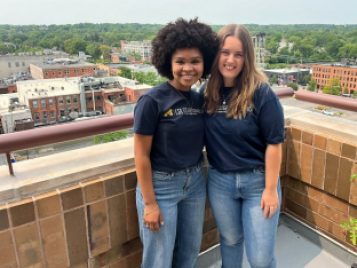
Photos, from top: An image from the Panorama of a Presidency exhibit in the OPCM; Adam Casini and Linda Batwin O'Donovan at a recent event. Photos courtesy of batwin + robin


Look to Michigan for the foundational knowledge and experience to ignite purposeful change.
LSA is the place where creative thinkers engage with a complex, diverse, and changing world. See how your support can make an impact on what’s next, for a better tomorrow. Learn more.
