


As a public humanities intern at the Institute for the Humanities, Gianna Limarvin found a way to bring together two important parts of her life—military service and the humanities—through an oral history project with veterans. The project opened her eyes to the importance of listening closely to others’ experiences, and it informed her idea of the kind of leader she wants to be.
Now, she’s wrapping up an honors thesis in the Program in International and Comparative Studies (PICS) on language, political action, and Southeast Asian history. Limarvin, who is from Troy, Michigan, talked with LSA about how the humanities have shown her what it looks like to take academic work seriously, while also making it “accessible, public-facing, and meaningful to a broader community.”
LSA: Could you please share how you decided to study in LSA?
Gianna Limarvin: I actually first arrived at LSA as a transfer student from U-M Dearborn during the second semester of my sophomore year, and in many ways that decision reshaped my entire undergraduate experience. I had initially started college as a biology major, but over time I found myself increasingly drawn to questions that were less about the natural sciences and more about people and history. Once I transferred to Ann Arbor, I realized that LSA offered exactly the kind of intellectual space I had been looking for.
From my first semester here, I appreciated the breadth of the college and the freedom it gave me to move beyond a narrow academic track and pursue an education that connected my interests in language, history, and regional study. And it was that flexibility that led me to international studies, which I first encountered through an introductory course. Upon reflection, I truly believe that my experience in LSA helped me see the humanities as a framework for thinking more seriously about the kind of world I want to help shape.
LSA: How did you bring the expertise you gained from your major to your Public Humanities Internship experience?
GL: I am majoring in international studies, with a focus on international security, norms, and cooperation. Much of my academic work has focused on conflict, political violence, and the role institutions play in shaping world events, but my Public Humanities Internship at the Institute for the Humanities challenged me to think about those same themes through a more personal and deeply human lens.
One of the projects I designed through my internship was Voices in Uniform, an oral history workshop for ROTC cadets at the University of Michigan. As an Air Force ROTC cadet myself, that project meant a great deal to me because I wanted to find a way to bring together two parts of my life that are both important to me: military service and the humanities. I felt that teaching the importance and practice of oral history allowed those two worlds to meet in a way that felt grounded and meaningful.
For the workshop, I invited retired officers with backgrounds in military history and historical documentation to speak about the importance of oral history and to demonstrate what an interview actually looks like in practice. We also gave attendees the materials and time to practice interviewing one another.
One of the most meaningful parts of the experience was hearing how much the cadets valued the chance to listen to each other’s stories. Many shared that they hoped to use those same skills to interview service members in their own lives, whether family, friends, or mentors, so those stories could be remembered and recorded. Overall, this experience was meaningful to me because it changed the way I think about leadership. ROTC has taught me a great deal about responsibility and leading others, but the humanities taught me that leadership also depends on listening closely and understanding people’s experiences. That project helped me see that the strongest leadership often comes from being able to do both.
LSA: Can you describe some of the most inspiring classes, experiences, and professors that you encountered during your time in LSA?
GL: Some of the most formative parts of my experience in LSA came from the combination of generous mentorship and challenging (but enjoyable!) coursework. Professor Mike Hawkins’s course, “From Archives to Fieldwork: Qualitative Research Methods,” was especially transformative for me. It changed the way I think about research by pushing me to ask better questions, work more carefully with evidence, and build arguments that were both rigorous and meaningful. That class, and especially Professor Hawkins’s teaching and expertise, played a major role in giving me the confidence to pursue an honors senior thesis. In a very real sense, it was his course that made graduate school feel possible to me.
At the same time, I truly cannot overstate how grateful I am to have studied Indonesian with Professor Agustini during my time at Michigan. Over the past two and a half years, her courses have shaped not only my language ability, but also my relationship to the region itself. She brought so much care, rigor, and cultural depth to the classroom that studying Indonesian never felt like memorizing vocabulary in isolation. It felt like being invited into a much larger conversation about the region’s history, culture, and especially its people. I am deeply thankful for the time I have spent in her classes and for the care she has invested in my growth as a student.
Outside the classroom, my past year as a public humanities intern at the Institute for the Humanities was equally influential, as that experience has shown me what it looks like to take academic work seriously while also thinking carefully about how to make it accessible, public-facing, and meaningful to a broader community.
LSA: You mentioned that you will graduate with an honors thesis, which is no small accomplishment. Could you please share what your thesis project is and why you decided to pursue this topic?
GL: My honors thesis examines how religious rhetoric shaped the political framing of the 1965–66 mass killings in Indonesia, particularly among elite actors in Central and East Java. I am especially interested in how religious language functioned as an active mechanism for legitimizing violence, rather than simply serving as background context. I chose this topic because it reflects several of the questions that have shaped my time in LSA, including how language influences political action and how major historical events are remembered, interpreted, and sometimes oversimplified. Indonesia’s 1965–66 violence is one of the most consequential episodes of political violence in the 20th century, yet discussions of it often overlook regional differences and the political power of rhetoric itself.
Writing this thesis has been one of the most challenging and rewarding parts of my undergraduate experience, and it has strengthened me as a researcher, writer, and thinker. The process pushed me to become a better researcher and a more serious thinker about the stakes of the history I am trying to understand.
LSA: What are your plans after graduation?
GL: After graduation, I will continue my education by pursuing a master’s degree at Georgetown University’s Walsh School of Foreign Service in Washington, D.C. Upon completion of my studies, I will commission and serve as a military officer in the U.S. Air Force.
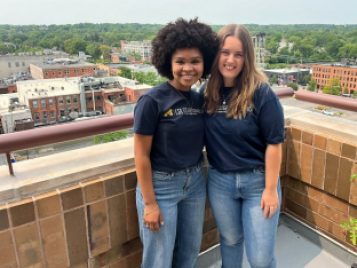
Photo Credit: AFROTC Detachment 390


Look to Michigan for the foundational knowledge and experience to ignite purposeful change.
LSA is the place where creative thinkers engage with a complex, diverse, and changing world. See how your support can make an impact on what’s next, for a better tomorrow. Learn more.
