
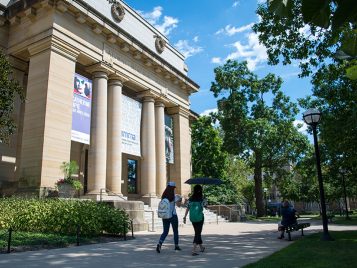




U-M’s Kelsey Museum of Archaeology opened its first permanent gallery in nearly two decades last month with The Byzantine and Islamic Worlds: 400-1800.
The new gallery contains more than 100 objects that explore 1,400 years of history across the eastern Mediterranean, North Africa, the Middle East, as well as the wider networks that connect these regions to Asia, Europe, and Africa.
Many of these objects have never been on permanent display.
“The research and scholarship required to prepare an exhibition of this magnitude is nothing short of extraordinary,” said LSA Dean Rosario Ceballo at the gallery’s opening reception. “The faculty, staff, students, humanists, and researchers who work in the Kelsey … deserve recognition and applause for their tremendous work.”
Throughout the gallery, objects reveal connections that crossed political, religious, linguistic, and geographic boundaries. The textiles trace generations of weavers, illustrating how they adapted materials and techniques to new contexts.
Texts from Greek, Coptic, Arabic, Hebrew, Persian, and Ottoman Turkish people reveal changing traditions of education, administration and religious learning. And coins, musical instruments, ceramics, and glass reveal networks of travel, commerce, performance, and artistic exchange.
Read the full article in The University Record.
Photo by Charlotte Smith/Michigan Photography


Look to Michigan for the foundational knowledge and experience to ignite purposeful change.
LSA is the place where creative thinkers engage with a complex, diverse, and changing world. See how your support can make an impact on what’s next, for a better tomorrow. Learn more.
