
Thursday, April 16, 2026
4:30-5:30 PM
4th Floor Amphitheatre
Rackham Graduate School (Horace H.)
Map
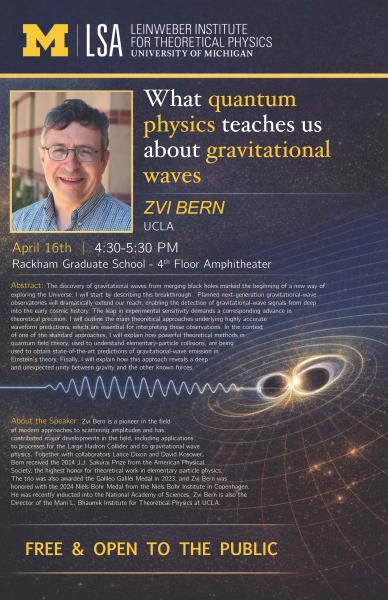
The discovery of gravitational waves from merging black holes marked the beginning of a new way of exploring the Universe. I will start by describing this breakthrough. Planned next-generation gravitational-wave observatories will dramatically extend our reach, enabling the detection of gravitational-wave signals from deep into the early cosmic history. The leap in experimental sensitivity demands a corresponding advance in theoretical precision. I will outline the main theoretical approaches underlying highly accurate waveform predictions, which are essential for interpreting these observations. In the context of one of the standard approaches, I will explain how powerful theoretical methods in quantum field theory, used to understand elementary-particle collisions, are being used to obtain state-of-the-art predictions of gravitational-wave emission in Einstein’s theory. Finally, I will explain how this approach reveals a deep and unexpected unity between gravity and the other known forces.
| Building: | Rackham Graduate School (Horace H.) |
|---|---|
| Event Type: | Lecture / Discussion |
| Tags: | lecture, Litp Public Lecture, Physics, Talk |
| Source: | Happening @ Michigan from Leinweber Institute for Theoretical Physics, Department of Physics, Physics Workshops & Conferences, Leinweber Institute for Theoretical Physics Workshops and Conferences, Leinweber Institute for Theoretical Physics Seminars |
Events
Featured
Apr
18
Saturday Morning Physics | The Science of Physicist Jens Zorn's Art
Multiple U-M Faculty Speakers
10:30 AM
170 & 182
Weiser Hall
Upcoming
Apr
17
Cosmo-Astro Seminar | Weak Gravitational Lensing Cosmology with the Roman Space Telescope High Latitude Imaging Survey
Kaili Cao (Ohio State University)
11:00 AM
3247 Neal Lab
Randall Laboratory
Apr
17
HET Seminar | Abelian Instantons in Quantum Field Theory and Gravity
Isabel Garcia-Garcia
3:00 PM
340
West Hall
Apr
20
CHPS Seminar | Reconstructing the properties of the protosolar disk using cosmochemistry
Alessandro Morbidelli (Observatoire de la Cote d'Azur)
1:00 PM
411
West Hall
