
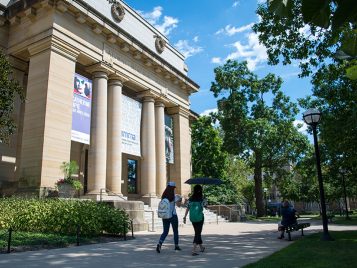

On Sunday afternoons in the late 1960s, Jan Carline’s (A.B. 1970) favorite place on campus was the second floor of the Exhibit Museum (now known as the University of Michigan Museum of Natural History, or UMMNH) in Ruthven Hall.
Carline remembers climbing the stairs as an undergraduate to the second floor, stepping into the hall where the mastodon skeleton stood, and settling behind the front desk on quiet Sundays. Surrounded by fossils, dioramas, and curious visitors, he would greet families, answer questions, and read in the quiet stretches between groups.
“College was demanding, but the museum felt different,” Carline says now, more than 50 years later. Once he learned the exhibits and felt confident explaining them, his docent shifts became a kind of refuge.
“Being in college can be quite stressful, but the atmosphere of working in the museum—after I learned what I was talking about—was comfortable,” he says. “It was engaging.” The museum gave him a sense of calm, purpose, and belonging that stayed with him long after he left Ann Arbor.
Those memories are the foundation of the Jan D. Carline Student Docent Fund. Carline’s fund supports the training, educational enrichment, and ongoing work of the Museum of Natural History's student docent program. His hope is straightforward: that the museum can continue to be as meaningful for other undergraduates as it was for him.
“The museum widened my world ...
it was one of the best things I did at Michigan.”
—Jan Carline
One Visit Changed Everything

“This museum is actually why I’m here at the University of Michigan, because I wanted to be a part of this so badly.”
—Lani Reyes
Lani Reyes (B.S. ’26) didn’t originally go to college to study fossils. When she discovered UMMNH four years ago, she was a first-year student at a nearby university, majoring in criminology and psychology.
Remembering her first visit, not long after UMMNH opened in its modern new space at U-M’s Biological Sciences Building (BSB), Reyes describes her wonder. Bright, open, and inviting galleries. Discovery stations where kids could touch real fossils. And—something she hadn’t expected to see at all—the people who were teaching kids and running activities were students, not much older than she was.
It was a pivot point, the moment that Reyes realized she could turn her childhood interest in geology and paleontology into a career. She changed her major and transferred to the University of Michigan to pursue a degree in earth and environmental sciences with a minor in paleontology. And she found herself pulled back to UMMNH again and again.
“The museum was a safe space for me before I ever became a docent. When I transferred as a junior, I didn’t know anyone. I felt lost and out of place, so I’d spend time here between classes,” she says. “When I started to make friends, I’d bring them here to show them how cool it is. This museum is actually why I’m here at the University of Michigan, because I wanted to be a part of this so badly.”
Reyes has worked as a docent for the past two years. The job became the gateway to another life-changing opportunity: a position in the University of Michigan Museum of Paleontology (UMMP) Fossil Prep Lab, which has a large picture window into the natural history museum's main atrium. Reyes spends part of her weekends working in the Fossil Prep Lab, helping to clean and repair fossil specimens for display or research—all while talking to museum visitors about what she’s doing through a live microphone.
“It’s like arts and crafts with power tools. Working with fossils has become a huge passion for me. It has opened up this new avenue of paleontology that isn’t purely research,” she says of her work as a vertebrate fossil preparator, which she hopes to pursue as a career. “An added bonus about the UMMNH lab being visible to museum visitors is that I can let people into this really specific area that I love, while also teaching them about the things I’m doing in an active scientist role.
“Working at the museum has opened so many doors for me—the prep lab, a field research season in Wyoming, my first academic conference,” she says. “At the core, it all comes back to deciding to be here.”
Making the Museum Tick

The Carline Student Docent Fund not only supports the student docent program directly but also makes possible museum internships that expand what students can take away from the role. Calista Cruikshank (B.S. ’26), a recent graduate in ecology, evolution, and biodiversity with a minor in museum studies, started working as a UMMNH docent in the fall of 2023, after a field trip with the Women in Science and Engineering Residential Program (WISE-RP) introduced her to the museum.
“When I started working at the museum, I was interested in education but knew I didn’t want to be a teacher,” says Cruikshank. “As a scientist, I wanted a career where I could both learn and teach something new every day—museum education seemed like an interesting option. And what better way to explore that than through a job at a campus museum?”
Cruikshank completed her required museum studies internship at UMMNH with support from Carline’s fund. The internship centered on one of UMMNH’s most beloved hands-on discovery station (HODS) carts, Michigan Mammals. A HODS cart is a themed gallery cart with objects and lesson plans. The aging Michigan Mammals HODS cart that Cruikshank worked on displayed a collection of decades-old animal pelts and skulls that needed to be replaced. Cruikshank spent a semester researching and developing a plan to source replacement materials responsibly and ethically. She also updated the cart’s curriculum to add two new animals, the gray wolf and the river otter, chosen for their conservation relevance in Michigan.
The project gave her a view of the museum she’d never had from the visitor-facing side of a docent shift. “It was an interesting way to flex my brain and understand how a different area of the museum operates,” she says. It also became a defining talking point in a high-stakes interview months later, for a career-building summer internship at the Smithsonian National Air and Space Museum.
“My Smithsonian supervisor later told me that I interviewed so well because I was able to talk about my work on the Michigan Mammals HODS cart,” she says. “I was better able to visualize how these [teaching tools] can be utilized in other contexts. It was really valuable to have that additional background knowledge.”
Working at UMMNH also gave Cruikshank a more well-rounded understanding of general ecology and evolutionary concepts related to her major, “because I needed to be able to talk to visitors about everything from human evolution, to the evolution of whales, to Michigan’s natural history,” she says. “I have to be able to explain complex science to non-scientists—and that has also helped me retain my coursework better.”
Cruikshank is pursuing a master’s degree in museum education, a path she traces directly back to her time at the museum. “Working at UMMNH absolutely shaped my postgrad plans,” she says. “Everyone that I’ve met who works in a museum is just so excited to show up to work every day, to learn and share what they’ve learned.”
“I have to be able to explain complex science to non-scientists—and that has also helped me retain my coursework better.”
—Calista Cruikshank
Essential Elements
Stories like Reyes’s and Cruikshank’s aren’t the exception at UMMNH; they’re closer to the rule, which is part of why the student docent program is an essential element in the museum’s operation.
Museum Programs Manager Brittany Burgess oversees the staff of 60 students. “Student docents have the opportunity to do almost everything here at the museum,” she says. Because the museum has such a small permanent staff, student docents play a critically important role. They greet visitors and groups, run programming, lead tours and demonstrations, and work in the planetarium, the store, and the gallery spaces with hands‑on objects. “They’re a big part of how we can do what we do,” says Burgess.
The student docent program is treated as a serious professional placement. Cohorts are hired only twice per year. Training for the position is extensive and paid, and core training can be supplemented with optional scaffolding for more specialized roles, such as docent positions in the planetarium. Docents gain public speaking and science communication skills, and they deepen their science knowledge. “Not all of our docents are science majors,” points out Burgess. In fact, deep science knowledge is not a prerequisite for the job.
Both Cruikshank and Reyes were docent representatives, an additional leadership role that serves as a liaison between the museum’s student docents and its professional staff and board of advisors.
“Being a docent representative was a huge learning experience,” says Cruikshank. “Seeing all of the processes that are going on behind the scenes, from the day-to-day operations to the strategic plan, and how the mission and vision of the museum shape changes.”
“Jan Carline’s support for the student docent program at UMMNH brings our educational mission to life,” says Museum Director Lucie Howell. “It allows us to train student docents, create and improve hands-on learning exhibits, and launch innovative programs—while providing internships, professional development, and real-world experience that can turn an undergraduate student’s first museum job into the foundation for a meaningful career.”
“[Student docents] are a big part of how we can do what we do.”
—Brittany Burgess
Part of Something Bigger
Jan Carline’s own work as a docent in the late 1960s joined his interests in anthropology, archaeology, and natural history with a lifelong pull toward working with kids. He’d led Sunday school classes and summer camps during high school and college summers and would go on to briefly consider youth ministry before landing permanently in higher education.
At the museum, “I found it very rewarding to be able to answer the kids’ questions, broadening their view into what shaped the world around them,” he says. What stayed with him wasn’t just the teaching, though. It was the sense of being part of something bigger—the graduate students and faculty who passed through, the conversations that stretched his sense of what was possible.
“The museum widened my world,” says Carline. “It became much more than simply leading tours. The chance meeting with a faculty member about their work or discoveries could be quite broadening and endlessly interesting, learning what they were doing, asking, ‘How did you do it?’”
Carline went on to earn a master’s degree in education and a Ph.D. at the University of Washington. As the director of educational evaluation and a professor of biomedical informatics and medical education during his 41-year career at the University of Washington School of Medicine, he focused his research on evaluating how medical students learn. When he and his wife, Carol Sue Ivory (A.B. 1969), began thinking through their estate planning and which U-M experiences reflected who they’d become, the museum was an easy answer.
“Although I didn’t go on with museum work, being a part of the museum was one of the best things I did at Michigan,” says Carline.
Meaningful Support
A first-generation college student, Carline recently documented a new planned gift to the university, broadening his impact beyond UMMNH to include the Kessler Scholars Program, a leading support model for first-generation students established at U-M. Carline’s estate will also support the University of Michigan Museum of Anthropological Archaeology (UMMAA), through which he spent a formative summer doing fieldwork as an undergraduate research assistant along the south shore of Lake Superior, and a year counting fish ear bones in an UMMAA lab. Carline has served on the UMMAA Advisory Committee since 2025.
Life-Changing Education in LSA
Life-changing education in the University of Michigan’s College of Literature, Science, and the Arts takes shape through experiential opportunities that students can make their own. An undergraduate job in a welcoming campus museum space can become a launchpad to a career in the lab, the field, or museum education—each Sunday shift, visitor question, and hands-on activity revealing a new path to opportunity.


Look to Michigan for the foundational knowledge and experience to ignite purposeful change.
LSA is the place where creative thinkers engage with a complex, diverse, and changing world. See how your support can make an impact on what’s next, for a better tomorrow. Learn more.
