
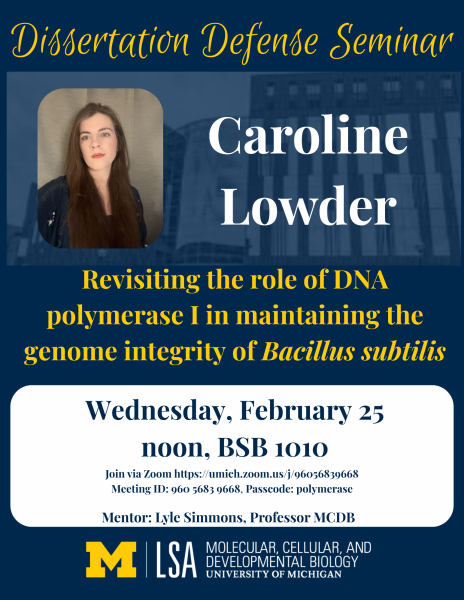
MCDB Dissertation Defense Seminar> Revisiting the role of DNA polymerase I in maintaining the genome integrity of Bacillus subtilis
Caroline Lowder
One of the essential biological findings of the past century was the discovery of DNA polymerase, which revealed the core mechanism by which DNA is faithfully replicated and repaired in cells. While polymerases were first described in bacteria, homologous proteins are present in all domains and contribute to multi-faceted systems that employ multiple DNA polymerases to optimize both fidelity and processivity. Of these, one of the most adaptable enzymes is the originally discovered bacterial polymerase, DNA polymerase I (Pol I). This protein has three distinct domains that confer different functions: a 5′-3′ flap endonuclease (FEN) for removing downstream nucleic acids, a 3′-5′ exonuclease for proofreading the nascent strand, and a 5′-3′ polymerase for synthesizing DNA. These three activities allow Pol I to contribute broadly to DNA repair and replication, though its canonical roles are primer removal and Okazaki fragment maturation.
The role of Pol I in primer removal, however, was established using Pol I from the gram-negative bacterium Escherichia coli and does not consider diverging functions that may have developed as bacterial lineages evolved separately. Using genetic screens and biochemical assays, we characterized Pol I and a Pol I-independent FEN from Bacillus subtilis (FEN, formerly YpcP). We demonstrate that FEN is actively involved in Okazaki fragment maturation in vivo, as cells lacking fenA are sensitive to the accumulation of RNA-DNA hybrids and this phenotype is not rescued by over-expression of polA. Using a variety of substrates, we show that FEN is a more active nuclease than Pol I. FEN showed significant activity on substrates mimicking intermediates formed during Okazaki fragment maturation (5′, 3′ double-flap, 5′ flap, nicked duplex, and 3′ overhang), whereas Pol I preferentially acted on DNA-only nicked and 3′ overhang structures. These substrate preferences indicate that the major role of FEN is Okazaki fragment maturation while Pol I nuclease function is more important for DNA repair. As Pol I nuclease activity was not stimulated by concurrent DNA synthesis, we propose that in bacteria that encode a second, active FEN, RNA primers are primarily removed by FEN rather than Pol I.
A more recent repair activity attributed to A-family polymerases, such as Pol I, is RNA-templated lesion bypass. As our FEN data suggest that the primary role of BsPol I is in DNA repair, we investigated whether Pol I could use ribonucleotides as a template for DNA synthesis. Since RNA is often found incorporated in DNA, either as part of R-patches or R-tracts, this category of damage represents a significant barrier to successful replication. We show that BsPol I performs efficient primer extension using both a template composed entirely of RNA or a DNA template containing embedded ribonucleotides. We also assayed other bacterial Pol Is and found that they possess similar capabilities as BsPol I, though the efficiency of this synthesis varies by species. This activity is not performed by the B. subtilis replicative polymerases, PolC and DnaE, as we found that neither are capable of sustained synthesis using a template that contains ribonucleotides. PolC was arrested by the inclusion of a single ribonucleotide in the template, while DnaE was able to synthesize DNA using a template that contained a stretch of 5 ribonucleotides. Together, these data support RNA-templated DNA synthesis by Pol I as a viable pathway for replication forks to navigate ribonucleotides incorporated in DNA.
The role of Pol I in primer removal, however, was established using Pol I from the gram-negative bacterium Escherichia coli and does not consider diverging functions that may have developed as bacterial lineages evolved separately. Using genetic screens and biochemical assays, we characterized Pol I and a Pol I-independent FEN from Bacillus subtilis (FEN, formerly YpcP). We demonstrate that FEN is actively involved in Okazaki fragment maturation in vivo, as cells lacking fenA are sensitive to the accumulation of RNA-DNA hybrids and this phenotype is not rescued by over-expression of polA. Using a variety of substrates, we show that FEN is a more active nuclease than Pol I. FEN showed significant activity on substrates mimicking intermediates formed during Okazaki fragment maturation (5′, 3′ double-flap, 5′ flap, nicked duplex, and 3′ overhang), whereas Pol I preferentially acted on DNA-only nicked and 3′ overhang structures. These substrate preferences indicate that the major role of FEN is Okazaki fragment maturation while Pol I nuclease function is more important for DNA repair. As Pol I nuclease activity was not stimulated by concurrent DNA synthesis, we propose that in bacteria that encode a second, active FEN, RNA primers are primarily removed by FEN rather than Pol I.
A more recent repair activity attributed to A-family polymerases, such as Pol I, is RNA-templated lesion bypass. As our FEN data suggest that the primary role of BsPol I is in DNA repair, we investigated whether Pol I could use ribonucleotides as a template for DNA synthesis. Since RNA is often found incorporated in DNA, either as part of R-patches or R-tracts, this category of damage represents a significant barrier to successful replication. We show that BsPol I performs efficient primer extension using both a template composed entirely of RNA or a DNA template containing embedded ribonucleotides. We also assayed other bacterial Pol Is and found that they possess similar capabilities as BsPol I, though the efficiency of this synthesis varies by species. This activity is not performed by the B. subtilis replicative polymerases, PolC and DnaE, as we found that neither are capable of sustained synthesis using a template that contains ribonucleotides. PolC was arrested by the inclusion of a single ribonucleotide in the template, while DnaE was able to synthesize DNA using a template that contained a stretch of 5 ribonucleotides. Together, these data support RNA-templated DNA synthesis by Pol I as a viable pathway for replication forks to navigate ribonucleotides incorporated in DNA.
| Building: | Biological Sciences Building |
|---|---|
| Website: | |
| Event Type: | Workshop / Seminar |
| Tags: | Biology, Bsbsigns, Dissertation, Dissertation Defense, seminar |
| Source: | Happening @ Michigan from Department of Molecular, Cellular, and Developmental Biology |
