Investigate Labs: Your students will use scientific tools and museum specimens to answer questions and solve problems. Open for short lab activities when available or you can schedule a class workshop!
- The Nature Lab features hands-on collections inquiry, highlighting specimens from paleontology, zoology, botany, geology, and anthropology.
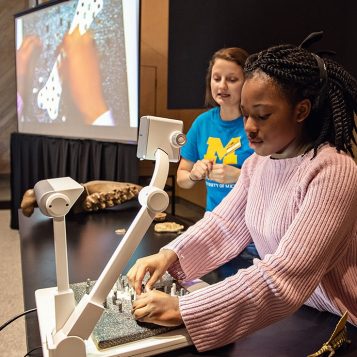
- The Micro Worlds Lab offers opportunities to use microscopes and lab equipment to inquire into molecular, cellular, and developmental biology.
INVESTIGATE LABS
Hands-on public Investigate Labs where students can dig in and do what scientists do.
- 30 students
- 45 minutes
- $8/person
Price in addition to Group Admission.
Programs available Monday-Friday with limited weekend availability.
Assistive listening devices are available in both Investigate Labs upon request.
Nature Lab Workshops
The Nature Lab is an interactive space providing opportunities for students to answer questions with museum specimens in an engaging environment full of animal displays, plants, rocks, and fossils. Programs help explain the natural world through current research in biodiversity, evolution, ecology, geology, and conservation.
Discovering Dinosaur Adaptations
Grades 1–4
This hands-on workshop for elementary students explores how dinosaurs survived, thrived, and ruled their environments—by studying the incredible adaptations written into their bones. Students will use evidence to infer how different dinosaurs moved, ate, defended themselves, and lived.
In this hands-on investigation, students will...
- Examine fossil replicas and specimens—from a Triceratops horn to a Camarasaurus vertebra
- Compare dinosaur features (teeth, horns, armor, limbs, and tails) and connect form to function
- Solve adaptation mysteries using observation and scientific reasoning
- Discover how paleontologists help us understand living things from the past
Michigan Rock Stories
Grades 2–6
This program blends science, storytelling, and plenty of hands-on discovery—so every student leaves knowing that rocks aren’t just stuff on the ground… they’re Michigan’s history you can hold. This is a hands-on workshop where students become “rock detectives,” exploring how Michigan’s landscapes were shaped over time. Through observation of real rock samples, students touch, test, and investigate the three rock types—igneous, sedimentary, and metamorphic—and discover how rocks form, change, teach about Earth’s past, as well as how people depend on rocks in everyday life.
In this hands-on investigation, students will...
- Examine authentic Michigan rocks and minerals and learn to identify key features like texture, layers, and crystals
- Explore the Geography and Geology of Michigan
- Create a “Rock Story” workbook, documenting observations like a real field scientist
Are Birds Really Dinosaurs?
Grades 5–8
This hands-on workshop tackles one of the coolest questions in science: "Did the asteroid really wipe out all dinosaurs, or did some survive and evolve into birds?" In this program, students become evolutionary biologists, using evidence from the museum’s collections of fossils and modern birds to create an explanation of the dinosaur-to-bird connections.
In this hands-on investigation, students will...
- Examine fossils and museum specimens and record observations like real scientists
- Compare features of living birds—bones, feathers, beaks, claws, and more—to features seen in ancient reptiles
- Build an argument from evidence
The Micro Worlds lab is an interactive space where students use scientific tools to explore topics such as the biodiversity of microscopic organisms, cells, genetics, and developmental biology. Students learn about current research on how the smallest organisms can have large impacts on our lives.
Tiny Clues, Big Knowledge
Grades 5 and up
Through guided observation and hands-on activities, students will learn how scientists use microscopes to study biodiversity, ecosystems, evolution, and Earth history. Students will rotate through activity stations where they compare living and nonliving specimens, sketch what they observe, and make evidence-based conclusions about structure and function. Along the way, they will practice essential scientific skills including careful observation, measurement, classification, and recording data in a field notebook. This workshop connects microscopy to natural history collections and real scientific research. Students will leave with a deeper appreciation for the tiny structures that reveal big stories about life on Earth.
In this hands-on investigation, students will...
- Learn basic microscopy skills
- Investigate how microscopy helps solve real-world problems
- Explore STEM careers that use microscopy techniques
Scheduling



Biological Sciences Building, 1105 North University Avenue, Ann Arbor, MI 48109-1085
ummnh.info@umich.edu | 734-764-0478

- Information For
- Prospective Students
- Current Students
- Faculty and Staff
- Alumni and Friends
- More about LSA
- About LSA
- How Do I Apply?
- News
- LSA Magazine
- Give
- Maps