
Click the image to the left or go here for a full listing of events at WCEE and its affiliated centers, the Center for Russian, East European, and Eurasian Studies (CREES) and the Copernicus Center for Polish Studies (CCPS).
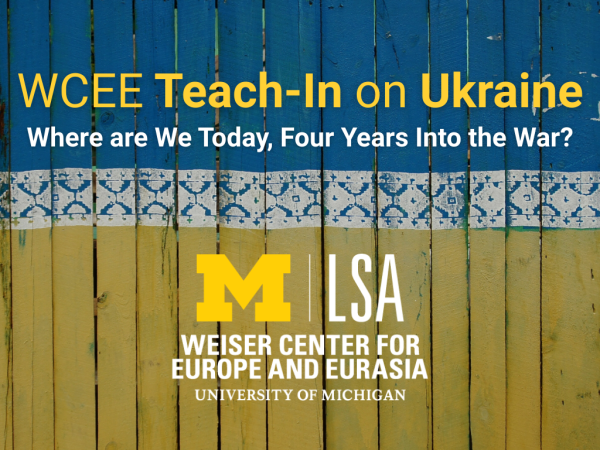
Join U-M faculty and experts as they discuss the current situation in Ukraine, with the latest developments and issues sharply in view, four years into the full-scale war. Open to all, including students and the wider community. Moderated by Douglas Northrop, Professor of History & Middle East Studies, and WCEE Acting Director, U-M.
2:30-2:55 PM | “Zelenskyy as Jewish War Hero: The role of ethnicity in Russia's war on Ukraine”
Jeffrey Veidlinger, Joseph Brodsky Collegiate Professor of History and Judaic Studies, Director of the Raoul Wallenberg Institute, U-M
2:55-3:20 PM | “Ordinary Lives Four Years Into War”
Danielle Leavitt, WCEE Postdoctoral Fellow, U-M
3:20-3:45 PM | “Geopolitics or Imperialism?: Why the Russo-Ukrainian War and How to End It”
Ronald Grigor Suny is the William H. Sewell Jr. Distinguished University Professor of History and Professor of Political Science at the University of Michigan and Emeritus Professor of Political Science and History at the University of Chicago.
3:45-4:10 PM | “Ukraine’s Genocides: Are We Witnessing Another?”
Yuri Kaparulin, Wallenberg Fellow and former WCEE Ukrainian Scholar at Risk Fellow (2022-2025), U-M
4:10-4:35 PM | “Realism and U.S.-Ukraine Relations”
Markian Dobczansky, Associate, Harvard Ukrainian Research Institute
Register here to join the virtual teach-in: https://myumi.ch/dgz87
Jeffrey Veidlinger is Joseph Brodsky Collegiate Professor of History and Judaic Studies and Director of the Raoul Wallenberg Institute at the University of Michigan. His latest book, In the Midst of Civilized Europe: The Pogroms of 1918-1921 and the Onset of the Holocaust, won a Canadian Jewish Literary Award and a Vine Book Award, and was a finalist for the Lionel Gelber Prize, the National Jewish Book Award, and the Wingate Literary Prize. Professor Veidlinger is also the author of the award-winning books, In the Shadow of the Shtetl: Small-Town Jewish Life in Soviet Ukraine, The Moscow State Yiddish Theater: Jewish Culture on the Soviet Stage, and Jewish Public Culture in the Late Russian Empire.
Danielle Leavitt is a historian of modern Ukraine and the Soviet Union, with a particular interest in Russian and Ukrainian relations, human age, generation, and gender. Her work examines the function of generation and human age in Soviet history and works to insert the stories of underrepresented populations, such as the elderly and women, into consequential debates about stagnation, cultural life, Soviet collapse, post-Soviet economic and political development, and the Russo-Ukrainian war.
Dr. Leavitt’s first book, By the Second Spring: Seven Lives and One Year of the War in Ukraine (2025, FSG), charted the lives of seven Ukrainians through the first year of Russia’s war on Ukraine. Based on a unique set of online diaries, Leavitt contextualized her seven subjects, Ukrainian society, and its predicaments for a wide audience, introducing readers to a rigorous but accessible history of Ukraine, the Soviet Union, its collapse, and Russia’s historical relationship with its neighbors.
Leavitt received her PhD in History from Harvard University in 2023. From 2023-2025, she was a postdoctoral fellow at the Harvard Ukrainian Research Institute.
Ronald Grigor Suny is the William H. Sewell Jr. Distinguished University Professor of History and Professor of Political Science at the University of Michigan and Emeritus Professor of Political Science and History at the University of Chicago.
Professor Suny’s intellectual interests have centered on the non-Russian nationalities of the Russian Empire and the Soviet Union, particularly those of the South Caucasus (Armenia, Azerbaijan, and Georgia). The “national question” was an area of study that was woefully neglected for many decades until peoples of the periphery mobilized themselves in the Gorbachev years. His aim has been to consider the history of imperial Russia and the USSR without leaving out the non-Russian half of the population, to see how multi-nationality, processes of imperialism and nation-making shaped the state and society of that vast country. This in turn has led to work on the nature of empires and nations, studies in the historiography and methodology of studying social and cultural history, and a commitment to bridging the often-unbridgeable gap between the traditional concerns of historians and the methods and models of other social scientists.
Yurii Kaparulin is a historian and legal scholar who studies Eastern Europe's history and law, with particular interests in Holocaust and Genocide Studies, Human Rights, and International Сrimes. He is an associate professor in the Department of National, International Law, and Law Enforcement, and director of the Raphael Lemkin Center for Genocide Studies, at Kherson State University. He was awarded a 2024-27 Raoul Wallenberg Fellowship at the University of Michigan.
Kaparulin is the author of the book Oleksandr Riabinin-Skliarevskyi (1878-1942): An Intellectual Biography of a Historian, which reveals the background of the late Russian Empire, the Ukrainian Revolution of 1917-1921, and Soviet Ukraine in the 1920s and 1930s through the life of a repressed military officer and historian. His second current book project is titled Between Soviet Modernization and the Holocaust: Jewish Agrarian Settlements in Southern Ukraine (1924-1948).
Markian Dobczansky was the Associate Director of the Russian, East European, and Eurasian Center at the University of Illinois Urbana-Champaign, where he taught classes in Slavic and Eurasian Studies, Soviet and Ukrainian history, and EU Studies.
He received a Ph.D. in Russian/Soviet history from Stanford University with a dissertation on the politics of culture in twentieth-century Kharkiv, and held post-doctoral fellowships at the University of Toronto and Columbia University. His research interests include the history of the Soviet Union, Ukraine, and Russia, the politics of culture, urban history, and the Cold War. He has also worked in an administrative capacity at the Central Eurasian Studies Society, the Shevchenko Scientific Society in the U.S., and the Kennan Institute of the Woodrow Wilson International Center for Scholars.
If there is anything we can do to make this event accessible to you, please contact us at gosiak@umich.edu. Please be aware that advance notice is necessary as some accommodations may require more time for the university to arrange.
2:30-2:55 PM | “Zelenskyy as Jewish War Hero: The role of ethnicity in Russia's war on Ukraine”
Jeffrey Veidlinger, Joseph Brodsky Collegiate Professor of History and Judaic Studies, Director of the Raoul Wallenberg Institute, U-M
2:55-3:20 PM | “Ordinary Lives Four Years Into War”
Danielle Leavitt, WCEE Postdoctoral Fellow, U-M
3:20-3:45 PM | “Geopolitics or Imperialism?: Why the Russo-Ukrainian War and How to End It”
Ronald Grigor Suny is the William H. Sewell Jr. Distinguished University Professor of History and Professor of Political Science at the University of Michigan and Emeritus Professor of Political Science and History at the University of Chicago.
3:45-4:10 PM | “Ukraine’s Genocides: Are We Witnessing Another?”
Yuri Kaparulin, Wallenberg Fellow and former WCEE Ukrainian Scholar at Risk Fellow (2022-2025), U-M
4:10-4:35 PM | “Realism and U.S.-Ukraine Relations”
Markian Dobczansky, Associate, Harvard Ukrainian Research Institute
Register here to join the virtual teach-in: https://myumi.ch/dgz87
Jeffrey Veidlinger is Joseph Brodsky Collegiate Professor of History and Judaic Studies and Director of the Raoul Wallenberg Institute at the University of Michigan. His latest book, In the Midst of Civilized Europe: The Pogroms of 1918-1921 and the Onset of the Holocaust, won a Canadian Jewish Literary Award and a Vine Book Award, and was a finalist for the Lionel Gelber Prize, the National Jewish Book Award, and the Wingate Literary Prize. Professor Veidlinger is also the author of the award-winning books, In the Shadow of the Shtetl: Small-Town Jewish Life in Soviet Ukraine, The Moscow State Yiddish Theater: Jewish Culture on the Soviet Stage, and Jewish Public Culture in the Late Russian Empire.
Danielle Leavitt is a historian of modern Ukraine and the Soviet Union, with a particular interest in Russian and Ukrainian relations, human age, generation, and gender. Her work examines the function of generation and human age in Soviet history and works to insert the stories of underrepresented populations, such as the elderly and women, into consequential debates about stagnation, cultural life, Soviet collapse, post-Soviet economic and political development, and the Russo-Ukrainian war.
Dr. Leavitt’s first book, By the Second Spring: Seven Lives and One Year of the War in Ukraine (2025, FSG), charted the lives of seven Ukrainians through the first year of Russia’s war on Ukraine. Based on a unique set of online diaries, Leavitt contextualized her seven subjects, Ukrainian society, and its predicaments for a wide audience, introducing readers to a rigorous but accessible history of Ukraine, the Soviet Union, its collapse, and Russia’s historical relationship with its neighbors.
Leavitt received her PhD in History from Harvard University in 2023. From 2023-2025, she was a postdoctoral fellow at the Harvard Ukrainian Research Institute.
Ronald Grigor Suny is the William H. Sewell Jr. Distinguished University Professor of History and Professor of Political Science at the University of Michigan and Emeritus Professor of Political Science and History at the University of Chicago.
Professor Suny’s intellectual interests have centered on the non-Russian nationalities of the Russian Empire and the Soviet Union, particularly those of the South Caucasus (Armenia, Azerbaijan, and Georgia). The “national question” was an area of study that was woefully neglected for many decades until peoples of the periphery mobilized themselves in the Gorbachev years. His aim has been to consider the history of imperial Russia and the USSR without leaving out the non-Russian half of the population, to see how multi-nationality, processes of imperialism and nation-making shaped the state and society of that vast country. This in turn has led to work on the nature of empires and nations, studies in the historiography and methodology of studying social and cultural history, and a commitment to bridging the often-unbridgeable gap between the traditional concerns of historians and the methods and models of other social scientists.
Yurii Kaparulin is a historian and legal scholar who studies Eastern Europe's history and law, with particular interests in Holocaust and Genocide Studies, Human Rights, and International Сrimes. He is an associate professor in the Department of National, International Law, and Law Enforcement, and director of the Raphael Lemkin Center for Genocide Studies, at Kherson State University. He was awarded a 2024-27 Raoul Wallenberg Fellowship at the University of Michigan.
Kaparulin is the author of the book Oleksandr Riabinin-Skliarevskyi (1878-1942): An Intellectual Biography of a Historian, which reveals the background of the late Russian Empire, the Ukrainian Revolution of 1917-1921, and Soviet Ukraine in the 1920s and 1930s through the life of a repressed military officer and historian. His second current book project is titled Between Soviet Modernization and the Holocaust: Jewish Agrarian Settlements in Southern Ukraine (1924-1948).
Markian Dobczansky was the Associate Director of the Russian, East European, and Eurasian Center at the University of Illinois Urbana-Champaign, where he taught classes in Slavic and Eurasian Studies, Soviet and Ukrainian history, and EU Studies.
He received a Ph.D. in Russian/Soviet history from Stanford University with a dissertation on the politics of culture in twentieth-century Kharkiv, and held post-doctoral fellowships at the University of Toronto and Columbia University. His research interests include the history of the Soviet Union, Ukraine, and Russia, the politics of culture, urban history, and the Cold War. He has also worked in an administrative capacity at the Central Eurasian Studies Society, the Shevchenko Scientific Society in the U.S., and the Kennan Institute of the Woodrow Wilson International Center for Scholars.
If there is anything we can do to make this event accessible to you, please contact us at gosiak@umich.edu. Please be aware that advance notice is necessary as some accommodations may require more time for the university to arrange.
| Building: | Weiser Hall |
|---|---|
| Event Type: | Lecture / Discussion |
| Tags: | russia, ukraine |
| Source: | Happening @ Michigan from Weiser Center for Europe and Eurasia, International Institute, Center for Russian, East European, and Eurasian Studies |
Videos of programs organized by WCEE affiliates are posted on the CCPS and CREES websites.
Videos of select events are also available on the University of Michigan's YouTube Channel.
