
Democracy Week | Beacon of Democratic Resilience: Visual Truths and the Legacy of Korea's 5·18 Democratization Movement - A Photographic Archive of the May 1980 People’s Uprising in Korea
Link to the official event poster:
https://myumi.ch/kVdVV
For parking information, please visit this link: https://www.dc.umich.edu/about-the-dc/maps-floor-plans-hours/#parking
Exhibition Opening Event:
- When: Friday, September 18, 5 pm to 6 pm
- Where: Duderstadt Center Gallery
- Open to the public
- Description: Please join us for the opening of this photo exhibition. The event will feature remarks by the organizers, the exhibition curators, one of the featured photojournalists, and a former Peace Corps volunteer who has stood in solidarity with the people of Gwangju since 1980. Light refreshments are provided.
Exhibition Description
This photo exhibition features 90 curated images from the UNESCO-inscribed May 18 Archives. Documenting the May 18–27, 1980 democratization uprising in Gwangju, South Korea, the collection captures the shift from peaceful student protests to military violence and unified citizen resistance, carried out under a complete blackout as civilians and photojournalists risked their lives to photograph atrocities and smuggle film past cordons. Beyond serving as historical artifacts, these preserved visual truths offer a living blueprint for popular resilience against authoritarianism, transforming local trauma into a universal defense of human rights. Displaying these records at Michigan bridges 1980 Gwangju with our present moment, inviting viewers to engage past resistance in the ongoing effort to defend democracy today.
Exhibition Composition
The exhibit will be composed of a visual narrative comprised of six chronological sections and two additional special sections:
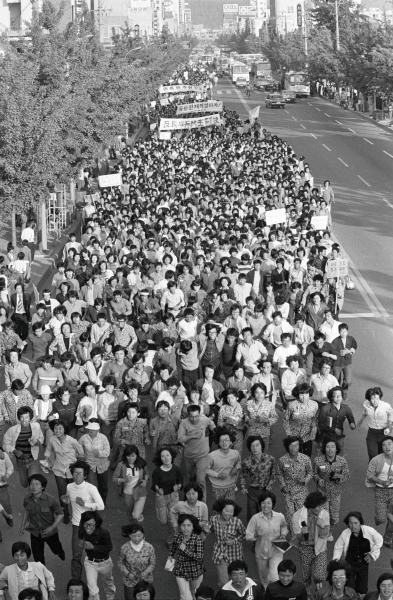
1. Protest (May 5–16, 1980):
Following the collapse of Park Chung-hee’s military dictatorship in October, 1979, Gwangju students and citizens held peaceful rallies for campus autonomy and the end of martial law. Photos from this era show orderly marches and hopeful faces, capturing a society on the brink of change before the structural contradictions shifted toward state-led violence.
2. Suppression (May 18–19, 1980):
A new junta government led by Chun Doo-hwan extended martial law to the entire country on May 17. Students at Chonnam National University protested against the new junta government’s decision. State violence escalated as paratroopers, who were deployed to Gwangju, engaged student protesters. Streets became scenes of brutal beatings and kidnappings. Beyond documenting victims, the images on display in this section serve as primary historical evidence and legal proof of the military's methods and the sudden transformation of citizens into targets of control.
3. Uprising (May 20–21, 1980):
The movement shifted into a popular struggle. Vehicles lined up in Gwangju’s main thoroughfare, Geumnam-ro. This massive vehicle parade symbolized the people becoming active subjects of resistance. The military was given the order to use live ammunition against civilians. In reaction, the city became a space of voluntary mobilization and citizens emerged as historical political actors.
4. Resistance (May 22–26, 1980):
While isolated and cut off from communications, Gwangju established an autonomous system of self-governance. Photos in this section testify to the efforts made to establish a sense of order based on solidarity—sharing food and donating blood—rather than chaos. The formation of this "Daedong (Great Unity) Community" and the visual documentation thereof serve as foundations of democracy in South Korea.
5. Massacre (May 27, 1980):
The uprising was crushed by a dawn military operation. While the armed resistance ended, the resulting photographs of the aftermath reveal the stark reality of the massacre. These images became the catalyst for future truth-seeking movements and the pursuit of historical justice in South Korea.
6. Mourning:
Scenes of coffins, portraits, and silent vigils represent a collective ethical gaze. During this period, mourning was more than a display of grief; it was a communal act used to redefine the city’s identity and establish new moral standards for justice.
7. Special Section A: The Photographers
This special section highlights the domestic and international photographers who documented the uprising. This includes Korean journalists alongside US journalists Robin Moyer and Norman Thorpe, French correspondents Patrick Chauvel and François Lochon, and German cinematographer Jürgen Hinzpeter. Their images transcend simple reporting, reflecting a moral commitment to record and a historical duty to ensure remembrance. Rather than viewing these photos solely as evidence, the exhibition reinterprets them through a lens of photographic history—examining their context, distribution, and how they transformed raw records into social truth and collective memory.
8. Special Section B: The Peace Corps: Americans Who Helped Gwangju
When Gwangju was isolated under martial law in May 1980, four American Peace Corps volunteers—Tim Warnberg, David Lee Dolinger, Judi Chamberlin, and Paul Courtright—refused to leave, choosing instead to assist the wounded, aid foreign journalists, and ultimately expose the truth to the world. Those pivotal ten days reshaped their lives into lifelong commitments to human rights, inspiring decades of memoirs, academic writings, and testimonies. Through photographs, video footage, and personal records, this section traces their journey from eyewitnesses to active defenders of human dignity, inviting us to reflect on what it truly means to take a stand in the face of another’s suffering.
Two additional events programmed in conjunction with this photo exhibition
1. Symposium:
“For Thee and All the World to See: May 18 Gwangju and the Visual Tenacities of South Korean Democracy”
https://myumi.ch/mVdVJ
2. Third Thursday at the Library:
Democracy in Motion: The Advancement of Democracy in Korea and the Students at the Frontline
https://myumi.ch/rwdwn
Content Warning: This exhibition contains historical photographs documenting the 1980 Gwangju Democratization Movement, including graphic depictions of violence, state military suppression, injuries, and grief. Viewer discretion is advised.
This exhibit is co-sponsored by the May 18 Archives, Center for Democracy & Civic Empowerment, Department of Political Science, Center for Emerging Democracies, Donia Human Rights Center, Asia Library, and Duderstadt Center.
If there is anything we can do to make this event accessible to you, please contact us. Please be aware that advance notice is necessary as some accommodations may require more time for the university to arrange.
https://myumi.ch/kVdVV
For parking information, please visit this link: https://www.dc.umich.edu/about-the-dc/maps-floor-plans-hours/#parking
Exhibition Opening Event:
- When: Friday, September 18, 5 pm to 6 pm
- Where: Duderstadt Center Gallery
- Open to the public
- Description: Please join us for the opening of this photo exhibition. The event will feature remarks by the organizers, the exhibition curators, one of the featured photojournalists, and a former Peace Corps volunteer who has stood in solidarity with the people of Gwangju since 1980. Light refreshments are provided.
Exhibition Description
This photo exhibition features 90 curated images from the UNESCO-inscribed May 18 Archives. Documenting the May 18–27, 1980 democratization uprising in Gwangju, South Korea, the collection captures the shift from peaceful student protests to military violence and unified citizen resistance, carried out under a complete blackout as civilians and photojournalists risked their lives to photograph atrocities and smuggle film past cordons. Beyond serving as historical artifacts, these preserved visual truths offer a living blueprint for popular resilience against authoritarianism, transforming local trauma into a universal defense of human rights. Displaying these records at Michigan bridges 1980 Gwangju with our present moment, inviting viewers to engage past resistance in the ongoing effort to defend democracy today.
Exhibition Composition
The exhibit will be composed of a visual narrative comprised of six chronological sections and two additional special sections:
1. Protest (May 5–16, 1980):
Following the collapse of Park Chung-hee’s military dictatorship in October, 1979, Gwangju students and citizens held peaceful rallies for campus autonomy and the end of martial law. Photos from this era show orderly marches and hopeful faces, capturing a society on the brink of change before the structural contradictions shifted toward state-led violence.
2. Suppression (May 18–19, 1980):
A new junta government led by Chun Doo-hwan extended martial law to the entire country on May 17. Students at Chonnam National University protested against the new junta government’s decision. State violence escalated as paratroopers, who were deployed to Gwangju, engaged student protesters. Streets became scenes of brutal beatings and kidnappings. Beyond documenting victims, the images on display in this section serve as primary historical evidence and legal proof of the military's methods and the sudden transformation of citizens into targets of control.
3. Uprising (May 20–21, 1980):
The movement shifted into a popular struggle. Vehicles lined up in Gwangju’s main thoroughfare, Geumnam-ro. This massive vehicle parade symbolized the people becoming active subjects of resistance. The military was given the order to use live ammunition against civilians. In reaction, the city became a space of voluntary mobilization and citizens emerged as historical political actors.
4. Resistance (May 22–26, 1980):
While isolated and cut off from communications, Gwangju established an autonomous system of self-governance. Photos in this section testify to the efforts made to establish a sense of order based on solidarity—sharing food and donating blood—rather than chaos. The formation of this "Daedong (Great Unity) Community" and the visual documentation thereof serve as foundations of democracy in South Korea.
5. Massacre (May 27, 1980):
The uprising was crushed by a dawn military operation. While the armed resistance ended, the resulting photographs of the aftermath reveal the stark reality of the massacre. These images became the catalyst for future truth-seeking movements and the pursuit of historical justice in South Korea.
6. Mourning:
Scenes of coffins, portraits, and silent vigils represent a collective ethical gaze. During this period, mourning was more than a display of grief; it was a communal act used to redefine the city’s identity and establish new moral standards for justice.
7. Special Section A: The Photographers
This special section highlights the domestic and international photographers who documented the uprising. This includes Korean journalists alongside US journalists Robin Moyer and Norman Thorpe, French correspondents Patrick Chauvel and François Lochon, and German cinematographer Jürgen Hinzpeter. Their images transcend simple reporting, reflecting a moral commitment to record and a historical duty to ensure remembrance. Rather than viewing these photos solely as evidence, the exhibition reinterprets them through a lens of photographic history—examining their context, distribution, and how they transformed raw records into social truth and collective memory.
8. Special Section B: The Peace Corps: Americans Who Helped Gwangju
When Gwangju was isolated under martial law in May 1980, four American Peace Corps volunteers—Tim Warnberg, David Lee Dolinger, Judi Chamberlin, and Paul Courtright—refused to leave, choosing instead to assist the wounded, aid foreign journalists, and ultimately expose the truth to the world. Those pivotal ten days reshaped their lives into lifelong commitments to human rights, inspiring decades of memoirs, academic writings, and testimonies. Through photographs, video footage, and personal records, this section traces their journey from eyewitnesses to active defenders of human dignity, inviting us to reflect on what it truly means to take a stand in the face of another’s suffering.
Two additional events programmed in conjunction with this photo exhibition
1. Symposium:
“For Thee and All the World to See: May 18 Gwangju and the Visual Tenacities of South Korean Democracy”
https://myumi.ch/mVdVJ
2. Third Thursday at the Library:
Democracy in Motion: The Advancement of Democracy in Korea and the Students at the Frontline
https://myumi.ch/rwdwn
Content Warning: This exhibition contains historical photographs documenting the 1980 Gwangju Democratization Movement, including graphic depictions of violence, state military suppression, injuries, and grief. Viewer discretion is advised.
This exhibit is co-sponsored by the May 18 Archives, Center for Democracy & Civic Empowerment, Department of Political Science, Center for Emerging Democracies, Donia Human Rights Center, Asia Library, and Duderstadt Center.
If there is anything we can do to make this event accessible to you, please contact us. Please be aware that advance notice is necessary as some accommodations may require more time for the university to arrange.
| Building: | Duderstadt Center |
|---|---|
| Event Type: | Exhibition |
| Tags: | Activism, Art, Asia, Asian Languages And Cultures, Exhibition, History, Korea, Korean Studies |
| Source: | Happening @ Michigan from Nam Center for Korean Studies, University Library, International Institute, Center for Emerging Democracies, Donia Human Rights Center, Asian Languages and Cultures, Department of Political Science, Duderstadt Center |
| Upcoming Dates: |
Friday, September 25, 2026 12:00-6:00 PM
|
