
Nam Center Colloquium Series | The Efficacy of Using Singing as a Learning Tool in Foreign Language Acquisition
Moon-Sook Park, University of Arkansas
Please note: This lecture will be held in person and virtually on Zoom. The webinar is free and open to the public, but registration is required. Once you've registered, joining information will be sent to your email. Register for the Zoom webinar at:
https://myumi.ch/G2NdP
This lecture builds on Park's Fulbright U.S. Scholar project (2024–2025, Freie Universität Berlin, Germany), which investigates the role of singing as a pedagogical tool in foreign language acquisition. The project demonstrates how combining Korean lyric songs (가곡) with culturally significant works such as Arirang and popular songs from the 1970s, valued for their simple yet artistic character, creates powerful opportunities for both language learning and cultural engagement.
Singing activates multiple cognitive processes—memory, auditory discrimination, and articulatory precision—that support vocabulary retention, pronunciation, and prosodic fluency. Through guided sing-along activities, participants will experience firsthand how these repertoires enable learners, particularly non-Korean speakers, to internalize language patterns in a memorable and embodied way.
Beyond linguistic development, the juxtaposition of lyric, folk, and popular song traditions illuminates Korea’s diverse musical and cultural landscape. This interdisciplinary approach—linking vocal pedagogy, musicology, and linguistics—underscores the efficacy of song as both a dynamic tool for foreign language acquisition and a meaningful pathway to intercultural understanding.
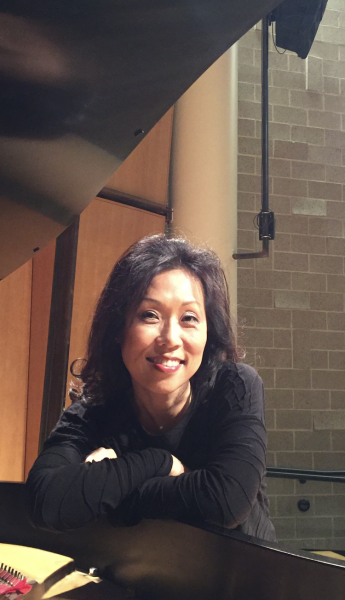
A native of Korea, soprano Moon-Sook Park has built an international career with performances throughout Europe, Asia, and the United States. Her U.S. debut recital at Carnegie Hall in 2001 marked a defining moment in her artistic life and established the United States as her second home. Her repertoire bridges German Liederkunst, Korean lyric art song, and diverse traditions of international art song literature, alongside chamber and contemporary experimental works. In addition to her concert career, she has performed leading operatic roles including Pamina in The Magic Flute, Susanna in Le nozze di Figaro, Liù in Turandot, and Gilda in Rigoletto. During her years in Germany, she was honored with the K.A.A.D. Award and the prestigious Bayreuth Wagner Stipend Award, recognizing her as a distinguished rising scholar-artist.
After earning her Bachelor of Music degree from Seoul National University, she continued her studies in Europe, completing graduate diplomas at the conservatories of Freiburg, Stuttgart, and Saarland in Germany. She later devoted more than a decade in Italy to the study of bel canto, immersing herself deeply in its vocal tradition and expressive artistry, and received a diploma from the Accademia di Canto F. Cavalli in Milan. She subsequently earned the Doctor of Musical Arts degree in Voice Performance and Vocal Pedagogy from the University of Cincinnati College-Conservatory of Music, integrating European vocal heritage with American pedagogical scholarship.
As an honored Fulbright U.S. Scholar (2024–2025) at Freie Universität Berlin, Dr. Park’s work bridges artistic performance and interdisciplinary research, exploring the role of singing in language acquisition and cultural exchange. She serves as Associate Professor of Voice at the University of Arkansas and, since 2019, has been a leading force behind the SHE: Festival of Women in Music, where she currently serves as Co-Chair.
Dr. Park’s scholarship includes co-authoring two volumes of Korean Art Songs: An Anthology and Guide for Performance and Study, Vols. I & II (Classical Vocal Reprints, Catalog Nos. 5076 and 5077), widely recognized as the first English-language anthology of Korean art songs published in the United States. She has also contributed an award-winning book chapter on vocal registration and leads interdisciplinary research on the AI-based revival of 15th-century Korean court music composed by King Sejong the Great.
Her recent study, “600 Years Reimagined: Reviving Sejong the Great’s Yongbieocheonga through Generative AI and Modern-Classical Vocal Interpretation,” co-authored with Dasaem Jeoung, received the Best Paper Award at the KAUPA Conference and is forthcoming as a chapter in Korean Studies in the Artificial Intelligence Era, Vol. II (CRC Press / Taylor & Francis), June 2026. She frequently presents internationally on vocal pedagogy, offers lectures and masterclasses, and actively promotes Korean lyric art song in dialogue with the broader traditions of global art song literature.
Accommodation: If there is anything we can do to make this event accessible to you, please contact us at ncks.info@umich.edu. Please be aware that advance notice is necessary as some accommodations may require more time for the university to arrange.
This lecture builds on Park's Fulbright U.S. Scholar project (2024–2025, Freie Universität Berlin, Germany), which investigates the role of singing as a pedagogical tool in foreign language acquisition. The project demonstrates how combining Korean lyric songs (가곡) with culturally significant works such as Arirang and popular songs from the 1970s, valued for their simple yet artistic character, creates powerful opportunities for both language learning and cultural engagement.
Singing activates multiple cognitive processes—memory, auditory discrimination, and articulatory precision—that support vocabulary retention, pronunciation, and prosodic fluency. Through guided sing-along activities, participants will experience firsthand how these repertoires enable learners, particularly non-Korean speakers, to internalize language patterns in a memorable and embodied way.
Beyond linguistic development, the juxtaposition of lyric, folk, and popular song traditions illuminates Korea’s diverse musical and cultural landscape. This interdisciplinary approach—linking vocal pedagogy, musicology, and linguistics—underscores the efficacy of song as both a dynamic tool for foreign language acquisition and a meaningful pathway to intercultural understanding.
A native of Korea, soprano Moon-Sook Park has built an international career with performances throughout Europe, Asia, and the United States. Her U.S. debut recital at Carnegie Hall in 2001 marked a defining moment in her artistic life and established the United States as her second home. Her repertoire bridges German Liederkunst, Korean lyric art song, and diverse traditions of international art song literature, alongside chamber and contemporary experimental works. In addition to her concert career, she has performed leading operatic roles including Pamina in The Magic Flute, Susanna in Le nozze di Figaro, Liù in Turandot, and Gilda in Rigoletto. During her years in Germany, she was honored with the K.A.A.D. Award and the prestigious Bayreuth Wagner Stipend Award, recognizing her as a distinguished rising scholar-artist.
After earning her Bachelor of Music degree from Seoul National University, she continued her studies in Europe, completing graduate diplomas at the conservatories of Freiburg, Stuttgart, and Saarland in Germany. She later devoted more than a decade in Italy to the study of bel canto, immersing herself deeply in its vocal tradition and expressive artistry, and received a diploma from the Accademia di Canto F. Cavalli in Milan. She subsequently earned the Doctor of Musical Arts degree in Voice Performance and Vocal Pedagogy from the University of Cincinnati College-Conservatory of Music, integrating European vocal heritage with American pedagogical scholarship.
As an honored Fulbright U.S. Scholar (2024–2025) at Freie Universität Berlin, Dr. Park’s work bridges artistic performance and interdisciplinary research, exploring the role of singing in language acquisition and cultural exchange. She serves as Associate Professor of Voice at the University of Arkansas and, since 2019, has been a leading force behind the SHE: Festival of Women in Music, where she currently serves as Co-Chair.
Dr. Park’s scholarship includes co-authoring two volumes of Korean Art Songs: An Anthology and Guide for Performance and Study, Vols. I & II (Classical Vocal Reprints, Catalog Nos. 5076 and 5077), widely recognized as the first English-language anthology of Korean art songs published in the United States. She has also contributed an award-winning book chapter on vocal registration and leads interdisciplinary research on the AI-based revival of 15th-century Korean court music composed by King Sejong the Great.
Her recent study, “600 Years Reimagined: Reviving Sejong the Great’s Yongbieocheonga through Generative AI and Modern-Classical Vocal Interpretation,” co-authored with Dasaem Jeoung, received the Best Paper Award at the KAUPA Conference and is forthcoming as a chapter in Korean Studies in the Artificial Intelligence Era, Vol. II (CRC Press / Taylor & Francis), June 2026. She frequently presents internationally on vocal pedagogy, offers lectures and masterclasses, and actively promotes Korean lyric art song in dialogue with the broader traditions of global art song literature.
Accommodation: If there is anything we can do to make this event accessible to you, please contact us at ncks.info@umich.edu. Please be aware that advance notice is necessary as some accommodations may require more time for the university to arrange.
| Building: | Weiser Hall |
|---|---|
| Website: | |
| Event Type: | Lecture / Discussion |
| Tags: | Asian Languages And Cultures, Korea, Korean Studies, Languages, Linguistics, Music |
| Source: | Happening @ Michigan from Nam Center for Korean Studies, School of Music, Theatre & Dance (SMTD), International Institute, Asian Languages and Cultures |
