
CJS Noon Lecture Series | Nourishing Life: Cultures of Food and Health in Early Modern Japan
Joshua Schlachet, Associate Professor, University of Arizona
Please note: This lecture will be held in person in room 1010, Weiser Hall, and virtually on Zoom. If you would like to attend via Zoom, registration is required. Once you've registered, joining information will be sent to your email. Register for the Zoom webinar at:
https://myumi.ch/ykpz2
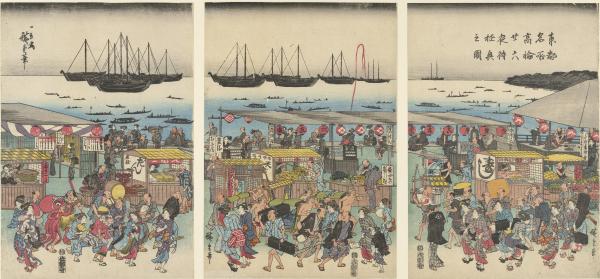
Can food determine your fate? Could indulging in delicacies bring calamity to your community? This talk reevaluates the history of Japanese food culture by examining how ideas of healthy eating became both a popular phenomenon and a matter of grave concern among trained medical experts and amateur culinary enthusiasts alike. It explores why ordinary people ate what they did, how these ideas on proper eating came to be, and what social, economic, and moral concerns propelled their rise. Guidance on dietetics conveyed priorities about how well-nourished bodies were meant to act in the world, whether as agricultural workers, samurai bureaucrats, or merchant consumers. Failure to keep a proper diet carried life-or-death consequences, according to these guides, that could bring not just disease to oneself but financial and moral ruin to one’s household, domain, or even society at large. This study of historical nourishment modes in Japan thus reveals an early modern dietetic revolution in the making, which disrupted older forms of expertise and provided a venue to critique official policies on eating and living right before the introduction of modern scientific nutrition.
Joshua Schlachet is a historian of Japan, specializing in the cultural history of nourishment in the eighteenth and nineteenth centuries. His new book, Nourishing Life: Cultures of Food and Health in Early Modern Japan (University of Hawaiʻi Press, 2026), examines how the emergence of a dietary common knowledge expanded concepts of a well-nourished body to encompass economic productivity, status hierarchy, and moral cultivation. Schlachet is co-editor of Interdisciplinary Edo: Towards an Integrated Approach to Early Modern Japan (Routledge, 2024), a collected volume of innovative humanistic research on society and culture in the Tokugawa era. He received his Ph.D. in East Asian languages and cultures from Columbia University in 2018 and is a proud graduate of the University of Michigan's Center for Japanese Studies.
If there is anything we can do to make this event accessible to you, please contact us. Please be aware that advance notice is necessary as some accommodations may require more time for the university to arrange.
Can food determine your fate? Could indulging in delicacies bring calamity to your community? This talk reevaluates the history of Japanese food culture by examining how ideas of healthy eating became both a popular phenomenon and a matter of grave concern among trained medical experts and amateur culinary enthusiasts alike. It explores why ordinary people ate what they did, how these ideas on proper eating came to be, and what social, economic, and moral concerns propelled their rise. Guidance on dietetics conveyed priorities about how well-nourished bodies were meant to act in the world, whether as agricultural workers, samurai bureaucrats, or merchant consumers. Failure to keep a proper diet carried life-or-death consequences, according to these guides, that could bring not just disease to oneself but financial and moral ruin to one’s household, domain, or even society at large. This study of historical nourishment modes in Japan thus reveals an early modern dietetic revolution in the making, which disrupted older forms of expertise and provided a venue to critique official policies on eating and living right before the introduction of modern scientific nutrition.
Joshua Schlachet is a historian of Japan, specializing in the cultural history of nourishment in the eighteenth and nineteenth centuries. His new book, Nourishing Life: Cultures of Food and Health in Early Modern Japan (University of Hawaiʻi Press, 2026), examines how the emergence of a dietary common knowledge expanded concepts of a well-nourished body to encompass economic productivity, status hierarchy, and moral cultivation. Schlachet is co-editor of Interdisciplinary Edo: Towards an Integrated Approach to Early Modern Japan (Routledge, 2024), a collected volume of innovative humanistic research on society and culture in the Tokugawa era. He received his Ph.D. in East Asian languages and cultures from Columbia University in 2018 and is a proud graduate of the University of Michigan's Center for Japanese Studies.
If there is anything we can do to make this event accessible to you, please contact us. Please be aware that advance notice is necessary as some accommodations may require more time for the university to arrange.
| Building: | Weiser Hall |
|---|---|
| Website: | |
| Event Type: | Lecture / Discussion |
| Tags: | Asia, Asian Languages And Cultures, center for japanese studies, Food, History, japan, Japanese Studies |
| Source: | Happening @ Michigan from Center for Japanese Studies, International Institute, Asian Languages and Cultures |
