
Resilience and Sociopolitical Change at Udo, Southern Nigeria: Emerging Archaeological Evidence from Settlement and Earthwork Investigations
Timilehin Ayelagbe, PhD Student U-M Dept of Anthropology
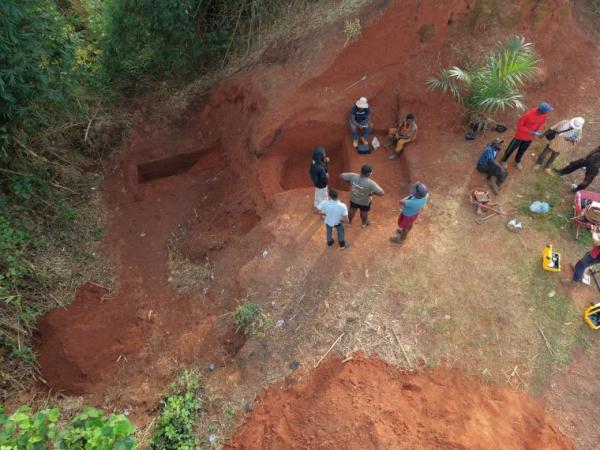
Udo, an earthwork-enclosed settlement in southern Nigeria, provides an important opportunity to investigate the relationships between environmental conditions, settlement organization, and sociopolitical change beyond major regional political centers. Enclosed by an extensive ditch-and-embankment system covering approximately 11 km², Udo occupies a significant position within the historical landscape of the Benin region. This presentation discusses preliminary findings from archaeological investigations conducted in 2026, focusing on the functions of the earthwork and changes in settlement activities over time.
Excavations across the settlement and earthwork revealed evidence of architectural remains, collapsed structures, occupation deposits, and diverse material culture. Radiocarbon determinations indicate considerable chronological variation, including a date of approximately 3500 BP from beneath the embankment, although its relationship to earthwork construction remains unresolved. Ongoing ceramic analysis examines variations in decorative styles and paste characteristics across excavation contexts, while sedimentological, geochemical, and palynological investigations contribute to reconstructing environmental and depositional histories. Preliminary GIS-based hydrological analysis also suggests interactions between the earthwork and local drainage patterns.
Together, these findings provide a developing archaeological framework for examining how communities at Udo organized their built environment, participated in broader material networks, and negotiated changing environmental and sociopolitical conditions. Rather than assigning a single function or construction episode to the moat, the research approaches Udo as a landscape shaped by potentially multiple phases of occupation, construction, and transformation.
| Building: | School of Education |
|---|---|
| Event Type: | Lecture / Discussion |
| Tags: | Africa, Anthropology, Archaeology |
| Source: | Happening @ Michigan from Museum of Anthropological Archaeology, Department of Anthropology, Interdepartmental Program in Ancient Mediterranean Art and Archaeology, Archaeology at Michigan |
