
The Raoul Wallenberg Institute at the University of Michigan aims to enhance student learning and understanding and to foster greater tolerance of others inside and outside the classroom.
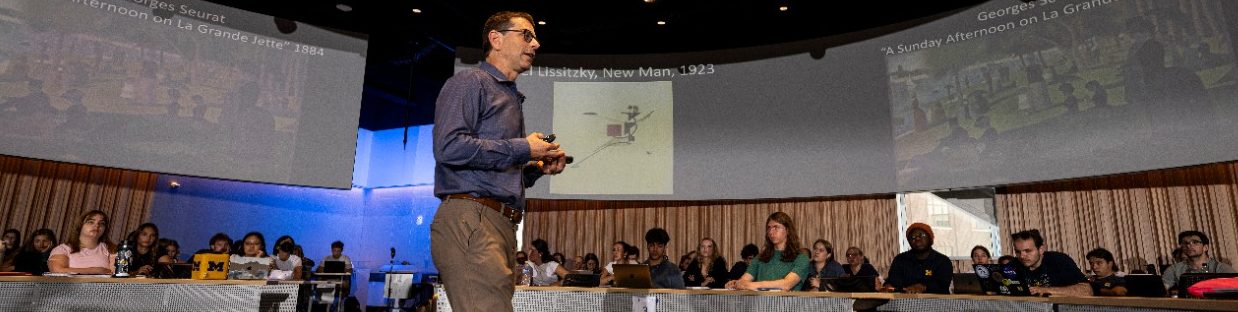

Curricular Development
The Raoul Wallenberg Institute at the University of Michigan provides funding for instructors to develop new courses, including team-taught classes and courses devoted to research on relevant topics; to add modules to existing courses; or to redesign courses that advance the mission of the institute. Funding may also be used for undergraduate and graduate student support, course website development, the acquisition of curricular materials, digital and technological assistance, or other projects related to curricular development. The institute may also want to develop a certificate program.
Flagship Course
Beginning in fall 2025, the Raoul Wallenberg Institute at the University of Michigan will offer a flagship course, in which students will observe challenging conversations between experts drawn from across the University of Michigan; engage in workshops focusing on the skills of dialogue, discourse, and compassion; and engage in challenging conversations with diverse populalations of University of Michigan classmates. More details about this course will be available soon.
Student Leadership and Experiential Learning
The Raoul Wallenberg Institute at the University of Michigan will fund and assist in the identification and development of experiential learning and leadership training opportunities for students who seek to engage with the values of the institute beyond the classroom. Experiential learning can be integrated into courses and/or promoted through internships. The institute will work with and support instructors to identify or develop experiential learning opportunities in collaboration with community partners.
Through the flagship course, students will be introduced to methods of discussion leadership and those eager to continue will have the opportunity to join the Wallenberg student leadership program, geared specifically toward fostering crosscultural dialogue and common understandings about charged issues related to the mission of the institute.
Upcoming Fall 2026 Courses
ALA 259- Religious and Ethnic Tolerance
Instructor: Miriam Eve Mora
This course brings experts from across campus for meaningful discussions about difficult issues related to ethnic and religious tolerance. Students observe discussions as audience members and engage in group conversations, learning content from expert panelists and dialogue skills through their own engagement.
ANTHRCUL 356- Topics in Sociocultural Anthropology: Monuments and Memory
Instructor: Anoush Tamar Suni
Why do monuments matter? Do monuments matter? Why and when are monuments contested, altered, or taken down? In this course, we will examine the politics of history and public memory by analyzing contested monuments, buildings, landscapes, and places. We will question why and how certain pasts are valorized and memorialized while others are silenced, repressed, and forgotten. To answer these questions, we will explore comparative case studies including the debate over US confederate monuments, the fate of socialist monuments after the fall of the USSR, and ongoing conflict over violent histories and repressed memories of minority communities in Turkey, with a focus on the Armenian Genocide of 1915. Students will engage with anthropological and historical scholarship as well as visual material, memoirs, journalism, and documentaries.
Partnerships

National History Day
A partnership was established with National History Day to create teacher resources and guides for middle and high school educators on topics of ethnic and religious tolerance.
