
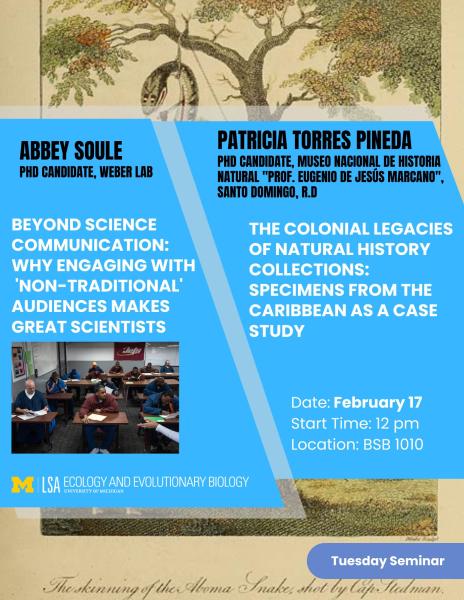
Speaker 1: Abbey Soule, PhD Candidate, Weber Lab
Title: Beyond Science Communication: Why Engaging with 'Non-Traditional' Audiences Makes Great Scientists
Description: Public engagement and outreach activities help scientists strengthen their communication skills while (ideally) improving public understanding of and trust in the research process. Science communication is considered an important part of professional development, yet the opportunities for engaging in outreach activities often favor certain venues (e.g., museums) and audiences (e.g., K-12). As a result, public reach is biased towards more mobile and/or affluent communities with easier access to engagement opportunities, leaving many populations out of the conversation entirely. In my talk, I will share my experiences participating in and organizing outreach efforts aimed at bringing underrepresented, 'non-traditional' audiences into scientific conversations including scientist and audience testimonials as well as the logistical challenges of working in certain venues.
----------
Speaker 2: Patricia Torres Pineda, PhD candidate
Museo Nacional de Historia Natural "Prof. Eugenio de Jesús Marcano", Santo Domingo, R.D
Title: The colonial legacies of natural history collections: specimens from the Caribbean as a case study
Description: It has been estimated that at least 1.1 billion zoological specimens are housed in natural history museums and collections around the world. These specimens comprise the foundation of a plethora of biological and environmental research, including studies on wildlife biology, ecology, and conservation, habitat restoration, predictive investigations related to climate change and public health, as well as education and public engagement. In the last decades, museum and collections professionals have started important conversations regarding the colonial legacies that have shaped and, in many cases, still inform the practices, access, and use (or lack thereof) of collections. Regrettably, these debates are still not as prevalent in the field of natural history collections and museums. Despite the Caribbean being one of the top Biodiversity hotspots of the planet (geographic areas that concentrate a large number of unique species), this diversity is not being fairly represented in Caribbean-based museums and collections. Here, I present preliminary results of an exploratory study on the geopolitical distribution patterns of zoological natural history specimens from the Caribbean in collections around the world, where striking disparities in quantity and quality of collections housed locally, in comparison with those in Global North institutions, become evident. In order to address the causes and implications of these biases and open a dialogue that moves us towards more inclusive and fairer practices in zoological collecting and curating, we must understand the extent and magnitude of the disparities.
Title: Beyond Science Communication: Why Engaging with 'Non-Traditional' Audiences Makes Great Scientists
Description: Public engagement and outreach activities help scientists strengthen their communication skills while (ideally) improving public understanding of and trust in the research process. Science communication is considered an important part of professional development, yet the opportunities for engaging in outreach activities often favor certain venues (e.g., museums) and audiences (e.g., K-12). As a result, public reach is biased towards more mobile and/or affluent communities with easier access to engagement opportunities, leaving many populations out of the conversation entirely. In my talk, I will share my experiences participating in and organizing outreach efforts aimed at bringing underrepresented, 'non-traditional' audiences into scientific conversations including scientist and audience testimonials as well as the logistical challenges of working in certain venues.
----------
Speaker 2: Patricia Torres Pineda, PhD candidate
Museo Nacional de Historia Natural "Prof. Eugenio de Jesús Marcano", Santo Domingo, R.D
Title: The colonial legacies of natural history collections: specimens from the Caribbean as a case study
Description: It has been estimated that at least 1.1 billion zoological specimens are housed in natural history museums and collections around the world. These specimens comprise the foundation of a plethora of biological and environmental research, including studies on wildlife biology, ecology, and conservation, habitat restoration, predictive investigations related to climate change and public health, as well as education and public engagement. In the last decades, museum and collections professionals have started important conversations regarding the colonial legacies that have shaped and, in many cases, still inform the practices, access, and use (or lack thereof) of collections. Regrettably, these debates are still not as prevalent in the field of natural history collections and museums. Despite the Caribbean being one of the top Biodiversity hotspots of the planet (geographic areas that concentrate a large number of unique species), this diversity is not being fairly represented in Caribbean-based museums and collections. Here, I present preliminary results of an exploratory study on the geopolitical distribution patterns of zoological natural history specimens from the Caribbean in collections around the world, where striking disparities in quantity and quality of collections housed locally, in comparison with those in Global North institutions, become evident. In order to address the causes and implications of these biases and open a dialogue that moves us towards more inclusive and fairer practices in zoological collecting and curating, we must understand the extent and magnitude of the disparities.
| Building: | Biological Sciences Building |
|---|---|
| Event Type: | Workshop / Seminar |
| Tags: | Bsbsigns, department of ecology and evolutionary biology, Discussion, ecology, Ecology & Biology, Ecology And Evolutionary Biology, eeb, Graduate Students, Museum, Museum - Herbarium, Museum - Zoology, Museum Of Zoology |
| Source: | Happening @ Michigan from Ecology and Evolutionary Biology, EEB Tuesday Lunch Seminars |
