
- All News
-
- Search News
- News Archive Pre-2010
- Archived News 2010-2016
- Agent-Based Modeling Poster Contest Winners - Fall 2025
- All Events

Every semester Complex Systems offers an undergraduate course on Agent-Based Modelling (COMPLXSYS 270). In this course, students learn how to use Python to examine and modify well-studied agent based models of complex systems, then apply this knowledge to formulate models of their own and participate in a poster session where they vote on their favorite posters/models.
The Fall 2025 poster session showcased a wide range of student research exploring how interactions between agents and their environments can give rise to complex and emergent phenomena. Students presented original work examining and modifying well-studied agent-based models, as well as developing models of their own, across topics in the biological and social sciences. We are pleased to recognize the outstanding projects from this semester and invite you to join us in congratulating the students. Projects were presented during the poster session and evaluated through peer voting.
First Prize was awarded to Anjan Singer for "Modelling Water by Its Atoms with a Particle-Life Approach" also refered to as "The Shape of Water". The project explores whether macroscopic properties of water (such as phase transitions) can emerge from atomic-scale interactions modeled through agent-based techniques.
"The emergent properties of water allow life, among other chemical processes, to exist. Despite its importance the energetics as well as the phase diagram of water are incompletely understood. Although there is an entire field of physical chemistry related to such questions, I thought it would be a fun challenge to model water by its atoms which is a rare approach. " says Anjan.
Anjan also reflected on the broader impact of the course, noting that COMPLXSYS 270 helped him connect ideas across disciplines:
"The thing I liked most about 270 was that it pulled together ideas that I had experienced in different classes and research from completely disparate subjects into a framework for looking at the world and interrogating the big problems that interest me."
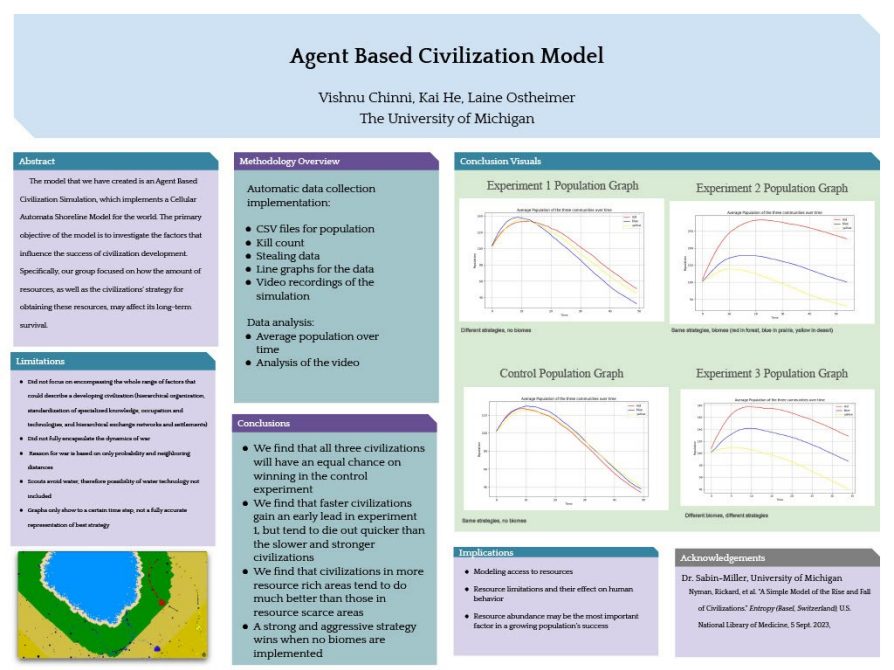
Second Prize was awarded to Vishnu Chinni, Kai He, and Laine Ostheimer for "Agent-Based Civilization Model". Their project investigates how access to resources, environmental conditions, and strategic behavior influence the long-term survival of civilizations. By modeling civilizations as interacting agents within a dynamic environment, the team examined how early advantages and resource distribution shape population outcomes over time.
A tie for Third Prize recognized two distinct applications of agent-based modeling. Emmett Heisen, Kunal Shinde, and Ohn Yoo presented "Poker Bot", which uses neural networks and evolutionary strategies to train agents to compete in Kuhn Poker. Ethan Franklin and Jack Teachman earned recognition for "Game Theory of Relationships: The Pickiness Dilemma", a model that applies agent-based methods and game-theoretic decision-making to study how individual selectiveness affects relationship outcomes and overall utility.
Together, the winning projects reflect the interdisciplinary spirit of COMPLXSYS 270 and demonstrate how agent-based modeling can be used to explore questions ranging from molecular physics to social behavior and strategic decision-making.
We invite you to interact with us on Instagram and X and congratulate the winners.
- Slide 0
- Slide 1
- Slide 2
