
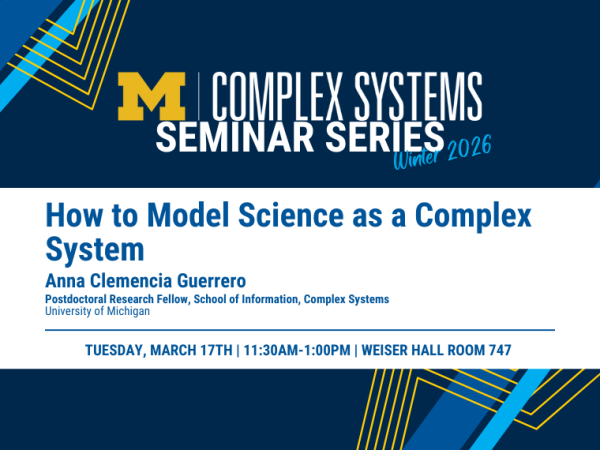
Tracing the historical dynamics of science can reveal how scientific knowledge emerges and evolves over time. Because scientific knowledge is embedded in increasingly complex systems, comprising shifting relationships among people, the organisms and matter they study, technology, data, publications, and the concepts they utilize, scholars are looking beyond traditional historiographical methods towards quantitative and computational tools. Big data, network analysis, and machine learning enhance the scale and speed of analysis, but these methods often ignore or erase the critical roles that context (like time period, geography, and discipline) and different types of data (like image and audio data) play in the development of new knowledge. In this talk, I present context- and data-sensitive computational methods that extend efforts to model the evolution of science as a complex system. These methods reveal when new knowledge emerges and how the features of old scientific information constrain features of new scientific knowledge.
| Building: | Weiser Hall |
|---|---|
| Website: | |
| Event Type: | Workshop / Seminar |
| Tags: | Agent Based Modelling, Complex Systems, Complex Systems Minor, Complex Systems Modelling, Complexity, Information, Science, seminar |
| Source: | Happening @ Michigan from The Center for the Study of Complex Systems |
