
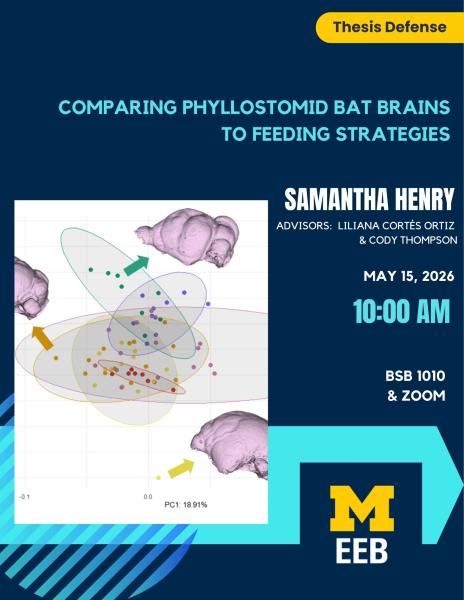
Summary: In mammals, large brains are associated with improved cognitive performance and complex social interactions. Some hypotheses posit that solving complex ecological problems (e.g., foraging) drive some taxa to evolve large brains. Although many studies have analyzed bat brain size relative to diet, few have analyzed bat brain shape in the same way. The bat family Phyllostomidae is an ideal taxonomic group to examine brain morphology and diet because of the wide range of diet types within the family, including carnivores, frugivores, insectivores, nectarivores, omnivores, and sanguivores. My thesis addressed two questions: (1) what is the effect of various diets on brain size in phyllostomid bats; and (2) what is the effect of various diets on the shape of the brain in phyllostomid bats? Using 3D Slicer (3D segmentation and visualization software), I generated endocranial casts (endocasts) from the skulls of 73 voucher specimens located in four natural history museums. Endocasts are often used as a proxy for brain size and shape. I used 3D Slicer to determine the endocast volume, measure the occipital condyle width (a proxy for body size), place 30 fixed landmarks on the endocast, and export Procrustes landmark coordinates to determine size and shape. The results indicated that diet was not a significant predictor of endocast volume in phylogenetic analysis of variance (ANOVA) models. However, the generalized linear mixed models showed that frugivorous and sanguivorous phyllostomids had significantly larger endocast volumes than insectivorous phyllostomids, but the magnitude of the change was not large. Regarding endocast shape, the principal component analysis (PCA) showed that the first principal component accounts for 18.9% of the variation in brain shape, which corresponds with some aspects of cerebrum and cerebellum size along the sagittal plane, and length of the olfactory bulb. The second principal component accounts for 14.3% of the variation in brain shape, which corresponds with changes in endocast height and width. The third principal component accounts for 10.6% of the variation in brain shape, which corresponds to the width of the olfactory bulb and the paraflocculus. Based on the PCA and the phylogenetic Procrustes ANOVA results, the effects of diet on endocast shape in phyllostomid bats appear minimal or absent. Instead, endocast (and likely brain) shape seems to be driven primarily by other, potentially species-specific factors that vary among species.
| Building: | Biological Sciences Building |
|---|---|
| Event Type: | Workshop / Seminar |
| Tags: | biological science, Bsbsigns, department of ecology and evolutionary biology, Ecology & Biology, Ecology And Evolutionary Biology, eeb, Graduate School, Graduate Students, Thesis Defense |
| Source: | Happening @ Michigan from Ecology and Evolutionary Biology, EEB Defenses |
